Stuyvesant’s Science Olympiad Team Qualifies for Nationals
Stuyvesant’s Science Olympiad Team placed first in States on March 21, qualifying for Nationals.
Reading Time: 6 minutes
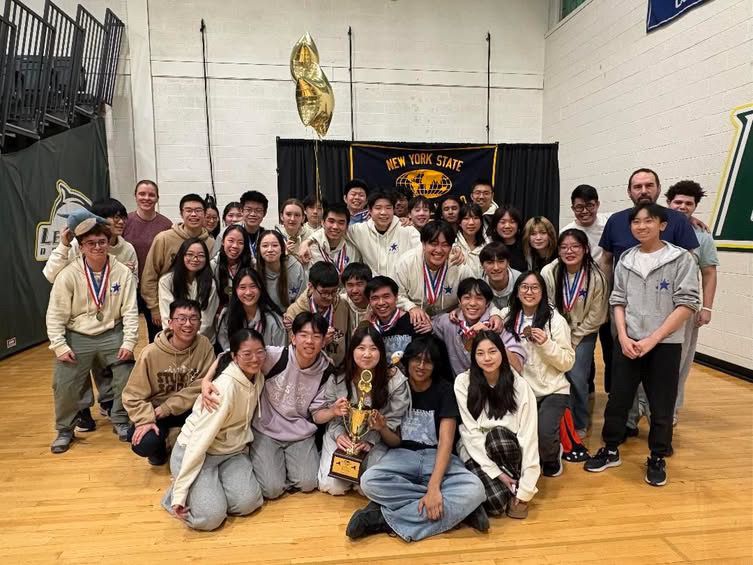
Stuyvesant’s Science Olympiad (SciOly) team competed at the New York State Science Olympiad Tournament on March 21 against many top and rival New York schools, including Syosset High School, Brooklyn Technical High School, and Great Neck South High School. Despite the high level of competition, the SciOly team placed first and is moving on to the national tournament at the University of Southern California for the second time in the past 30 years. This victory marks a major milestone for the team as it places Stuyvesant among the top-performing teams in the state.
Science Olympiad has 23 events, or topics, that competitors can choose to specialize in. “There are two competition formats for SciOly… ‘study’ events, where you take a test on subjects like biology, chemistry, physics, and earth science, and ‘build’ events, where you engineer something and run a demonstration at the competition,” senior and SciOly president Rachel Wang said in an email interview.
Out of those events, there are two main formats in which the team can earn points: a written examination and a building examination. The written examinations often assess both content knowledge and the ability to interpret data under time constraints. In order to succeed, team members must study and prepare for the written exams. “I make a cheat sheet for the written test, and I just have to write down all my answers for the problems that they give me,” junior and Disease Detective Team Leader Madeleine Villamil said.
Build events, which fall under the Tech division, require teams to physically construct devices that are judged on performance. Unlike written exams, these events leave little room for error. “[Tech] just has to build their own thing and pray it runs,” Villamil said.
Points are then distributed based on the teams’ performance in the two examinations, which are added up to form the total score. Points are assigned based on placement in each event, with lower scores indicating better performance, meaning that consistency in all events is critical. “The least amount of points wins,” Wang said in an email interview. “Every error adds to your overall team score.” At states, Stuyvesant took first place with 187 points, three points less than the runner up, Great Neck South High School.
The SciOly team was surprised about this win. Though they worked hard in preparation for the competition, they never expected to place so high and advance to Nationals. “We were confident in getting within that range at states, but I wasn’t completely sure if we could win the whole thing,” senior and Physics Captain Cody Cai said.
For some, the realization that Stuyvesant could win it all came during the competition itself. In states, competitors work in pairs within each event, meaning each duo’s performance directly impacts the team’s overall score. “When my partner Checed Ligh and I saw the [scores for] our event and realized we got first ahead of everyone else, that's when I knew we actually had a shot,” Cai said. “I didn’t want to jinx it, but I could feel the team getting first place as well.”
Some participants were confident in their own abilities and didn’t falter when it came to the placements. Even though they were facing the best in the state, some members made it clear that they were not simply hoping for a strong performance, but were expecting one. “I knew I was gonna get first in all my events,” Cai said. “Me and my teammate were really confident after we took our test. I was even tempted to go on stage before our names were announced,” Ligh said.
The small, selective nature of the team that competed in states also played a role in their success. Since the team only included around 20 students, some events, like Disease Detectives, had only two participants from Stuyvesant. Individual responsibility and trust were essential for success because competitors could not rely on other team members as backup. Rather than relying on one specific strategy, the team’s success was shaped by strong leadership. “I was a very open person and I wanted to answer as many questions as possible. I let [the rookies] email me whenever they want,” Villamil said.
The team’s success was not built on strategy alone. For some members, the relationships formed throughout the season proved just as important as preparation itself. Senior and biology specialist Philip Zhang credited his partner with keeping him motivated throughout the season. “Shout out to my partner Shri [...] he motivated me to study so much,” Zhang said. “He also helped me place well at states, so I want to tell him that I love and appreciate him.”
For Wang, this sense of community has been central to the team’s success. “Our competitors work hard and study very hard because they truly enjoy SciOly,” she said in an email interview. “The community and the fun we have going to competitions is really what motivates us to keep working hard and doing better.”
The team also reflected on what made this season different from previous ones. Unlike prior years, the team invested heavily in recruitment at the start of the year, drawing in a larger and more diverse group of members. The growth of the roster ultimately strengthened the team’s breadth, ensuring that no single event rested entirely on one competitor’s performance heading into states. “We were definitely a lot better and more consistent,” Zhang said. “We advertised in the beginning of the year and brought a lot of new people, which made things easier, but also harder, because now there’s more people.”
Prior to states, the team competed in several invitational tournaments at different prestigious universities. These smaller competitions served as practice, exposing members to the pressure of timed events and real competition. “Cornell, Battle at Valley Forge, MIT, Columbia, Princeton, Yale, Upenn, Brown, and a few online invitationals. Doing invitationals helps us gauge our performance compared to other teams and it forces our competitors to study consistently,” Wang said in an email interview.
Throughout the season, the team made significant progress due to their consistent participation in these competitions. They allowed members to test their knowledge and correct any previous mistakes before states. These strong performances indicated that Stuyvesant could compete at a high level. “The Stuyvesant team would usually place top three or five at the invitationals,” Cai said.
The invitationals also proved crucial in building the team’s confidence. “Performing well at invitationals really made my confidence go up, as well as the motivation I had to make Nationals yet again,” Cai said. “It made me prepare even harder than last year.”
The team built momentum throughout the season and is now focused not just on maintaining their performance, but pushing even further to succeed at the national level. “So our preparation for states was also from that [invitationals], and now for preparing for Nationals, we have this motivation because we got first at states,” Villami said.
While there was no guaranteed path to qualifying for Nationals, the team emphasized consistent efforts and internal motivation. “There wasn’t really a specific ‘process’ of making Nationals. All you can do is do things that you think will help, as you can’t predict outcomes,” Wang said in an email interview. “A deeper reason for our success is really our team spirit.”
Beyond the immediate celebration, some team members are thinking about what this victory means for the club’s future. The win marks Stuyvesant’s second national qualification in the history of its Science Olympiad team, which has not been lost on the team. “Winning states is one thing, but what this does for next year’s team is bigger,” Cai said. “Freshmen who were watching from the sidelines now know it’s actually possible.”
With Nationals approaching, the team has wasted no time shifting its focus toward the next challenge. Members meet daily after school in the innovation lab, where preparation has taken on a new urgency. “The lab is open every day for people to come in and study or build,” Wang said in an email interview. “We are continuing to study and make builds. We are also working to help fund our upcoming trip and extra materials needed for this competition.”
The team’s confidence ahead of Nationals borders on certainty. For some members, competing on the national stage has only sharpened their self-assurance. After months of invitational competitions, late nights in the lab, and consistent preparation, the team has arrived at Nationals ready to compete. Zhang has made no secret of his expectations heading into the competition. “I’m not even nervous for Nationals since I already know I’m getting first in all of my events,” Zhang said.