Self-Driving Cars are the Future of Transportation
Baseless talking points and fear-mongering distort the truth; autonomous vehicles are an amazing innovation with the potential to increase safety and wealth.
Reading Time: 5 minutes
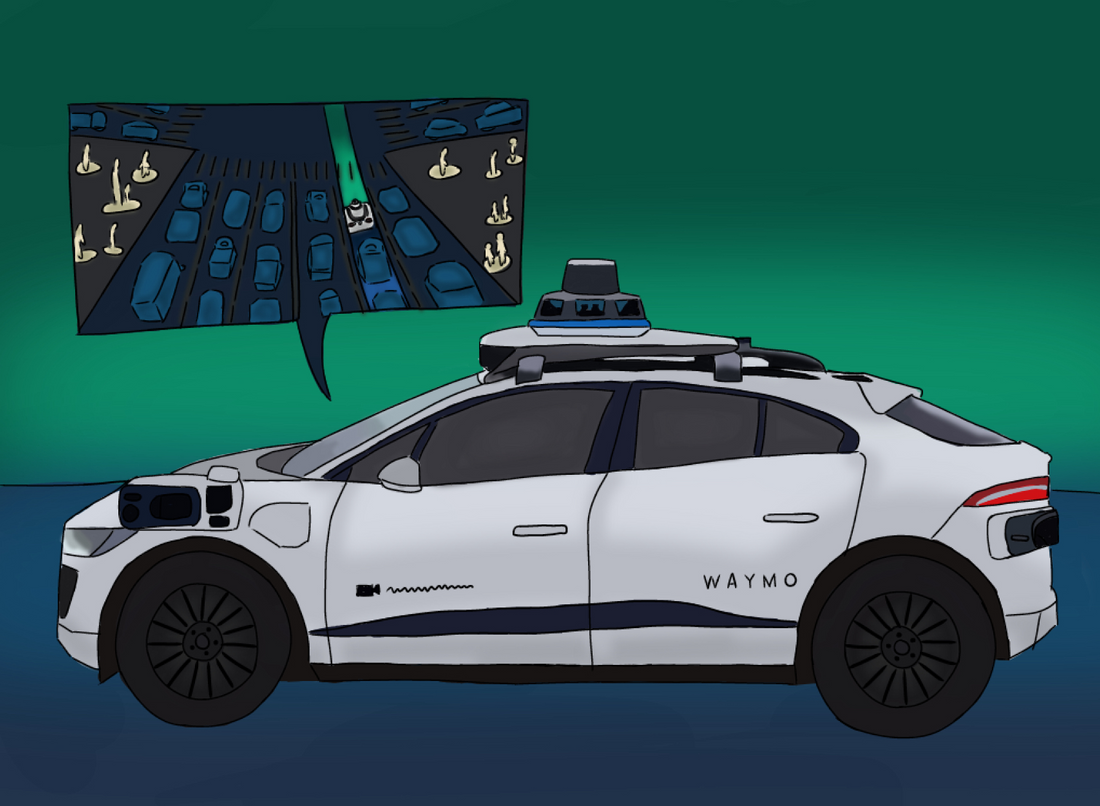
Just minutes after your request for a car, a white Jaguar with a sensor in the form of a spinning black dome on the roof stands directly in front of you. Once the vehicle comes to a halt, you tap a button on your phone, and the doors open. You enter the dark interior of the car, noting two screens in the front and back that allow you to select the music, control the temperature, and initiate the ride. You shift your gaze to the front seat. There’s no driver in control, only a steering wheel in motion, turning according to its GPS.
This isn’t futuristic science fiction; thousands of people across ten major U.S. cities have shared the experience of riding in fully self-driving cars from the company Waymo—the current leader in U.S. robotaxi services. Despite its recent introduction, Waymo’s services have already been beneficial where they have been implemented.
The emergence of artificial intelligence (AI) has enabled the replacement of human perception and control in driving; driverless vehicles can now employ cameras and sensors that create a 360-degree model of their surroundings and use AI to process imagery, predict future actions, plan the car’s movement, and send commands to the vehicle’s actuators—processes more complex than those in human driving. Despite the recent developments in autonomous vehicles, many remain skeptical about the technology’s safety and economic impacts based on unwarranted assumptions. A 2025 survey found that around 60 percent of American drivers were afraid to ride in a self-driving vehicle. Another analysis conducted in 2026 reported that 85 percent of Americans believe the widespread use of these vehicles would lead to job losses for ride-hailing, ridesharing, and delivery drivers. Much of this can be attributed to people being scared of any sort of change and its potential to be detrimental to their lives, even if the chances are slim. As a result, people pay more attention to the accidents caused by self-driving cars than accidents involving human drivers—even if they are rarer—or come to unfair negative conclusions about their economic effects. However, contrary to popular belief, the spread of driverless cars has only led to safer driving and will result in greater prosperity for the places that adopt them.
Driverless vehicle services have, on average, been much safer than human driver services have because they eliminate the risk of drunk, tired, or distracted drivers. Additionally, cars equipped with AI and advanced sensors are significantly more capable of making safer split-second decisions than humans. The removal of human error in driving has already saved lives and could save millions more. Waymo’s automated driving is 10.4 times safer than human driving in terms of the number of claims filed, and it has caused an 88 percent reduction in property damage claims and a 92 percent reduction in bodily injury claims. To put that into perspective, over six million car accidents are reported annually in the United States, with roughly 16,000 to 17,000 crashes per day. Given the large number of accidents, a ten-time reduction would have a major impact on millions of American lives and, on a larger scale, lives across the world.
Furthermore, a number of assault cases occur with rideshare apps like Uber and Lyft. Court records show that from 2017 to 2022, 400,181 Uber trips resulted in reports of sexual assault and sexual misconduct in the U.S., and female riders were the primary victims. With the emergence of autonomous vehicles, there would be an absence of potential perpetrators from cars, further preserving the safety of passengers.
Beyond safety, the increase in autonomous vehicle use would also translate into greater economic prosperity. One concern that people have held regarding driverless cars and, in a more general sense, AI, is about the potential loss of jobs. However, to understand the reality of its economic impact, it’s important to note the usual effects of technological advancements on economies. Prior to the 1800s, low agricultural productivity meant most of the world’s population worked in that sector. However, new farming techniques and innovations led to massive agricultural productivity growth and eventually industrialization. Rather than an increase in poverty and a lack of job opportunities, there was a shift to a consumer-driven economy as real income for most skyrocketed. Although people tend to fear efficiency boosts resulting from innovation when they are first introduced, new jobs arise, meaning that mass unemployment is never the outcome. A more recent example is the rise of the computer and digitalization. Similarly, at the beginning of the computer age, many worried about long-term job shortages and mass unemployment. Yet, history repeated itself again, and the computer has led to massive productivity gains, shifted labor to high-skilled roles, and moved resources freed up from improved efficiency to other areas of the economy in the long term.
Autonomous vehicles will allow businesses to reduce labor and efficiency costs and shift commute time into potential productive work or leisure time. They may also create more high-skilled jobs in software development or machine-learning engineering. There could be up to 455,000 job positions created in the case of widespread autonomous vehicle adoption, with many not even requiring a college degree yet paying above the U.S. median wage. As autonomous vehicles improve in efficiency through greater firm competition, adopting the vehicles will also become easier. Although Waymo rides are currently still slightly more expensive than rideshare apps with human drivers, their prices in recent years have been rapidly decreasing. Waymo prices dropped by an average of 3.62 percent between April 2025 and early 2026, while Uber’s rose 12 percent and Lyft’s rose seven percent. Driverless cars are already relatively accessible, and their accessibility will only rise as efficiency does. With the widespread adoption of these vehicles, there may be potential short-term job shortages, but over time, resources will flow to other areas of the economy, and increased economic output will make the general populace wealthier.
This adoption could also drastically change the need for traditional vehicle infrastructure in cities. Due to better precision in navigation, cities can narrow driving lanes on roads and use the freed-up space for other purposes, like wider sidewalks and outdoor dining. Traffic incidents would also fall as accidents decrease, and thus mobility and transportation efficiency would improve.
For society to enjoy the advantages of self-driving cars, it first needs to accept the technology. For that, accurate information about autonomous vehicles should be spread to the public to prevent fear-mongering and distrust. Simultaneously, in the pursuit of safety and economic growth for those they represent, more governments should strive to allow autonomous vehicle companies like Waymo and its competitors to test and eventually provide their robotaxi services without restriction. Unnecessary regulation based on misinformation hinders innovation and potential upgrades in the quality of life of millions. Instead, these costly and confusing local regulations that could disincentivize robotaxi companies from testing and selling their services should be streamlined and cut to reduce bureaucracy. The sooner the world decides to utilize the incredible technology it has access to, the sooner everyone can benefit.