
Activism and Access: Toby Mamis and Stuyvesant’s Shift to Coeducation
A profile on the life of Toby Mamis, man who advocated to make Stuyvesant co-ed and later continued pursuing his goals in life, no matter the consequences.
Reading Time: 6 minutes
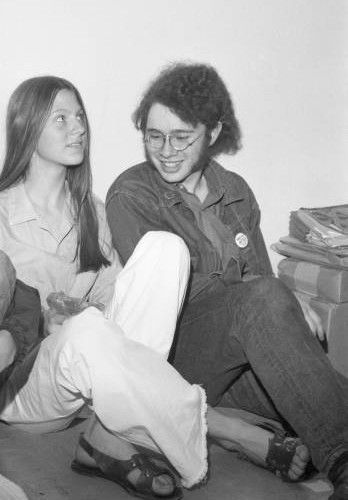
For many students over the years, Stuyvesant has been a symbol of academic vigor and progress, but it hasn’t always been open to all. While it is well known that Stuyvesant was an all-boys school from its opening in 1904 to 1969, how the school became co-ed remains an obscure part of the school’s history. Stuyvesant becoming co-ed was a lengthy and difficult process spearheaded by student activists, one of whom is unfamiliar to the majority of the student body: Toby Mamis (‘70).
Mamis’s early love for activism stemmed from his home life, as his mother was a social activist involved with The Committee for a Sane Nuclear Policy (SANE) and the Women’s Strike for Peace. Before his time at Stuyvesant, Mamis advocated for various causes over the years. In 1963, Mamis was a sixth grader in South Shaftsbury, Vermont. An outspoken child, Mamis once got into a debate with his teacher, who had taped a Bible to the classroom walls in protest against Supreme Court verdicts banning Christian prayer in schools (Engel v. Vitale in 1962 and Abington School District v. Schempp in 1963). Just a few years later, Mamis took action against a bigger issue. “My first [official] action was marching in a Fifth Avenue anti-Vietnam War march in 1966, when I was 13, just before I entered Stuyvesant that September as a ninth grader,” Mamis recalled in an email interview. From the beginning, Mambis took these actions simply because he believed they were the right thing to do.
At Stuyvesant, Mamis’s first major project was his underground newspaper that later became the NY Herald Tribune—not to be confused with the other publication of the same name. His newspaper eventually spread to other well-known schools in New York City, such as Brooklyn Technical High School and Hunter College High School. “We covered all the issues of the day [that] concern[ed] us: the war, racism, women’s rights, oppressive school policies,” Mamis explained.
Mamis participated in actions against a strike of racist teachers in the 1960s, when New York City saw an influx of Black and Puerto Rican communities. After noticing that some teachers would purposely call in sick or suspend children of certain demographics, parents filled leadership positions in their local school committees to serve as voices to represent marginalized children. Their goal was to bring attention to this racist behavior and to hold teachers accountable. In response to this advocacy, Albert Shanker, the president of the United Federation of Teachers (UFT), announced a strike, pulling all teachers from the Ocean-Hill Brownsville area. Many principals and janitors helped to keep schools shut to show their support for the racist teachers’ strike. The then-mayor, John Lindsay, was against such bigoted behavior and encouraged civilians to go against the strike and open schools by any means necessary, a movement that Mamis joined. While attempting to break into Washington Irving High School, one of the many schools forced into lockdown, Mamis and two Washington Irving teachers were arrested for breaking and entering. “I didn’t give it a second thought when I was arrested,” Mamis said. “I was just, as always, doing what seemed right. I wouldn’t change a thing. I acted on my principles.”
Mamis remained true to his values when he began publicly acknowledging the inequalities present at Stuyvesant as a junior. “I started talking about how it seemed discriminatory that Stuyvesant, a public school paid for by taxpayers, was male-only,” he explained. At the time, Bronx Science was the only specialized high school open to girls. Mamis thought it was highly unfair that girls did not have the same opportunities as boys. “Boys had options to go to either Stuyvesant or Bronx Science, but girls who wanted that level of education were limited to Bronx Science,” Mamis said. Schools such as Washington Irving and Julia Richman did welcome girls, but focused on home economics and not intellectual rigor or business subjects. This drastically diminished their chances to get jobs in other fields, only perpetuating sexism.
Mamis knew civil lawyers who echoed his frustrations over sexism in schools, but they told him he needed to find someone new; for the case to be arguable, the person had to be a girl who was capable of gaining admission into Bronx Science. After all, Mamis was a boy already attending Stuyvesant, so he didn’t have any legal standing—he couldn’t demonstrate the need to have girls at the school. “One of the guys in our activist group, whose name was Ralph Ferguson, said he knew an eighth grader in Brooklyn who he thought wanted to go to Stuyvesant but was resigned to having to go to Bronx Science,” Mamis elaborated.
This eighth grader was Alice deRivera, who was more than willing to fight for an opportunity to attend Stuyvesant and whose parents supported the idea of suing the Board of Education, the predecessor to the New York City Department of Education. In the spring of 1969, the group presented the case to the Board. “The Board decided to not challenge the suit. We won. It was remarkable. It showed what can be done when someone with an idea figures out a way to act on it, and not just moan about it,” Mamis said.
Following his junior year, Mamis dropped out of Stuyvesant and opened a free, alternative school in Chelsea. Though some may question this decision given Stuyvesant’s reputation, he still feels that it was the right choice. “I felt constrained by Stuyvesant at the time [and] was doing so much outside of Stuyvesant with my activism, writing for some other underground papers as well as our own NY Herald Tribune, interning for a music business publicity firm, and feeling more fulfilled outside of school than in it,” he said. Mamis and a few of his friends worked together to found The New World School, a rented brownstone where recruited volunteer professors from Columbia University and New York University would teach classes the students were interested in.
Surprisingly, though Mamis saw the school as a grand experiment, many of its students graduated and went on to attend college. “We were completely unaccredited and we made our own schedules,” Mamis recalled. In fact, when the University of Massachusetts opened a new experimental school known as Hampshire, the administration reached out to Mamis because of his experiences in a structureless school. They believed that his expertise would be helpful to incoming students, but he ultimately turned them down. “I just decided to keep pursuing my extracurricular life, writing for various underground and rock magazines, dabbling in music PR, and continuing to be active in the anti-war movement, which had expanded to include anti-racism, women’s rights, and gay rights,” Mamis said.
After his time at The New World School, Mamis went on to work in music and continued speaking out about sociopolitical issues. He said, “As I’ve aged, I’ve become a bit more conservative; I’m now only slightly to the left of [Alexandria Ocasio-Cortez] and Bernie Sanders.” Ultimately, Mamis said, “I like to think I live my life with the same principles. Fairness. Equality. Equity. Honesty.” He credits Stuyvesant for being able to collaborate and defend his positions, noting that, while some times may have been challenging for him, he was constantly surrounded by interesting, intelligent people.
Mamis has led a life characterized by civic action and commitment to his values. Now, current politics worries him. “The rise of fascism here, among so many citizens but also—incredibly—in our current federal government, is terrifying and I worry that people are reacting slowly and relying on internet commentary as opposed to taking to the streets. At 72, I think it’s for younger people to fight this fight,” Mamis said. His advice for younger generations is similarly one of warning. “The fact that we’re re-fighting the separation of church and state (especially in public schools), which I fought at age 10 in Vermont in sixth grade, is mind-numbing to me,” he said.
If Mamis and his peers had not encouraged Alice deRivera to sue the Board of Education in 1969, Stuyvesant may still be male-only today. Instead, girls now have access to the high-quality education that they need to reach the highest levels they can. Anyone can make a difference, and in this time of change, it is even more crucial for youth to fight for their rights and demands.