Stuyvesant Science Olympiad Competes in Nationals
After winning first place at the regionals and state competitions, the Science Olympiad team advanced to and competed in Nationals.
Reading Time: 4 minutes
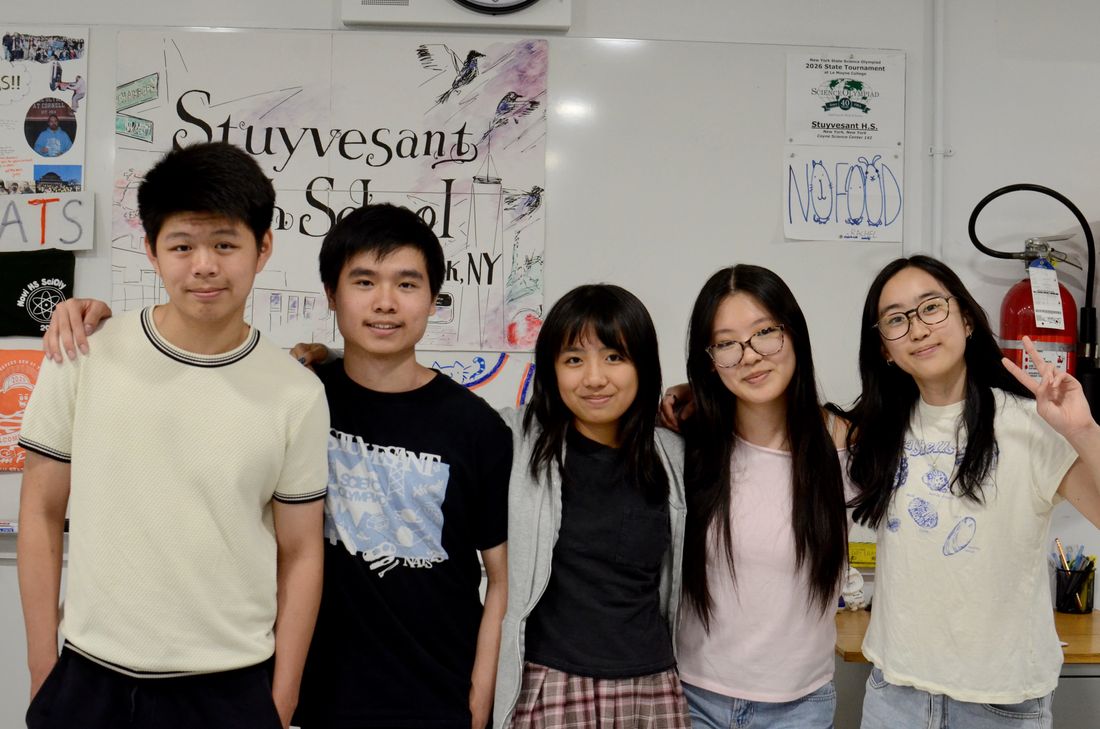
Stuyvesant’s Science Olympiad team placed 17th out of 60 teams and medalled in 7 events in the 2026 Science Olympiad National Tournament in California this year from May 22 to May 23. Just several months before, the team won first place at the New York state competition, earning them the opportunity to represent New York State at Nationals. More memorably for graduating members, however, the national competition marks the end of the Science Olympiad’s season.
The team had to work incredibly hard to ensure that they were sufficiently prepared for Nationals. Members mainly prioritized taking practice tests and reviewing topics repeatedly. “Many of us were staying after school, studying during free periods, on the weekends, and at 3 in the morning,” sophomore and Secretary Sabrina Gao said. “You would see many of our members taking practice tests and testing builds in the innovation lab […] all the way sometimes to eight o’clock.”
At the same time, the team’s preparation for Nationals wasn’t particularly different from that of their previous competitions. “It’s pretty similar to just preparing for any competition,” senior and President Rachel Wang said. “The topics stay the same the whole year. So we’re just building upon [with] the same base of knowledge that we had from the beginning of the year,” she said.
Furthermore, members found that in their preparation for Nationals, there was much overlap between Nationals and other competitions, making it not too difficult to adapt to the newer topics. “At states, we had learned a lot,” senior and Tech Captain Checed Ligh said. “But then for Nationals, you don’t need to learn that. There’s a couple extra topics, but we also had to do those topics for national-level institutions.” These extra topics include botany, code craze, which targets computer science, and protein modeling.
However, despite some conveniences, there were still many challenges. “One of the biggest challenges that I think a lot of people faced before the competition was balancing all the tests, APs, and schoolwork while preparing for the competition,” Gao said.
Additionally, there were setbacks with some of the team’s builds. “We replaced most of our States builds before Nationals and we were competing using new builds. Although they were made with more experience from competitions, they were new builds so we wouldn't have known how they would do, which probably contributed to a lower builds performance across the team,” junior and inquiry division Captain Owen Ye said.
Travel logistics were also a challenge for the team due to the trip to California. “Some challenges were the organization of our team,” Wang said. “As you know, California is pretty far, so we have to fly there.” However, with the Alumni Association's funding and member contributions, the team was able to acquire round-trip flights and address those issues sufficiently.
Members described some positive experiences they had when bonding with competitors from other schools due to their shared interests. Freshman and member Mila Hsiung competed in the Entomology event—the study of insects or bugs. “There was other people who did entomology too, and it was kind of cool to talk with them,” Hsiung said. “I’m not the only one who's interested in this stuff and [...] they’ll actually understand me.”
Throughout Nationals, one special activity that expanded members’ connections even further was the Swap Meet. “Something cool about nationals is that we sort of get to meet with all the top teams around the country, and there is something that’s called the Swap Meet, where we just bring items from the state we’re representing to swap with other teams,” Wang said.
Throughout the competition, members explained the difficulty level of the competition tests. “My test personally felt fairly easy compared to some of the ones I’d taken before, but I heard other people say that they were quite hard,” Hsiung said.
Members also took the time to reflect on the necessity of communication and support for each other whilst preparing. “Managing time was really important [and difficult],” Gao said. “Still, we all supported each other, and I think that made a big difference in our performance.”
However, being constantly positive was difficult at times, especially because of the intense and competitive nature of Nationals and the team. “I think that people on our team should do a better job of empathizing with each other because when something bad happens or when you’re stressed, it’s easy to blame,” Wang said. “I just think that we would all benefit from being understanding towards each other.”
In the end, the hours spent on preparation and competing at nationals proved to be not only successful but a memorable and wholesome experience. “Seeing everyone hyped up for Nationals, I thought it was really cute that they were just so excited,” Wang said.
The team was also very proud of their results. “I am pretty content with our performance: personally getting 1st and 2nd was a very nice achievement, and as a team, we were able to improve from 4 to 7 national medals compared to last year,” Ye said.