
StuyAviators Hosts Guest Speaker Air Force Pilot First Lieutenant Cabrera
StuyAviators guest speaker.
Reading Time: 5 minutes
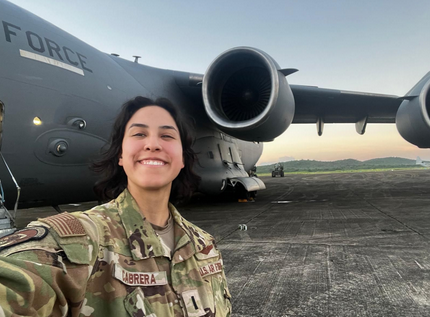
Stuyvesant’s StuyAviators club hosted a virtual talk featuring guest speaker First Lieutenant Kiara I. Cabrera Arroyo, a pilot in the U.S. Air Force, on December 11. The talk focused on pathways to aviation—including summer programs in aviation for high schoolers, Air Force Reserve Officers’ Training Corps in college, and the application process to become a pilot.
First Lieutenant Kiara I. Cabrera Arroyo is a C-17A Pilot at Joint Base McGuire-Dix-Lakehurst, New Jersey, leading global tactical and combat airlift missions with the $383 million aircraft and moving up to 170,000 pounds of cargo and personnel in support of national, joint, and humanitarian operations. She has completed Undergraduate Pilot Training, deployed for multiple contingencies, and has previously served as a Gold Bar Recruiter for the Air Force Reserve Officer Training Corps (AFROTC), engaging prospective officer candidates across East and South Florida, Puerto Rico, and the U.S. Virgin Islands. Her passion for pilotry began when she was young, inspired by her hometown. “I grew up in Puerto Rico, where it’s always summer and the stars burn bright,” Cabrera said. “So I’ve always wanted to see what it was like to fly and maybe reach for the stars.”
During the talk, Lt. Cabrera shared different ways to get involved in aviation. “There’s four ways to become an officer in the Air Force and henceforth a pilot,” she said. These options include AFROTC, United States Air Force Academy (USAFA), Officer Training School, and Air National Guard, with a focus on the former two options. ROTC is a three- to four-year college program that trains students to become officers in the U.S. Armed Forces, offering college scholarships in exchange for a military service commitment after graduation. It provides a path to become a commissioned officer in a branch of the U.S. military, including the Air Force, alongside regular academic studies in any major.
She emphasized the accessibility of AFROTC, given that the program is available in public and private colleges across the nation that allow students to apply. “This is a college course and it’s very flexible because you can do a three- or a four-year program,” she said. Furthermore, students can participate in the program with any major and are able to balance their commitment to attending the ROTC college class a few times a week. In college, Cabrera herself participated in AFROTC alongside studying mechanical and aerospace engineering, and noted how she was able to balance both commitments. “I was living my normal college life […] I was having a blast and I was still doing [AFROTC],” she said. “There’s also no commitment in those first two years, so if you don’t want a scholarship, you can just try it out, see if you like it.”
Attendees of the event praised Cabrera’s comprehensive slideshow presentation over Zoom, which was supported by her expertise, personal anecdotes, and advice. “I really liked how First Lt. Kiara Cabrera explained everything so clearly. She gave a really engaging presentation and told us a bit about her journey,” junior and StuyAviators Secretary Nancy Huang said.
Cabrera herself attended college at the University of Puerto Rico, Mayaguez, where she graduated with a bachelor’s degree in Mechanical Engineering. She joined AFROTC in her third year of college and found it challenging to balance with her complicated degree. However, reflecting back on AFROTC, Cabrera ultimately found it to be a very rewarding experience that prepared her for a career in the Air Force. She said, “You grow with the program and it pushes you to be more organized. At the end of the day, it was another college course that trained and prepared you to be an officer in the Air Force.”
Besides the flexibility of ROTC, college scholarships are available for ROTC participants. “I myself got a scholarship, so that was really nice; I got college for free,” Cabrera said. College scholarships are provided by ROTC given that the student will serve on active duty for a few years as an officer in the military immediately upon graduating with a bachelor’s degree. The military service requirement from AFROTC can be helpful for aspiring pilots, since it allows direct advancement into a career in aviation.
Aspiring pilots who are dedicated to pursuing pilotry also have the option to attend the U.S. Air Force Academy, an academy that provides a free four-year education combined with rigorous military training to become officers in the Air Force or Space Force. Lt. Cabrera noted the many polar differences between AFROTC and USAFA in her talk. “The difference is that ROTC is all over the nation [...] the academy is just one place. And it is a whole university surrounded by military decorum and Air Force through and through.” She also emphasized that in contrast to AFROTC, the academy is characterized by a highly structured, military environment. “With [the academy], there is no leeway. You’re going to be in a 100 percent military environment. You will eat, sleep, and live in that university.”
There are several ways high school students can explore the aviation field before choosing to participate in AFROTC or the Air Force Academy in college. Aviation programs including Civil Air Patrol Orientation flights, Air Force Junior Reserve Officer Training Corps Flight Academy, and Aim High Flight Academy provide opportunities to learn from experienced mentors about flight maneuvers, aircrafts, and careers in aviation. Students can gain firsthand experience flying an aircraft—all with limited to no previous flying experience.
Although senior and StuyAviators President Jerry Qiu wasn’t initially interested in joining the military, attending Aim High Flight Academy augmented his interest in pursuing a career in aviation within the Air Force. “The program also provided us with some USAF mentors and after learning more about the Air Force and the opportunities it provides, and I’m now more open to possibly serving in the Air Force. If I were to go in right now, I’d probably go in as a pilot,” Qiu said.
Missions have also given Cabrera the chance to encounter unique things that many people dream of experiencing up close like she has. “I’ve gotten to see a lot of weather phenomena throughout missions like the Aurora Borealis [and] cirrostratus [clouds] which produce rainbow halos around the Sun, and fly above the Arctic Circle where our magnetic compass heading had to be changed to a true heading given the magnetic variations!” Cabrera said in an email interview.
Cabrera’s career thus far as an Air Force pilot has been marked by both immensely challenging and rewarding experiences. She noted that her most challenging experience was working with medical papers. “It’s not fun when you’re not able to do a career because of something you have no control over. However, it took a huge team of people and a lot of support from my leadership to help me overcome that!” she said. Meanwhile, she found the most rewarding part of her career to be graduating from pilot training, which she achieved through countless effort poured into field training, passing written and physical tests, gaining pilotry experience, etc. Since becoming a pilot, she’s been able to travel all over the world for missions. “I’ve checked a lot of boxes in my bucket list in such a short time,” she said.