
Senior SING!: The Best Thing Since Sliced Bread
Diving deep into Senior SING! 2026.
Reading Time: 7 minutes
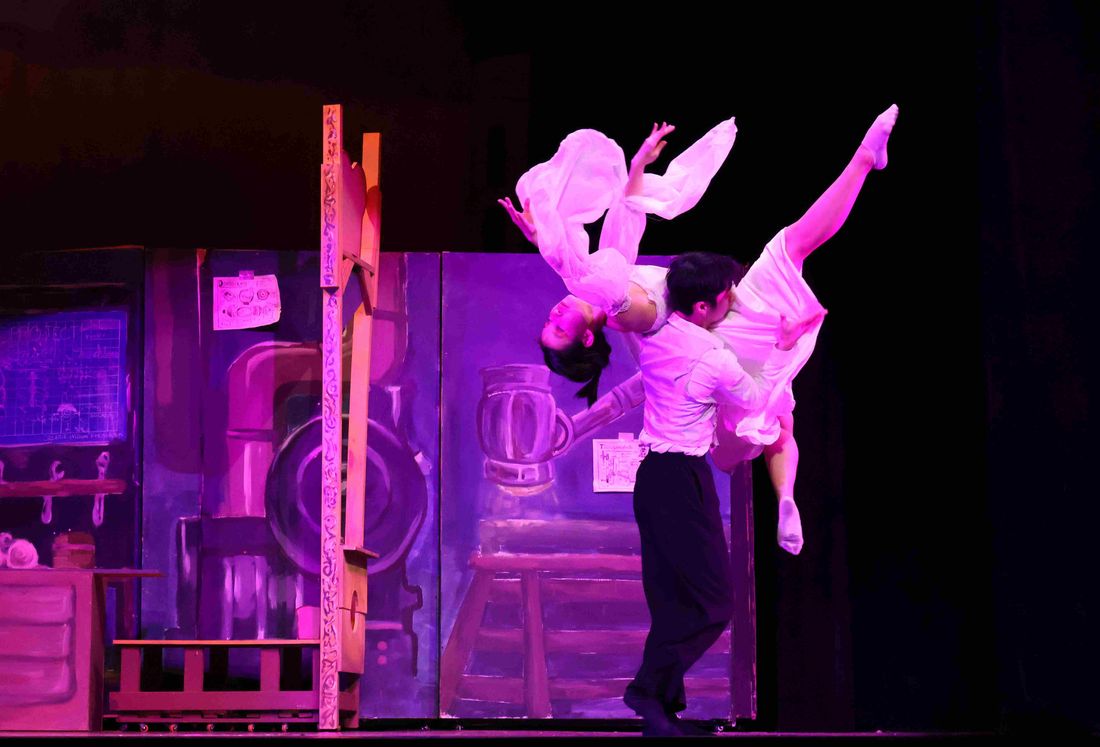
Under the dazzling lights of the Eiffel Tower, Senior SING! put on an unforgettable performance set in the city of love. Coordinated by Joanne Hwang and produced by her Slate—Creative Producer Amanda Greenberg, Music Producer William Farmer, Technical Producers Wanxin Gao and Timofey Volvovskiy, Dance Producer Wade Guo, and Admin/Creative Producer Leah Riegel—Senior SING! captivated the audience with a complex yet well-handled plot, nearly flawless sets and costumes, and a few outstanding performances. While the show suffered from some technical issues, it brought a level of professionalism to SING! that its competitors lacked.
At the 1889 Paris World Fair, Renée (Sofia Lawrence) hopes to make her big break as a journalist, though she is constantly sidelined for being female. She hopes to interview world-renowned inventor Henri-Jean-Jacques-Henrique-Cousteau (Henry Santos-Hendricks), whose latest creation is to be unveiled at the fair. However, it is later revealed that it is really Henri’s ex-wife, Colette (Audrey Hilger), who deserves credit for the invention.
Senior SING! was especially ambitious in its attempt to tackle mature themes of sexism in 1880s Paris, particularly in an already plot-packed show. While some of Henri’s jokes got repetitive, many were appropriate to the plot, his character, and the setting. However, even though the ending neatly resolved the show’s main conflict—Colette and Henri fighting over the invention—having Colette so easily compromise with Henri by opting for co-ownership over Bread Guillotine made the attempt to critique sexism fall short. The ending felt antithetical to both of their characters, retroactively hindering Henri’s ironic quips because they now appeared more as genuine statements than jokes. Thus, the seniors struggled with balancing a fitting ending for the characters with a historically reasonable ending for the theme.
Similarly, despite the opening scene implying a focus on Renée being a female journalist, her story was quickly sidelined in favor of the numerous other characters. Consequently, Renée’s story felt comparatively unfinished due to the show’s short time frame and her underdeveloped arc. A larger focus on Renée’s challenges as a female journalist would have completed her story and extended the theme of sexism—even a longer scene between her and Colette, or a greater explanation of Renée’s story in the epilogue could have effectively accomplished this.
In terms of one-liners, many felt like they rehashed the same topic, like Henri’s aforementioned jokes and mentions of “buns” and being “baked” in contexts outside of baking. Still, Senior SING!’s script was still chock-full of amusing, subtly slipped-in references, like Nicolas’s line, “You said it yourself, the life of a showgirl is awful!” taking a shot at Taylor Swift’s latest album, The Life of a Showgirl.
Across the board, the cast’s strong chemistry and coordination helped deliver memorable acting performances, with every actor bringing energy and enthusiasm to their roles. Lawrence had a strong, passionate performance as Renée, an ambitious journalist, especially while reacting to the inventions at the World Fair. This scene captured her fascination and eagerness at the possibility of writing a story quickly but also the nervousness she felt when attempting to get an interview from Henri. Her singing also stood out; her powerful voice and impressive vocal range brought emotion and strength to her performances, especially with the powerful opening of “Voulez-Vous” and her rendition of “Maybe This Time.”
The multiple duo dynamics also highlighted the strong chemistry that existed within the cast. Nicolas (Siena Short) and Eloise (Lily Wagman) made for an entertaining duo, as their arguing and sibling dynamic felt natural. Short’s chaotic energy balanced well with Wagman’s more level-headed performance. Similarly, Pierre (Ada Gordon) and Theo (William Lake) stood out, with Pierre’s swagger mixing well with Theo’s exhaustion as his assistant.
Senior SING! was also strong musically. “French Duel Commandments,” performed by Colette and Henri, stood out as the strongest musical number of the show. Its impactful message delivered through the rhythmic, rap-like exchange between the performers captured the moment’s tension and energy, making it one of the show’s most memorable highlights. The scene was especially difficult to execute because it required both physical coordination and vocal performance through its many sword movements, yet Hilger and Santos-Hendricks delivered.
However, singing parts didn’t always suit their actors. Nicolas, played by Short—a soprano—was assigned songs with a lower range. As a result, certain sections came across more like spoken lines than fully sung phrases. Lake’s opera singing performance was distinct and captivating, but it felt out of place both in terms of singing style and the context of the scene, as the transition was extremely abrupt. Yet, despite these challenges, each and every single cast member still brought energy and commitment to their performances, and their collective effort helped create a lively and memorable vocal showing for their final SING!.
Senior Band put on a show, entertaining the audience with variations of jazz, pop, and R&B. The most notable moments were Raymond Chen, William Farmer, and David Son’s climb onto stage to perform “Die With a Smile”; William Farmer’s accordion interlude, as well as his miniature trumpet jazz solo; and occasional shouts and cries from the pit. However, the performance did not complement the vocals as well as it could have—from many seats in the audience, it was difficult to hear the singing over the loud band, which at times overpowered the performers and pulled attention away from those meant to carry the scene.
The seniors’ dancing amazed the audience at almost every turn; every dance felt distinct yet cohesive while complementing the overarching narrative. Hip-Hop was explosively beautiful; the energetic dances reminiscent of the opening sequence from Deadpool and Wolverine (2024) gave the show a flair unlike any dance performances in this year’s SING!. Ballet mesmerized the audience with the dancers’ slow yet graceful leaps across the stage. However, at times, dance performances felt chaotic. For instance, the opening dance sequence struggled; having so many people doing different choreography overcrowded the show and made it hard to follow.
Senior SING!’s set did not disappoint. Their first set made creative use of the entire stage: two French flags and a grand clock upstage; various booths and flowers below; and a grand image of the Eiffel Tower in the background. The Cart de Bread and booths, in particular, clearly complemented the storyline, and the overall space seemed very natural, almost as if the actors were truly dancing in the streets of Paris.
The set also included several “hidden” elements that increased audience engagement. Following the Bolly performance, Tech reorganized the booths into different shops—including the Boulangerie, or bakery. In the process, the audience briefly saw a “GO TECH” sign, which was then lifted up to portray second-floor windows, another great use of space. Additionally, beyond the set design itself, their technical choices seemed unique. Rather than having several separate panels representing different shops, the use of a “cubicle” that contained multiple designs made the transitions seem flawless.
The props were also essential to the show’s visual identity. The blue fountain during Modern’s performance, for example, complemented the blue costumes of the dancers and featured twinkling lights, making the scene come to life. Similarly, following the Flow performance, the lighting up of the Eiffel Tower created a beautiful picture of Paris in the background. Although the blank screen prior to the fight scene was underwhelming in comparison to previous sets, as the screen lifted up, the audience was once again welcomed by new designs. Finally, the bread guillotine was thoughtfully designed and, being a major part of the plot, certainly did not disappoint. Its final placement in the middle of the stage as the SING! crew gathered during the theme song certainly united the story.
Furthermore, Senior SING!’s costumes were a highlight of the show, displaying incredible detail and thought. Bolly’s yellow dresses were bright and featured glittery patterns at the hem, which lent themselves well to the energetic music the performers danced to. Additionally, Geneviève (Jane No)’s costume quick change, despite being a bit rocky, was an exciting and unexpected moment of the show. Her initial Latin dress was distinct enough from the others’ that she stood out, and the costume change revealed a well-made yellow dress.
Most notable of the costumes was Colette’s, which featured elements of a classic 1880s evening gown: the fitted silhouette, draping and ruffling, and the “lobster tail” bustle. Her jewelry, hairdo, and floral pieces beautifully completed the look. Though not typical baker attire, her costume was nonetheless impressive and a stand-out of the show.
Technical issues and uneven choices interfered with Senior SING!’s performance. Early performances suffered from maladjusted microphones, leaving some audience members unable to hear otherwise strong moments. On Saturday, the beginning of the opening number faltered as the main vocalists’ microphones left their voices inaudible. Additionally, Geneviève’s microphone got stuck during her quick costume change on Saturday night’s show, forcing her to remove it entirely during the beginning of her duet. Despite the wardrobe malfunction, she effectively continued with the planned choreography while readjusting her microphone, rejoining her duet with Nicolas soon after. Lighting also had issues, as one scene started unlit and others frequently had flickering lights.
Overall, Senior SING! delivered a memorable performance that felt more polished than its competitors. The audience left the Paris World Fair to a final send-off of “Senior SING!, we love it!”, a parody of Icona Pop’s “I Love It”—a feeling reciprocated by the judges who awarded them first place with a score of 1915.