
Not Quite For The Better – Wicked: For Good
Wicked: For Good was error-ridden, but it’s still a fun time.
Reading Time: 4 minutes
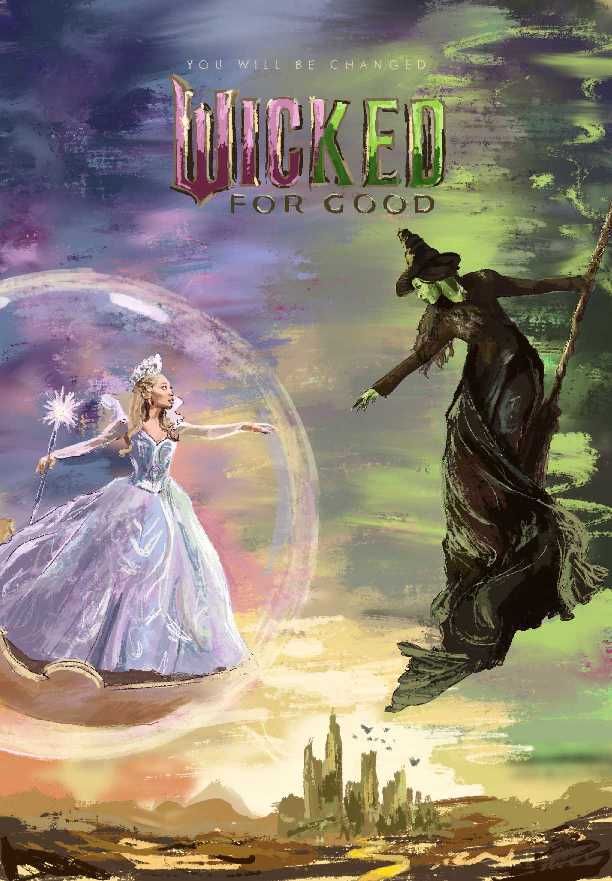
The waves of pink-and-green ice cream, slippers, and water bottles finally came to an end with Wicked: For Good’s release in theaters on November 21. Almost a year after the first film, Wicked, director Jon Chu continues through on his vivid, maximalist vision in this adaptation of the original Broadway show’s second act. The film ties up loose ends, introducing familiar characters, such as the Cowardly Lion, the Tin Man, and the Scarecrow, in the land of Oz. Yet while the film may give some long-time fans the closure they have been waiting for, Wicked: For Good falls short of earning its place as a truly worthy sequel.
Wicked: For Good picks up directly where Wicked left off, returning fans to the social and political uproar in Oz. Elphaba Thropp (Cynthia Erivo), the newly proclaimed Wicked Witch, tries to combat the Wizard (Jeff Goldblum) and his compatriot Madame Morrible’s (Michele Yeoh) plans of harming the animals of Oz. In the midst of this, Glinda the Good (Ariana Grande) and Prince Fiyero (Jonathan Bailey) find themselves torn between their connection to Elphaba and their roles within the Emerald City’s regime. In a struggle for power, freedom, and, ultimately, love, difficult decisions are made at great personal costs, forcing each character to reconsider what they truly desire.
The cast is just as bubbly and exciting as before, integrating themselves well in the rainbows and sparkles of Oz. Erivo is once again a brilliant Elphaba; even with less of a journey, she still conveys the intricate internal conflicts she feels. For example, when she discovers Fiyero has turned into a scarecrow, she is forced to reconcile her responsibility in the matter and what this will mean for their relationship. On the pink side of the spectrum, Grande’s performance marks a departure from her stiff and caricature-like portrayal in Wicked. Instead, she highlights the emotional rawness of Glinda’s arc: for instance, when she sees the people of Oz going to attack Elphaba, defiantly calling, “kill the witch!” Grande’s choices are realistic for someone drawn between power and “goodness,” redeeming Glinda in this second installation.
However, like its predecessor, the film suffers from its runtime. Wicked: For Good runs just over two hours and 15 minutes. While that initially may not appear expansive, the original Broadway show’s second act only takes about an hour. The extended runtime provided many opportunities to develop side plots or repair plot holes—how did Fiyero become captain of the Guard? What have Nessa and Boq been doing all this time?—but it is instead padded with unnecessary filler.
For instance, the film adds two songs to the original musical’s soundtrack: “No Place Like Home,” in which Elphaba tries to convince the animals of Oz not to flee, and “The Girl in the Bubble,” which sees Glinda reflect on her privileged isolation and her emerging sense of responsibility. Neither track meets the standard of the show. Both are unnecessary, for one, adding to the runtime, and also are far too heavy-handed with metaphors; in “The Girl in the Bubble,” the same pull-back mirror shot is used to indicate the back-and-forth in the “bright shiny bubble” over and over again. It feels as though the film doesn’t trust its audience enough to understand what’s already an obvious line.
Similarly, other major songs suffer from their visuals. In “As Long As You’re Mine,” an acclaimed, mature love ballad, Elphaba and Fiyero sing about their undying love, but their choreography for most of the song doesn’t convey the intimate level of the lyrics. Moreover, in Elphaba’s big number, “No Good Deed,” the excessive CGI distracts from Erivo’s emotional vocals. Viewers wondering why she can suddenly fly without a broom—or why the flying monkeys are setting off torches in an odd stone structure—may not fully appreciate her soulful interpretation of the song or her impressively high final riff.
Indeed, the runtime only serves to highlight the film’s major flaw: it can’t stand alone. Though it requires a back-half to tie back into The Wizard of Oz, the first movie has an emotional arc, major, exciting numbers, and a satisfying conclusion; when an audience leaves the theatre, they feel as though they’ve seen a full show. On the other hand, For Good is darker, sadder, and builds on necessary, carefully curated moments from its other half. For instance, Fiyero’s leaving Glinda for Elphaba and his clear romantic desires feel out of character, even scandalous, without the buildup and the small shots of him looking behind at her. One has to see Wicked first to truly appreciate For Good, pushing this film to the back burner and making dramatic reveals far less gratifying for viewers. Depending on the audience member, this could deter one from going to see the show on stage. Given how widespread the press and the films themselves have become, many are experiencing Oz for the first time through Wicked and Wicked: For Good. When Chu set out on this path, he took upon himself the responsibility to do the show justice, but it’s not entirely obvious he did.
However, it must also be said that judging the film’s content as an independent source of IP is not reasonable. It is, after all, a movie based on a musical based on a book based on a movie based on a book; originality was never its mandate, and it inevitably inherits the strengths and weaknesses of its predecessors. Still, the film does many things well. The cast, again, is wonderfully buoyant and interesting to watch. The set and props are sweeping, colorful, and realistic enough to make such a fantastical world feel believable—something even the original Wizard of Oz didn’t fully achieve. Ultimately, while Wicked: For Good was error-ridden, it does provide a space for new audiences, particularly younger ones, to enter Oz and have an enjoyable time. Compared with many box-office disappointments, Wicked: For Good does succeed in the most fundamental task of cinema: it entertains.