
Micah Lasher Reflects on His Time at Stuyvesant
The Spectator's interview with Micah Lasher.
Reading Time: 7 minutes
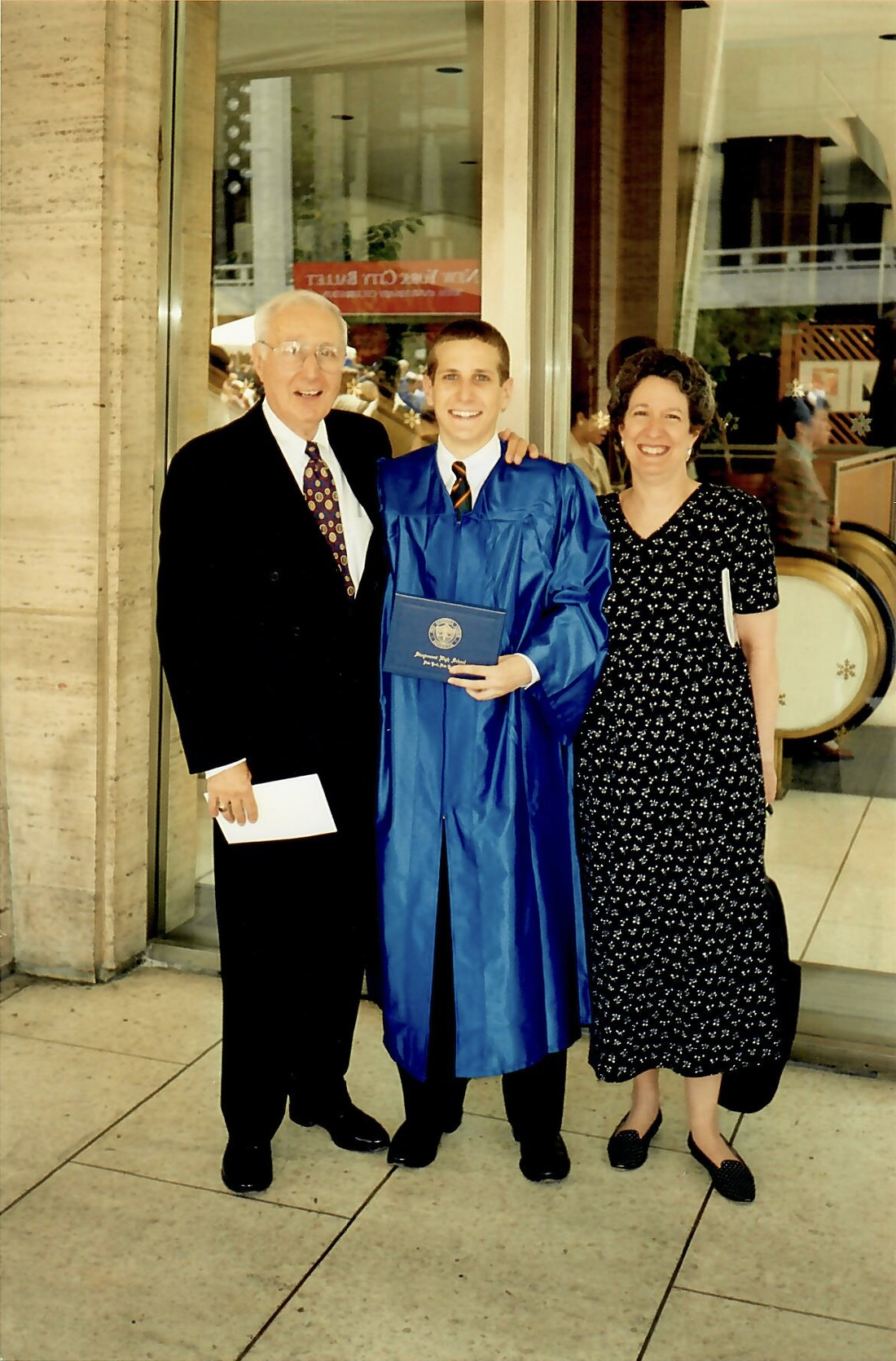
The Spectator recently interviewed Micah Lasher ‘99, a Stuyvesant alumnus who is currently running to represent New York’s 12th district in the House of Representatives. Lasher, a former Editor-in-Chief of The Spectator who now has nearly 30 years of experience in public service, spoke to us about his career and how attending Stuyvesant influenced his life. This article does not constitute a political endorsement.
We realize that some of our readership may not know who you are. Tell us a bit about yourself.
I grew up on the Upper West side of Manhattan [...] I was [in the] class of ‘99. I went to NYU. I got involved in politics when I was in high school, and started working on campaigns when I was in high school. [I] did communications consulting [and] went to work for Jerry Nadler as an aide in his office in 2007. That began a long career that has mostly been in public service at all three levels of government: for the congressman, in city government, in the Bloomberg administration, at both the Department of Education and at City Hall, in the State Attorney General’s Office where I was Chief of Staff, the Attorney General as Policy Director for the Governor, and I was elected two years ago to represent the Upper West Side in Morningside Heights [in] the State Assembly. On a personal level, I still live here on the Upper West Side. I’m married with three kids—my oldest is a sophomore at Stuyvesant. I have two other kids, one of whom is going to be in next year’s freshman class.
We know that you were one of the Editors-in-Chief of The Spectator. What did you enjoy most about that role?
Well, it was a great experience. It was... the sort of defining experience of my time at Stuyvesant in a whole bunch of ways. Most notably, at the time, we were at the center of a big fight with the administration, and that obviously was intense and stressful and formative. The work of leading the newspaper, working with all of my colleagues, trying to really bring the newspaper into the modern era at the time, was a really important growth experience for me. One of the big, basic, but significant things we did was say, “paper’s gonna come out every two weeks.” In the years before that, for as long as I was at Stuyvesant, [...] the paper would kind of come out whenever [...], so publication could be every month, every six weeks—it wasn’t even on a regular basis. It was as the staff was able. [...] It was very hard, particularly in the early days of making that adjustment. We also set about to cover topics that generally the paper had shied away from, and ultimately tried to forge some real editorial independence that then led to the administration shutting down the paper, and a big fight ensued, and it was a difficult experience. It was a bonding experience for all the students involved, and ultimately, the paper reopened and I think we were stronger for it.
How did you realize that you wanted to pursue a career in public service?
It was in high school and in college. I was very interested in public service and internals. I was interested both in the making of decisions and the use of government to improve society, as well as in the role that journalism could play in improving society, in part through holding public officials accountable. Those were really the two career paths that I was most interested in high school and in my early years in college. Ultimately, I gravitated toward public service in part because I concluded I wasn’t well suited to the neutrality that a good journalist brings to the job.
One of your competitors in this race went to Hunter. How do you feel your time at Stuyvesant in particular has helped you in your career as a public servant?
I certainly think that Stuyvesant is a place where you’re surrounded by a lot of peers, from a lot of different backgrounds, who generally share an optimistic ambition, a belief in the possibilities that the future might hold, and who are going to work really hard to realize those possibilities. I certainly think that that spirit rubbed off on me while I was at Stuyvesant [...] I [had] some great teachers that really expanded my horizons, and the experience on the paper. I think one of the real lessons that I took away from my time on the newspaper was a healthy skepticism of established authority. I think that that is also something that has served me well throughout my years in public service.
What do you value the most about your time at Stuy, and what moments do you look back on most fondly?
There was a program [called Spark]. They had an office way at the end of the second floor hallway by the pool. It was called the Spark Office, which was a sort of a counseling peer support program, and it was run by a couple of professionals. There was a group of students that did peer and peer counseling, and it was just a really warm place, a place that you could kind of go when it was all too much, and it was a place of real kindness. I remember that very fondly.
A great group of friends. I always remember going out for really lousy sandwiches at Blimpy, which was on the south side of Chambers Street. No more.
I had a fantastic teacher for AP English Language my junior year—Dr. Schulman, who was great. And this is, in no way, a reflection on how much I appreciated her class, only on my own immaturity as a high school student. Her class was my first class right after lunch, and [...] sometimes I’d go out for lunch and we’d make it a two-period lunch. She had lunch the following period, and I would, from time to time, run into her as she was coming out of the building, and I was going into the building having just missed her class. Not something I would encourage anyone to do or allow my own children to do.
I remember two Yankees parades when I was at Stuy, and half the school skipped to go march or celebrate the Yankees winning the World Series. Somehow, I found a gap in the security and they were going down Broadway [so] my friend and I joined the parade and marched for 10 blocks.
I remember Mike Zamansky’s computer science class, amazing Halloween costumes, Walter Gerns’s AP English Language class—he taught me as a sophomore and opened my eyes and my heart to great literature. And The Spectator—that really was the defining experience in my time in high school and particularly the solidarity that the editors on the paper felt and demonstrated in a period of great difficulty. Lots of funny stories!
If you could say one thing to Stuyvesant students to educate them more on your platform, what would you tell them?
I would say the Democratic Party has a lot more that it should be doing to fight Donald Trump and the incipient fascism that he has brought to the White House, and I’m running for Congress to make the Democratic Party a much more effective fighting force. I also believe that the Democratic Party needs to have an affirmative agenda that people can believe in that can restore the faith of the American people in the ability of the government to meet their needs. I think a lot of young people in particular are looking at a society that’s changing before [their] eyes and an economy that is transforming rapidly, wondering what are the jobs that are going to be available, whether they could possibly afford to live in New York City for very long, and ultimately, whether it’s possible to raise a family here. I have a platform that is focused on making it possible for the next generation of New Yorkers to have the same great privilege that I’ve had to be able to raise my own family in the place that I grew up.
Specialized high schools have fallen under heat from members of the Democratic party in recent years. Could you clarify your stance on the matter?
We need to recognize that the unequal state of affairs in our education system that leads to the demographics of Stuyvesant being vastly different from the student population of public schools is a grave injustice. The question is how do you tackle that injustice without diminishing the opportunity that Stuyvesant does provide to the thousands of students that work very hard to get there? I think we need to do a lot more to make sure that Black and Brown kids have access to Stuyvesant or other specialized schools that exist today, or other schools that we might create. But the answer is not to reverse-engineer the test.
What advice do you have for students interested in public service or politics?
Get as broad an education as you possibly can. Don’t over-engineer a career plan. I didn’t and I think that we need people in public service who know a lot about a lot of different things. So, soak up every learning opportunity you’ve got at Stuy. But also, get involved in a cause or a campaign issue that motivates you and learn how the political process works by being a part of it. Figure out if it's something that really inspires you to devote a chunk of your life to—it has for me, and it's been a great privilege.