
Finding Connection Through Connections: The Rise of Daily Puzzle Culture
The rise in popularity of The New York Times games, as well as puzzle culture in general, reflects how our generation seeks quick and daily mental challenges that shape habits and build communities.
Reading Time: 7 minutes
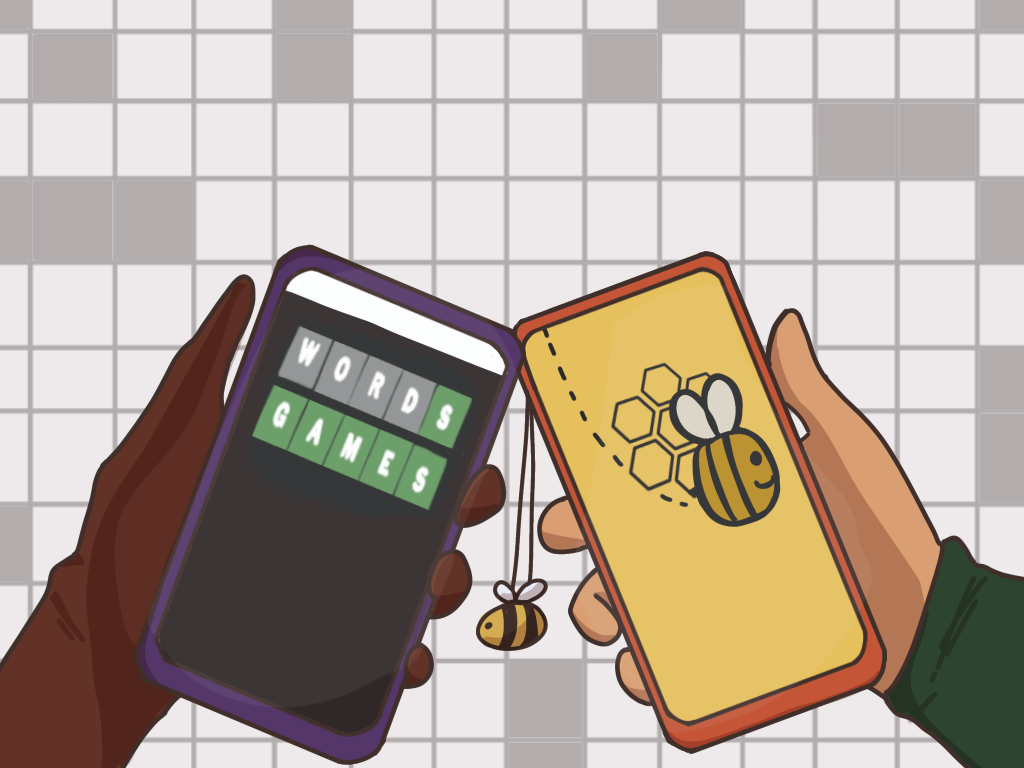
Every morning, millions reach for their devices to log onto The New York Times’s website or app. However, instead of checking the news, they head straight to the puzzles. From guessing a five-letter word in Wordle to making groups of four in Connections or searching for the pangram in Spelling Bee, playing these puzzles has become a daily ritual for many. The rise of The New York Times’s daily word games has shaped the way people engage with each other in modern culture.
First published in the New York World in 1913, crosswords quickly gained widespread popularity. Despite this, in a 1924 editorial, The New York Times stated that crossword solvers “get nothing out of it except a primitive sort of mental exercise.” In other words, they considered crosswords to be busywork. It took 20 years for The New York Times to reluctantly publish its first crossword puzzle, offering readers a way to pass the time during WWII blackouts. However, they quickly realized that crosswords were widely popular and boosted readership. Seven decades later, The New York Times Games was officially established as a strategic investment in puzzles, particularly for the digital age; the Mini Crossword debuted alongside it to encourage people to play the regular crossword in 2014.
The New York Times Digital Puzzle Editor Sam Ezersky plays a key role in developing and refining many fan-favorites. “I’m best known as the editor of the daily digital Spelling Bee. I also create the puzzles for Letter Boxed,” Ezersky said in an email interview. “The majority of my time, though, is actually spent on The Crossword, which is how I got my start—I’ve been constructing crosswords for The Times since I was in high school, and got hired full time after graduating from college in 2017. So I’ll always consider crosswords to be my ‘first love,’” Ezersky explained.
Players express that puzzles are great at stimulating deduction and logical reasoning. “I am an avid enjoyer of puzzles,” stated junior and Fun Column Writer Deon Woon. “I usually play nonograms and acrostic puzzles because I like puzzles that include logic. I like to know that my answer will be correct instead of using pure guessing. I like visually seeing the progress I have made in a puzzle from the start until I eventually solve it.” The daily puzzles that The New York Times publish are similar to nonograms and acrostic puzzles, but they are condensed into a shorter format. “I think because Wordle was so popular, simple and short puzzles have become more popular,” commented Woon. “I do feel a certain shift from more traditional puzzles like Jigsaw puzzles, sudokus, or crosswords. I think that people prefer to solve puzzles that take a shorter amount of time just to get easier gratification.”
While people individually solve puzzles for personal enjoyment, they can also bring people together, fostering social interaction and connection. Editors such as Ezersky explicitly look to spark interest between players in innovative and imaginative ways. “We’ve been talking more and more about ‘moments’ surrounding our puzzles: For a given puzzle, how can we talk about it?” Ezersky said. “Will it generate buzz on social media? Is there something thoughtful to point out from the lens of the editors? Maybe it's something as simple as introducing a fun word, phrase, or clue? I think about this a lot in my own ideation.” Playful and unexpected elements enhance the experience, contributing to the puzzles’ appeal and showing how small design choices can capture the attention of users. “This way, we continue to tailor to today’s audience, and bring more voices in from far and wide. It makes the puzzles that much better,” Ezersky added.
These “moments” stick out to solvers. One unique and memorable puzzle is Strands #483. Strands is a themed word puzzle where players search for related words in a letter grid. That day, the theme was “Hue are my sunshine,” and the featured words corresponded to the colors of the rainbow. “What I like about Strands is [the Spangram],” junior Silas Kwan shared, referring to the word or phrase that connects opposite sides of the grid and reveals the day’s theme. While Strands usually highlights the Spangram in yellow and other answers in blue, this puzzle instead marked the Spangram in red and color-coded the remaining words by theme. “I like it when they all follow a pattern. I think that’s cool,” said Kwan. After completing a game of Strands, players also get to share a summary of how their game went. Normally, the Spangram is represented by a yellow circle emoji while other words use a blue circle emoji; once again, they were color-coded.
In Connections, players are given 16 seemingly unrelated items and must identify four groups of four connected by a common category. While these items are normally words or short phrases, on April Fools Day 2025, Connections #660 featured various special characters instead, including a right angle (⊾). Solvers enjoyed its distinctiveness and subversion of Connections’s usual formula. “I thought it was very fun. I preferred that over the usual Connections because whoever makes the Connections usually relies on very obscure phrases or popular culture that young people definitely don’t know. If you’re using symbols, it’s much easier to think about different ideas because there are definite meanings that have widely been accepted,” commented Woon. These games have been so successful because they are founded on combining creativity and challenge.
Unique puzzles like those mentioned above are frequently shared and discussed on platforms like Reddit and Instagram. “These games, however bite-sized, have become somewhat of a larger daily diversion. A daily talking point. And in the social media era, perhaps a way to easily connect with someone, even if it’s a simple shareable Wordle or Connections score,” Ezersky said. Through online interactions, players keep these daily word games alive even after they complete them for the first time that day. The games’ popularity can be attributed to their ability to persist beyond solving them once, which creates a long-lasting impact.
When a game limits the number of guesses, that challenge engages solvers by quantifying their performance. “I play Wordle and Connections. I like these two games because I find them the most fun and challenging, partly due to their limited guesses. The limited guesses and very unique words from time to time keep me on my toes and make me look forward to the next one,” junior Jayden Wong explained in an email interview. The challenge of using the fewest guesses possible also works to create interaction through friendly competition: “I play Wordle with my friends sort of competitively. We see who can do it in the [fewest] guesses and if anyone actually failed to get the word,” Wong added.
Further still, puzzles are icebreakers—they leave enough room for players to share their unique experiences while creating opportunities for connection. “Look at these entire Reddit threads devoted to a single puzzle, full of strong opinions. Puzzles just feel like a backdrop for conversation, and an avenue to share our larger walks of life. Was that answer a gimme? Did you learn something culturally enriching? What is it about this word that feels so interesting to you?” Ezersky said. Puzzles create a sense of community that is shared across users worldwide, turning a solo activity into a shared experience. “In a sense, especially with Spelling Bee, it really is a ‘hive mind’ of us all conversing about the language of which we all know and speak. And believe me, it’s staggering to witness and help shape,” Ezersky said. The puzzles’ daily releases foster a network of millions who participate in this routine together.
In the past few years, crosswords have been increasingly appealing to a wider demographic. “We recognize that, in order to make our puzzles as accessible as possible, they need to truly resonate with solvers across wide demographics,” said Ezersky. “I’d say that, today more than ever, we are focused on keeping our puzzles feeling fresh and made for the modern world around us.” Indeed, a New York Times article detailed crossword answers that debuted in 2025. Those answers included modern slang like “CLOUT CHASING,” historical and cultural elements like Incan “QUIPU,” or pieces of pop culture like Nintendo’s “KOOPA TROOPA.” These words make people feel seen. “In crosswords in particular, we talk a lot about ‘voice’ and ‘constructor intent’—the angle in which something is clued might be different than the way I personally would have clued it, but perhaps it offers a thoughtful new lens. And it's a subtlety like this that can change the entire perception of a puzzle, and make a solver ‘feel seen.’” Ezersky noted.
Woon corroborated this idea. “I am inspired by multiple Japanese puzzle creators, who focus more on brainteasers, on YouTube,” he said in an email interview. “I find that the Japanese language allows for more interesting gimmicks that I try to utilize in my own puzzles.” Puzzles need to stimulate and present something new to a reader, which is why drawing and incorporating ideas from a variety of sources can create such engaging puzzles.
Daily puzzles like those published in The New York Times are multilayered cornerstones of everyday life. Puzzles not only absorb but also impact multiple different facets of our generation as a whole. They are easy to take part in and hard to forget about. They facilitate conversation and foster competitive spirit. They draw from and influence contemporary culture. Puzzles are inherently designed to be adaptable yet thought-provoking, which is why they have evolved along with modern culture. As these puzzles evolve, they reflect broader shifts in a changing society, revealing how people think, communicate, and find meaning in the connections they create.