
A Deep Dive Into APCS A vs. APCS A Honors
Computer Science Coordinator JonAlf Dyrland-Weaver explains the restructuring of post-foundations computer science classes offered at Stuyvesant, and students enrolled in AP Computer Science A (APCS A) and APCS A Honors share their thoughts on the classes so far.
Reading Time: 4 minutes
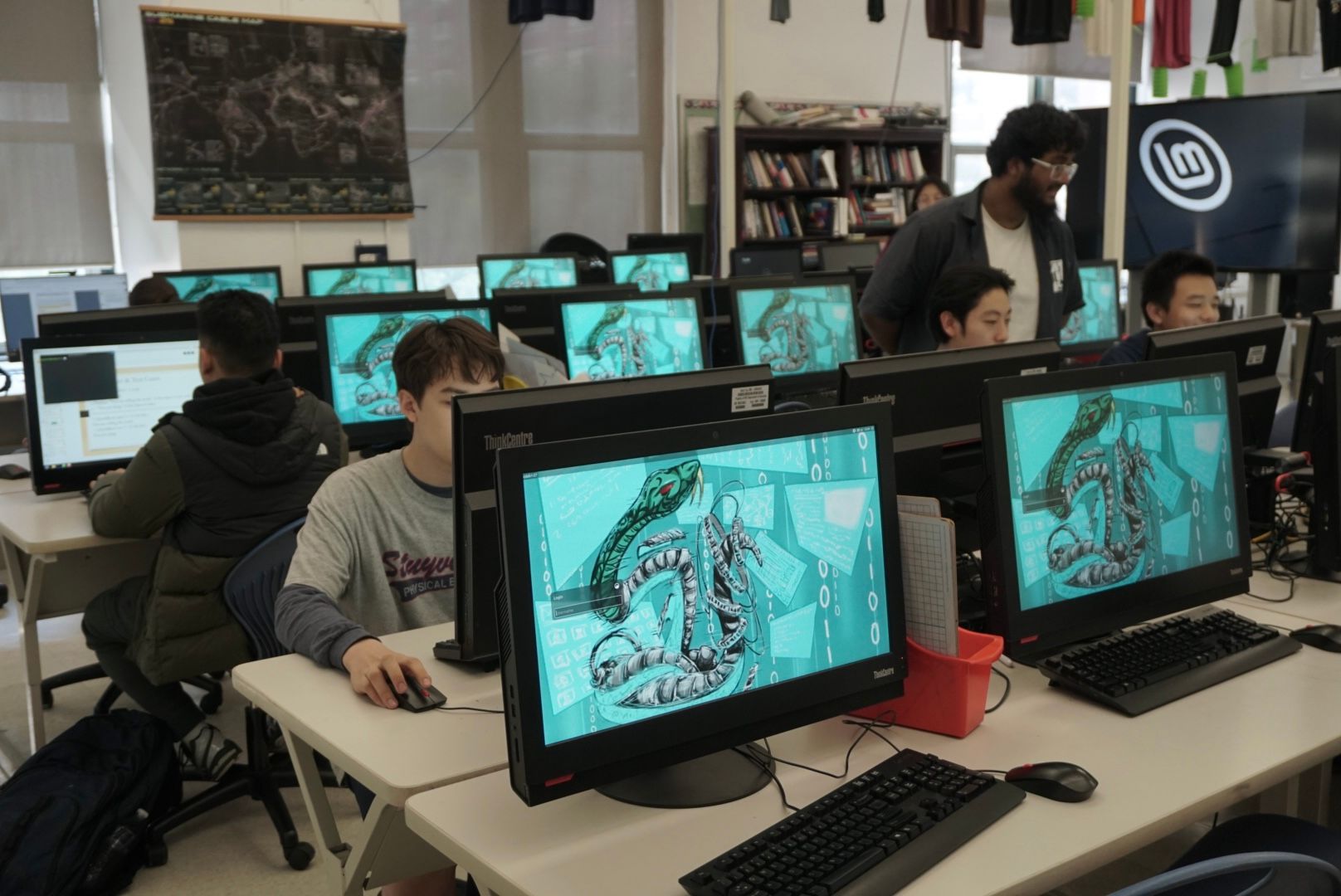
All sophomores are required to take at least one semester of the Foundations of Computer Science course, which introduces the basics of coding and how computers work. Upperclassmen who have done well in this course and are interested in further pursuing computer science have the option to take the AP Computer Science A (APCS A) course. This year, the format of the classes shifted slightly, and the options that were offered were APCS A and APCS A Honors.
Computer Science Coordinator JonAlf Dyrland-Weaver explained in an email interview that until several years ago, the College Board offered two AP Computer Science exams: A and AB. APCS AB was much more rigorous and was the only class offered at Stuyvesant, though students had the option to take either AP exam. However, the College Board discontinued APCS AB as it was unpopular, with only about 5,000 students taking the exam, 200 of whom were Stuyvesant students. Dyrland-Weaver continued: “Unfortunately, the College Board did not stop there, and since 2009, they have periodically removed content from the course, without replacing it with anything of consequence. By last year, the official APCS A class and exam had become a shell of its former self.” Thus, Stuyvesant’s Computer Science department felt that although continuing to offer a more rigorous class was important, they faced challenges in doing so, most notably that the high grade cutoff may discourage students from taking the course. “We originally had mitigated this issue by offering the NeXT CS course, which was developed by myself and a former CS teacher, Peter Brooks. At the time, students could take NeXT, and then decide to take the APCS A exam if they wanted, and those that did ended up doing well on the exam,” Dyrland-Weaver shared. However, this option was no longer possible when AP exams became digital, requiring further changes to the courses offered: “This leads us to the rebranding of our post-foundations AP CS courses. What we have been offering as APCS A we are now calling Honors, because of the expanded content. What we were offering as NeXT CS we are now calling APCS A. We will be making a few tweaks to the NeXT curriculum to make sure it adequately prepares students for the AP exam, but that will not require a major change,” Dyrland-Weaver explained.
Regarding what the classes themselves are actually like, Dyrland-Weaver summarized: “APCS A will still cover more material than the standard curriculum, but will not include some of the more advanced algorithms and data structures that are present in Honors. As such, the A course will be slower paced.” Both classes go beyond the College Board curriculum, and whether students take APCS A or APCS A Honors, they will learn more than enough in preparation for the AP exam. While neither class was truly newly introduced this year, Dyrland-Weaver considers APCS A the “new(ish)” class, explaining what makes it distinct: “We are using the Processing framework for Java, instead of standard Java. This allows us to smooth out some of the rough edges of Java programming (which isn’t on the AP exam anyway), and focus on creating engaging, graphical programs (there are some assignments in the honors course that use Processing for this reason as well).” The formatting of the classes frees teachers from the restrictive nature of the College Board curriculum, allowing them to help their students to learn more effectively.
Many students have chosen to take APCS A Honors as it covers more material, finding the extra challenge to be more enjoyable. “I find the class both challenging and enjoyable, as when referring to [computer science], I find these two adjectives inseparable. I enjoy being challenged, and this challenging aspect only allows me to grow,” junior Sebastian Waldman shared in an email interview. Computer science is largely about the satisfaction of figuring out logical puzzles, and being challenged can add to this satisfaction, which can even inspire joy. “Another simple adjective I would use for myself: fun. [Computer science] is always fun for me, whether my code works or not, and especially when I’m learning while doing,” Waldman continued. Challenge, learning, and fun are intertwined in computer science, and the APCS A Honors course creates an engaging balance between the three. “The perfect balance, in my opinion,” Waldman expressed.
Junior Benjamin Xie explained how he feels about his workload in APCS A Honors: “Honestly, I expected the workload to be higher. So far, it’s been fine. I feel like it’s about the same workload as the Foundations course. Compared to Foundations, I feel like Konstantinovich explains things more thoroughly and is more open to people asking questions.” The workload of APCS A Honors being similar to that of the Foundations of CS course presents a good baseline for students to compare difficulty and expectations. However, while comparing the workload of the classes can be helpful, it does vary greatly between teachers, just as opinions do between students.
Even though APCS A Honors is perceived to be more thorough when referring to the scope of its curriculum, junior Kazi Mehjabeen explained in an email interview that she feels she is learning and benefiting a lot from the regular APCS A course: “I am feeling alright about the AP exam because my teacher teaches so well! He seems like he cares about us. He is teaching us well: fast enough to not fall behind on the AP curriculum, yet slow enough to not leave anyone falling behind.” Regardless of whether a student takes APCS A or APCS A Honors, both will prepare students well for the AP exam, due to content bridges and other factors. Being on the right timeline and pace is beneficial, especially in an AP course.
More than preparing students for the AP exam, APCS A is about fostering genuine learning: “My teacher encourages us to not be afraid of mistakes which I really appreciate. All our life we were given the impression that mistakes are these unforgivable things; you can never forgive yourself for making one because now your life is over and will be that way forever. [...] I wish more classes would be like this, because it really does help in understanding the material more,” Mehjabeen shared.