
Yayoi Kusama: Forever in Infinity
Bearing a few hundred dollars, sixty kimonos, and 2,000 drawings, twenty-nine-year-old Yayoi Kusama looked down from the observation deck of the Empire State Building and promised herself that “one day [she] would conquer New York and make [her] name in the world.”
Reading Time: 6 minutes
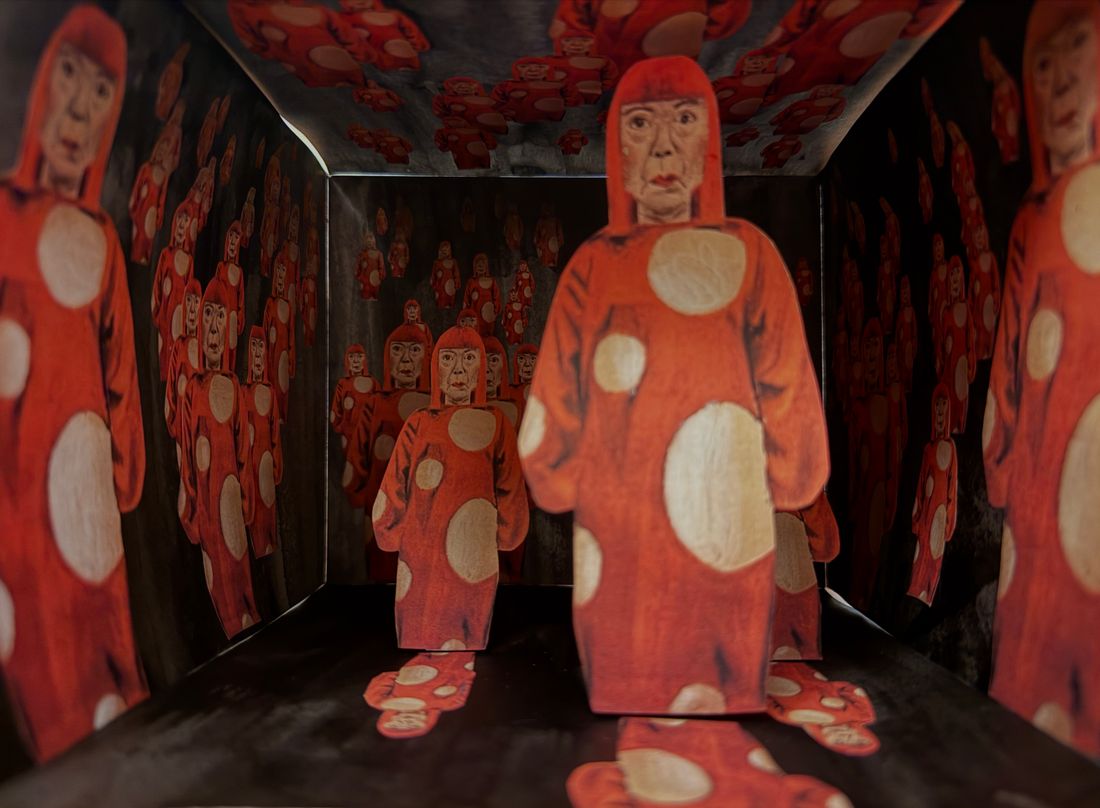
Polka dots let in the sunlight of the earth
The heart is filled with the shining light of the sun
All of the people who enter seeking the joy of being alive
Let there be eternal harmony among all in the circles and cycles of living
Peace and endless love for all
-Yayoi Kusama
Japanese artist and activist Yayoi Kusama was born on March 22, 1929, in Matsumoto, Japan, the youngest of four children in a wealthy, strictly conformist family. Her mother was physically, verbally, and emotionally abusive, and expected Kusama to follow the traditional path of an arranged marriage and becoming a housewife to a wealthy man. Her father, besides being a blatant womanizer, operated the family’s wholesale plant nursery and seed business. Growing up on the family farm, Kusama sought sanctuary in surrounding nature. She would arrange stones and leaves into compositions, fostering her love for art. However, her family strongly opposed her becoming an artist; her mother would confiscate her inks and canvases and throw her paint box.
Kusama experienced her first hallucination at 10, which she described as “flashes of light, auras, or dense fields of dots.” In the same year, she created one of her earliest surviving works: an untitled portrait of her mother, wearing a traditional kimono, with her head subtly lowered in a solemn expression. Polka dots, which are dispersed throughout the kimono, would become a consistent motif throughout Kusama’s artistic career. The word “polka” likely comes from the Czech word půlka, meaning “half,” referring to the bouncing half-steps used in polka dance. They are commonly featured to introduce playfulness; they are simple, clean, whole, and round, like the restless energy and innocence of a young child. In a way, by using polka dots, Kusama attempts to immerse herself in the childhood she never had.
Kusama was not only ostracized by her own family, but also by Japan’s traditional art scene. In 1941, when Japan entered World War II, 13-year-old Kusama would sew military parachutes (a skill she would later utilize for her soft sculptures). From 1948 to 1949, she studied nihonga, a traditional Japanese painting style, at Kyoto Municipal School of Arts and Crafts. In 1958, Kusama left Japan for New York. At the time, New York’s avant-garde art scene was transitioning from Abstract Expressionism toward Pop Art and Minimalism, and was dominated by white males such as Andy Warhol and Donald Judd. Kusama set about making her name known. She began by creating her “Infinity Net” oil paintings. One, No. F. (1959), sits on the fourth floor of the Museum of Modern Art in The David Geffen Galleries. From afar, the 41.5” x 52” monochromatic white painting completely encompasses one’s field of vision, possessing the expansiveness of an undulating ocean, calm yet pulsing. Close up, the intricate tangle of thick, textured, looped paint strokes gives it a rough, fibrous, rope-like quality. Yet, it’s not the typical standard, thin, flexible fishing net. This net is firm and flat. The holes are compact, as if the “knots” of the net are tight; there is not enough breath between the strokes, and it feels overwhelming and constricting. Perhaps it acts as an attempt to vicariously experience Kusama’s struggle to breathe as well.
In the early 1960s, Kusama shifted her artistic focus to three-dimensional space and interactive performance art. Her unauthorized “Anatomic Explosions,” also known as “Happenings,” involved her and participants painting dots on others’ naked bodies, and invited “self-obliteration,” or the liberation of the body and mind from the burdens of gender identity, sexuality, and societal oppression. Other “Happenings” were intended to critique war, commercialization of the art market, and other matters.
Often painting for 50 to 60 hours at a time, Kusama became so obsessed with painting that she fell ill. In 1973, she returned to Japan, and in 1977, she voluntarily checked into the Seiwa Hospital for the Mentally Ill, where she would live for the rest of her life. During the day, she would go to her studio a few blocks away, working with her team of assistants from nine a.m. to six p.m.
Kusama featured more sculptural works in the New York Botanical Garden’s 2021 exhibition. Dancing Pumpkin (2020), though a five-metre-tall yellow sculpture punctuated by black polka dots, is like a portrait of a young child. There is a subtle shift of weight to the left of the sculpture, and the rightmost and leftmost “limbs” look like flailing arms attempting to keep up with the restless motion of running in the park. This sculpture looks almost buoyant, like the flow-state feeling of floating amidst a run. In Ascension of Polka Dots on the Trees, Kusama wrapped white-dotted red polyester fabric around three-quarters of the trees. The bright red and white plague the earthly colors of the tree, a visual representation of Kusama’s hallucinations plaguing (or maybe even repairing) reality. Kusama’s works, though beautiful, should not just outwardly be perceived as poetic metaphors, but as renderings of serious perceptual disturbance.
In 2023, Kusama held a major exhibition at David Zwirner. I Spend Each Day Embracing Flowers (2023) is horrifically sublime. The petals don’t have the thin elegance of a typical flower; they are stout and solid; the stamens are not thin and supple, but thick, linear, vertical, and rigid: a representation of Kusama’s nonconformity in a traditional, conservative Japanese society. Straight-on, it is cavernous and hypnotizing, pulling the viewer into its pistil, like the mouth of a Dune sandworm. It is as if it both embraces and engulfs the viewer, embodying both the simultaneous comfort and terror flowers brought to Kusama. She once recounted, “I see the flowers everywhere, and there are so many, and I feel panicked and become so overwhelmed that I want to eat them all.” The title suggests Kusama is “embracing flowers,” as if she is accepting her hallucinations.
Some of Kusama’s most popular installations are her Infinity Mirror Rooms. One, Infinity Mirrored Room–Dancing Lights That Flew Up to the Universe (2019), is featured in the Solomon R. Guggenheim Museum. Visitors are allowed a mere 60-second retreat into a dark, mirrored room illuminated by multicolored LED lights, an immediate shock from the sterile white walls of the museum. Perhaps this short time is not only the result of the long entry wait, but also because it contributes to Kusama’s intended experience of “obliteration” and immersion in Kusama’s hallucinations. By restricting the viewer’s time in the room, Kusama expertly creates a sense of unfamiliarity, exclusiveness, and fleetingness. The viewer is not given enough time to adjust their eyes to what the art physically is: a room lined with mirrors and LED lights. What might seem like a room meant for Instagram mirror selfies is actually Kusama’s attempt “to show the cosmic image beyond the world we live in.”
The last show that Kusama actively worked on—another mirror room, The Hope of the Polka Dots Buried in Infinity Will Eternally Cover The Universe (2019)—is featured at the Amsterdam/Stedelijk Museum. Yellow serpent-like structures (of course once again punctuated with black polka dots) protrude from the walls, ground, and ceiling. Although they have the thickness of around six humans huddled together, they somehow seem weightless, soft, jointless, and boneless—eerily fluid and perfectly smooth and slick, almost to the point of looking wet, like an unwavering stream of oil. It has a still, silent lurking, that of a snake emerging from underground, its body in seemingly endless succession, predating, conquering, and “eternally [covering],” the universe.
There is no doubt that Yayoi Kusama, “Queen of Polka Dots,” marked her place in history. Maybe the greatest way we can honor Kusama is to step into the world she toiled to create, not just through museums, but within our active, ever-changing world: “Let there be eternal harmony among all in the circles and cycles of living / Peace and endless love for all.”