
Where Does Robotics’ Money Come From?
An inside look into the business machine powering Stuvesant’s largest student-run organization—and the team of teenagers behind it.
Reading Time: 5 minutes
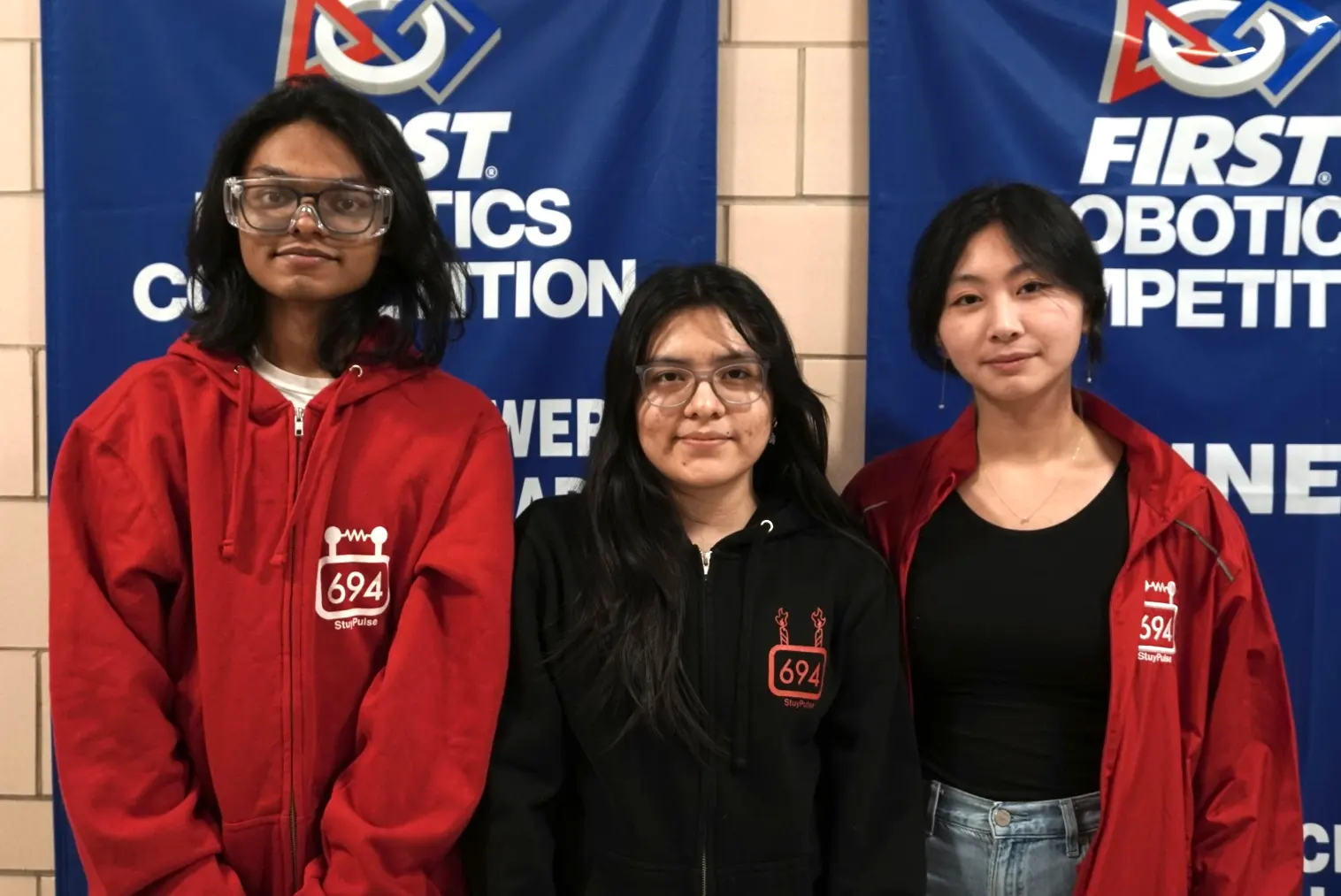
Founded in 2000, StuyPulse 694, Stuyvesant’s FIRST Robotics Competition (FRC) team, is now closing out its 26th season with around 150 active members and the debut of its sister team, 516. At this year’s Finger Lakes regional, the team won the Engineering Inspiration Award—one of FRC’s most prestigious recognitions. Given not just for robot performance, but also for a team’s demonstrated impact on its community, the award allows the team to qualify for the World Championships ahead of schedule. However, behind the robots and rows of banners lining the fourth-floor hallway is a group of students working hard to strategize and support the huge operation backing one of the largest student organizations at Stuyvesant.
The mechanical budget alone is $35,000.
For most clubs at Stuyvesant, that figure would take years of bake sales, car washes, or donation drives to reach. But for StuyPulse 694, it’s just a single line in a budget that spans six figures, funding over three competitions each year and a trip to the World Championships in Houston every spring.
Ask around at Stuyvesant which club gets the most funding, and just about everyone will point to the same corner of the fourth floor: robotics. This belief is so widespread that it has become almost an inside joke that StuyPulse is the golden child of Stuyvesant, because it receives many resources that other clubs do not.
StuyPulse’s student leaders, however, say that this is a common misconception and that the reality is far more complicated. “Definitely not,” senior and Business President Juliet Badillo Flores said. “A huge part of the misconception is that [people think] we just get all our funding from this school, which is not true.” Flores explained that StuyPulse applies for grants through the Alumni Association and Parents’ Association; those grants are available to every club. The team also runs multiple bake sales throughout the year and receives no special preference in securing meeting permits for rooms.
Interestingly, unlike most student organizations at Stuyvesant, StuyPulse operates as a registered nonprofit, meaning that it is independent of the Student Union. This independence grants the team greater flexibility to apply for private grants, but it also means that every dollar must be raised and accounted for by the students themselves. While its two largest institutional supporters—the Stuyvesant Parents’ Association and the Stuyvesant High School Alumni Association—are affiliated with the school, together, they account for roughly half of the annual budget. “The PA and the alumni are extremely generous, and we’re so thankful for the amount of support they give us every year,” senior and Financial Director Rachel Uh said. “But they are only a fraction of where we get our budget from.”
Keeping up with the budget year after year is a huge responsibility. Uh reported applying for approximately 20 different grants from corporations and foundations this season alone, while simultaneously building long-term relationships with private donors, overseeing three bake sales, and managing a steady stream of online merchandise sales. “We look at our mission, evaluate where we’re seeking funding from, and we work with corporations and outside donors to make that happen,” Uh said. Many of these corporate relationships start through alumni or parent networks, backed by former members who now work at companies with generous grant programs or parents who want to support their child’s team. Many of these partnerships are built through decades of trust, additionally endorsed by smaller donations collected via QR code at community events like StuySplash, the team’s annual scrimmage series, which drew over 50 teams from three states in December 2025.
StuyPulse’s mission extends well beyond competition. It aims to help students discover their passion for lifelong learning through a team culture built on sharing knowledge and giving back to the community. The team is open to anyone, and their priority is making sure that every student with even the slightest interest in STEM has the opportunity to explore that interest.
Budgeting money reflects that mission directly. Although robot parts and materials make up a significant portion of the budget, they are not representative of the majority. Uh explains that most of the budget actually flows back to the students through financial aid and competition costs. Registration fees for each regional competition cost over a thousand dollars; the World Championships in Houston require flights, hotels, and meals for a group the size of a small school trip. Competitors without financial aid have to write checks for around $1,150 for this seven-day tournament, which pays for flight tickets, registration fees, and room and board.
“We provide financial aid because a huge part of our team is first-generation American, low-income,” Flores explained. The team’s goal is to ensure that travel costs don’t determine who gets to compete in tournaments. “We have a really unique situation because a lot of FRC teams tend to send around 20 people max, and we have 150 students on our team, so that's a lot of us to support,” Flores added. The GoFundMe campaigns that occasionally appear on their social media page are to ensure that all students may attend.
What often gets overlooked in conversations about robotics and its budget is the sheer scale of everything else StuyPulse does. The team is organized into distinct departments—mechanical, software, business, awards, and more—each run entirely by students. In the past three years, the team has launched seven community programs and supported six robotics teams across the city. Since Hurricane Maria devastated Puerto Rico’s infrastructure in 2017, the team has remotely mentored 18 teams there, helping programs rebuild from thousands of miles away. StuyPulse also participates in Open Alliance, a public forum on Chief Delphi, an online community hub for FRC, where they share their developments and build progress openly.
The student-driven mission runs deeply into how the team operates internally. Rookie Education, the team’s onboarding program running from October through December every year, mentors roughly 200 students who arrive each fall with no prior knowledge of mechanical engineering or 3D modeling; they leave having been taught everything by their peers by the time the season begins in January. “Everything we plan, everything we design, everything we buy is really student-focused and student-led,” senior and Award Director Rachel Kim said.
Where legal and financial matters require adult oversight, the team has dedicated support it can reliably turn to. Coach Joe Blay and Navid Kashem, a team alumnus and student at Columbia University, manage legal and tax-related matters and review grant submissions. However, the curriculum, the spreadsheets, the sponsorship outreach, and the award strategy are all student-designed and student-run.
“At the end of the day, robotics isn't necessarily about winning a competition,” Uh said. “We’re trying to let students have the experience of being mechanical engineers, software engineers, working on real-world business scenarios and cases.” What appears from the outside as an unusually well-funded club is, in reality, a system in which students work tirelessly to maintain the community, mirroring the complexity of the professional world they are preparing to enter.