Introducing ARISTA’s 2026-2027 Executive Council
The new 2026-2027 ARISTA Executive Council board–Aidan Zeleniy, Emma Musyuk, Eric Lam, Mekot Sarder, and Krish Kalantry–discusses their hopes and ambitions for the next school year.
Reading Time: 5 minutes
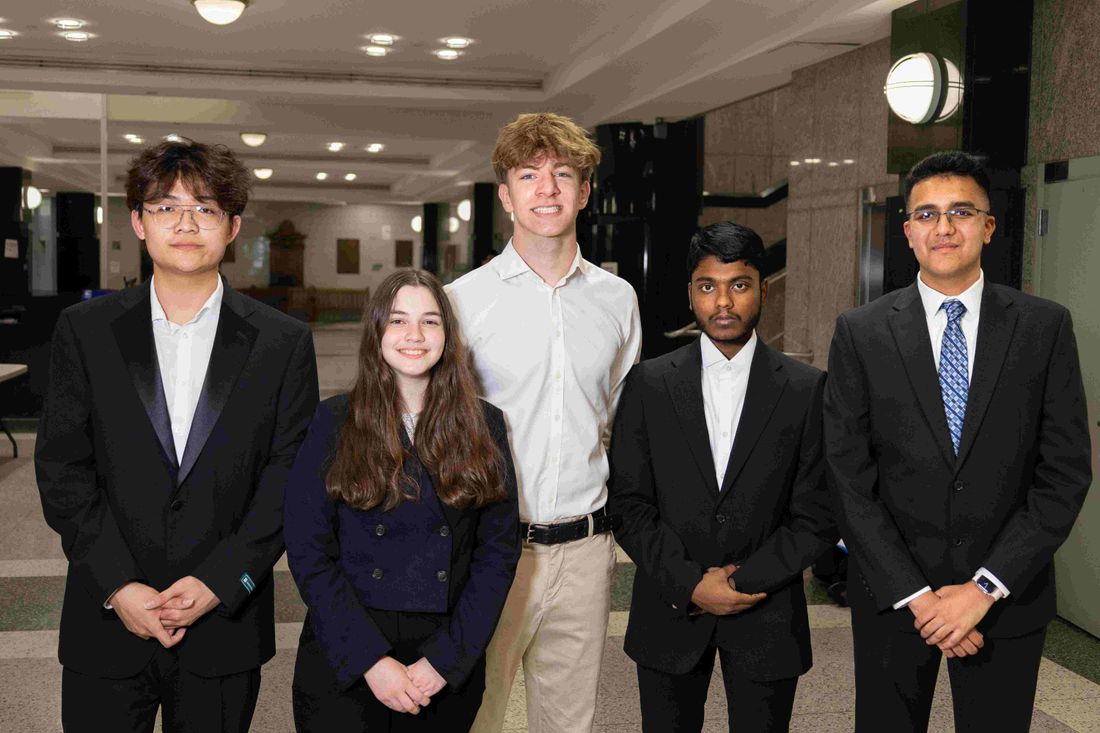
As the 2025-2026 school year comes to an end, the outgoing ARISTA Executive Council and English teacher and faculty advisor Anne Cooperstone have selected the new 2026-2027 Executive Council. Following a rigorous and competitive application process comprising of a written response, interview, consideration of previous dedication, and a faculty recommendation, the council announced its newest Executive Council members in late March: junior and President Aidan Zeleniy, junior and Vice President of Internals Emma Musyuk, junior and Vice President of Events and Service Eric Lam, junior and Vice President of Web Development Mekot Sarder, and sophomore and Head of Tutoring Krish Kalantry.
The various aspects of managing ARISTA are distributed among the different roles that make up the Executive Council. For the President, a focus is placed on overseeing different committees and ensuring that ARISTA is actively benefiting the school community. “It’s more so about making sure that all the different committees, they’re kind of working together, and that as a whole, the ARISTA member experience and the ARISTA member impact on the Stuyvesant community is measured,” Zeleniy said.
In past years, there have only been four council seats–the President, Vice President of Events and Service, Vice President of Operations, and Vice President of Web Development. “Originally the VP of Operations and thus the Operations Committee would be handling all of the tutoring and academic-based initiatives. But throughout the past years we’ve seen that it is a lot on the Operations Committee to also be tutoring on top of all the internal stuff that we have to manage,” Musyuk said.
In order to combat such challenges and workload, a new Head of Tutoring position was created. “My responsibilities will essentially be taking over the entire tutoring aspect of Operations, and that includes handling our AP review marathons, which we did several of this year,” Kalantry said.
Tutoring is one of the most major aspects of ARISTA’s mission. All members must serve as tutors and receive training through the new Tutor-a-Tutor program. Tutees benefit academically from ARISTA’s tutoring service, but tutors benefit equally as much. “I think [you] rather grow as a person. Through tutoring, you’re able to really understand how to connect with a student, and how to really realize the position that they’re in,” Sarder said. Tutoring other students through ARISTA often involves developing communication skills and open-mindedness.
As the Vice President of Web Development, Sarder’s responsibility is to manage the online aspect of ARISTA, as it’s especially crucial to keep the website up to date. He updates things such as the FAQ and study guides. “I wanted to […] add a personality to the website because now it just feels dull. So make the website, just the experience better for all our ARISTA members and for those that are trying to get tutored, make it a simple, quick, easy experience that they’ll want to keep on coming,” he said.
The Council has set goals for the next school year after reflecting on the past year’s progress. Specifically, the board aims to encourage collaboration with guidance counselors. “There is somewhat of a guidance counselor partnership with the Big Sibs, but ARISTA doesn’t really have a [direct] faculty connection with them. We just have the faculty advisor, the English teacher [Cooperstone], which is good, but it’s also really important to connect to the students themselves and find out from the guidance counselors who they need most,” Zeleniy said.
The events committee is also planning new initiatives for the student body. For example, they are planning a nonprofit fair, which will involve different nonprofit organizations and service opportunities. “And the goal of the fair is […] to help create stronger and longer-lasting relationships between students and organizations, because there are so many incredible groups and nonprofits in New York City that students may never normally encounter and we want to make those opportunities more accessible and centralized,” Lam said.
ARISTA has connections to many organizations, all of which can benefit members in different ways and open doors to new opportunities for students. “Also, we have several external partners […] whom we work with to provide tutoring to other communities within New York City. Namely, that’s PISTE Virtual Tutoring and the Metis Project. So, we want to continue our relationships with those organizations and strengthen our ties,” Kalantry said.
Other than creating future projects, the board also hopes to improve on previously established ideas and programs. “We started Tutor-a-Tutor this school year in September. It’s a new initiative that we started, but I thought that it wasn’t as effective as it could have been because it was just one 40-minute Zoom meeting with very little preparation done on behalf of everyone beforehand,” Kalantry said. As for the next school year, rather than a Zoom meeting, the Council plans on utilizing slideshows and Google Forms to orient new members on becoming tutors.
Moreover, the board has noticed issues they hope to resolve with their increased influence. “I think [event execution] can get a little bit hectic because there are so many events that are going on at the same time. So, one of the challenges as an events committee member is being able to make sure that you are on top of everything,” Lam said. Hence, they plan on reviewing committee applications carefully to ensure that committee members will be able to execute events successfully.
ARISTA ultimately seeks proactive members for its committee positions, which focus on challenging collaborative projects, yet yield rewarding results. “And so one of the things that I’ll also be looking for when committee applications turn around is the ability for committee members to be able to work with each other […] to ensure that our events are up to standards, and that our ARISTA members are able to receive the service opportunities that are meaningful,” Lam said.
The board has also pointed out the inconsistency in members’ event participation. “We have noticed that both as members and now as Executive Council, near the end of the second semester especially, we have fewer and fewer event sign-ups, as many members hit their event credit requirements,” Zeleniy said. To ensure a similar situation does not arise next school year, they plan to create an application-based system where members can adjust their tutoring and event hours, but only as necessary.
In addition to the five Executive Council members, ARISTA consists of around 200 members who also go through a rigorous application process to earn their place in the honor society. There is both a written application and interview process, where prospective members are evaluated based on various criteria. “We want members to be passionate about issues and have a valuable role in their community,” Musyuk said. “When I was reviewing applications, one thing that stood out to me was that if someone was passionate about an issue and then they also had a clear-cut path of how they’ve been trying to get involved in that issue with their community.”
Looking forward with their new goals and plans, the ARISTA Executive Council is hopeful for the next school year. “We have an incredibly strong team and we work together really cohesively,” Lam said. These leaders want to not only better the school, but the wider community as well. They aim to improve organization, efficiency, member participation, and dedication.