The World Wide Web is Dying
The web was built to send readers to people, and AI Overviews break that promise.
Reading Time: 4 minutes
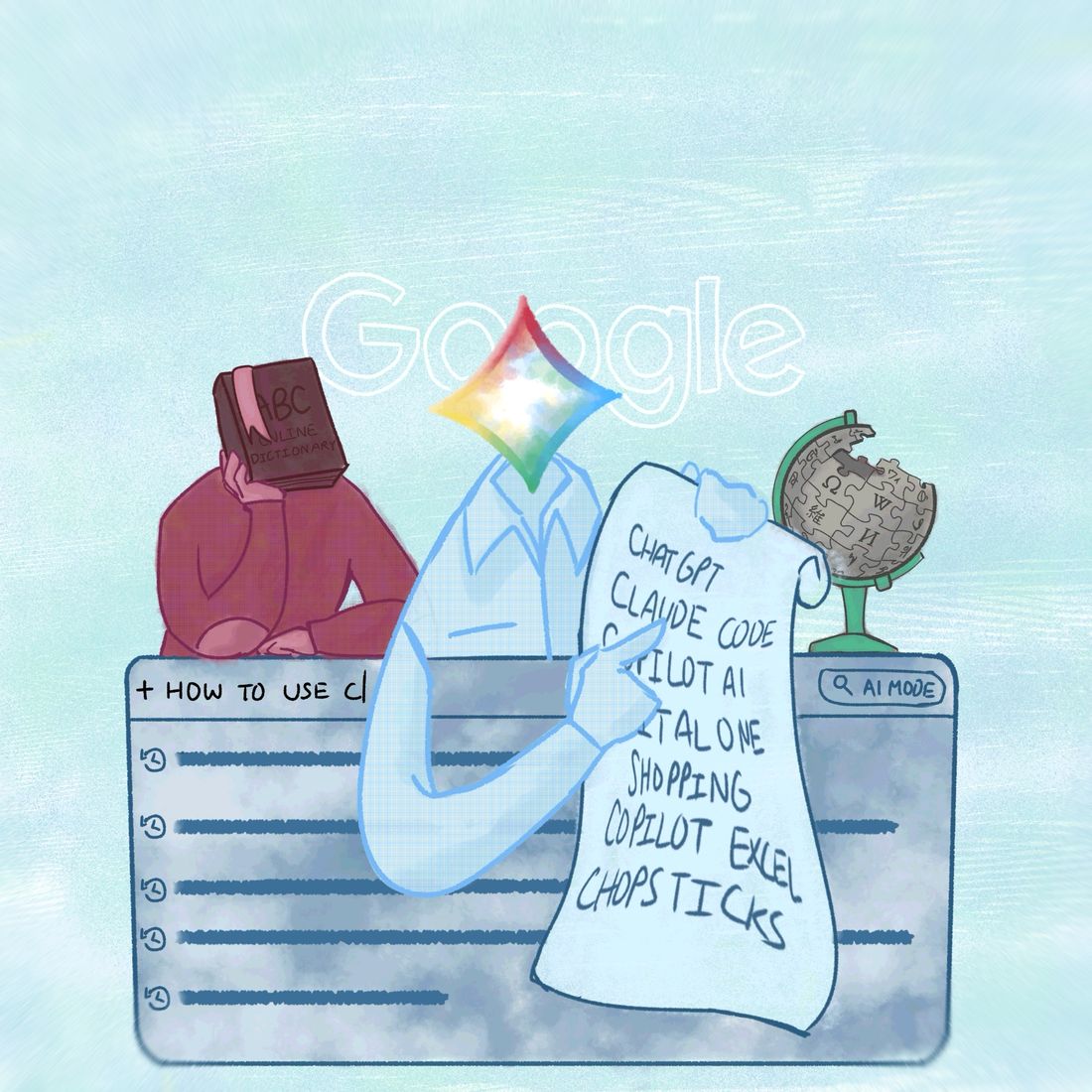
The European Center for Nuclear Research did something unthinkable for a technology institute in 1993: it created the World Wide Web, a global connection of pages designed to be free for anyone on the internet to use. Without royalties or owners, a page on a server in Geneva and a page on a laptop in Queens would be one click apart with nobody to stand in the middle for admission fees. Now, 33 years later, someone is standing in the middle. Try it. Type any question into Google—see how long it takes to boil an egg or what a tariff actually does. Before you see a single website, Google introduces you to a gray box brimming with confident paragraphs. They call it the AI Overview. It reads like an answer, but it’s closer to a smoothie: the recipe blog, the medical forum, and the local newsroom all blended together and handed back to you in a cup of gray sludge.
The people who made the ingredients of the smoothie get nothing. A Pew Research study found that users prompted with an AI summary clicked on traditional links eight percent of the time as compared to the 15 percent click-through rate without the AI. The click-through rate within the AI Overview box itself is less than one percent. People who read the summary were more likely to end their query altogether. This is the “zero click” world we are heading towards. A world where a chatbot can answer a question so completely that the primary source is never visited. A world where the fanfiction writer, the manga enthusiast, the independent food blogger, and the local journalist all feed an amoeba that swallows their work whole. Left with no visitors, no audience, and no ad money, what is keeping internet websites human? When a click is the only thing that pays for creativity, why should anybody bother being creative? What happens to the World Wide Web, a platform built on the promise of global sharing and communication, when we humans don’t share and don’t communicate? Instead, we let our AI slop “pals” do our talking for us. The World Wide Web is dying. Maybe it is already dead.
Google disputes all of this. Their head of search argued that studies about the impact of AI Overview inaccurately suggest dramatic declines in aggregate traffic. The validity of his argument is irrelevant. For 25 years, the agreement between Google and website publishers was clear. Publishers let Google’s crawler bots copy and index their pages for free, and in exchange, Google sent them readers. When a user enters a query into the engine, Google simply checks its massive database—an index of crawled and cataloged web pages—rather than scanning the internet in real time. Then, the search engine runs an algorithm to sort the results by relevance and optimize the results page for the user. In an ideal web, the top result is the most relevant to the user. For publishers, adapting to this formula became known as search engine optimization (SEO).
Google search accounts for 20 to 40 percent of referral traffic to publishers, so the rise of AI Overview is suboptimal for web creators, to say the least. A web creator already has limited opportunities to grow and develop their audience; they’re in constant competition with millions of other pages. Without Google’s SEO, creators are forced to fall back on social media, newsletters, and pay-per-click ads, methods more intrusive for the end user and far inferior in terms of client conversion. With AI Overview, Google fails to uphold its end of the bargain: they keep on indexing sites but withhold the engagement. Imagine a bookstore that photocopies every novel and then sells a summary to customers at the door. The bookstore gets traffic, but the books collect dust on the shelves.
Fine, AI Overview screws publishers. That much is clear. But at least it’s useful, right? Wrong. Google's AI Overview once suggested adding glue to pizza sauce so the cheese would stick. Another time, it helpfully noted that eating small rocks and drinking urine are an important part of daily nutrition. Hallucinations like this only get fixed when they go viral, but most errors never do. They remain at the top of the search window, phrased the same way: calm and completely certain. In a world where less than 10 percent bother to check responses for accuracy, the lies quietly slip by, accepted by the masses as truth.
Moreover, an increasing reliance on AI is beginning to plague the models themselves. A phenomenon known as “model collapse”—sometimes called “autophagous loop syndrome” or AI cannibalism—occurs when AI models are trained on synthetic data from other models rather than human writing. This results in a degradation of quality. The AI absorbs statistical inaccuracies, leading to a loss of nuance and amplified bias. In response, AI companies are rushing to purchase physical, dated, and rare books in bulk to scan and ingest them for training. This is only further evidence that we should value the humanity in our words above the polish of the robots, because if we don’t, AI will quite literally chew them up and spit them out.
The most important part is that we are not powerless to stop it. Every time a gray AI Overview appears at the top of a Google search, the solution is almost embarrassingly simple: scroll past it. Click the original link. Read the article. Support independent creators by bookmarking your favorite niche sites and choosing a search engine other than Google (DuckDuckGo No-AI, for instance). Without our help, we will lose everything weird that makes us human. Whether it be a retired mechanic’s 15-year-old guide to fixing one specific model of a Maytag washing machine, a fan site with an unhinged amount of detail about Game of Thrones, or a Stack Overflow post that magically fixes every WebGL render error, none of it is optimized, and that is the point. A web built to be summarized rewards things that are easy to summarize and starves everything strange, personal, or slow. The web was built on the idea that anyone could publish and anyone could find. Today, we, the readers, need to work together to uphold that principle.