The Truth Behind the Free Books Table
What’s really going on with those free books?
Reading Time: 5 minutes
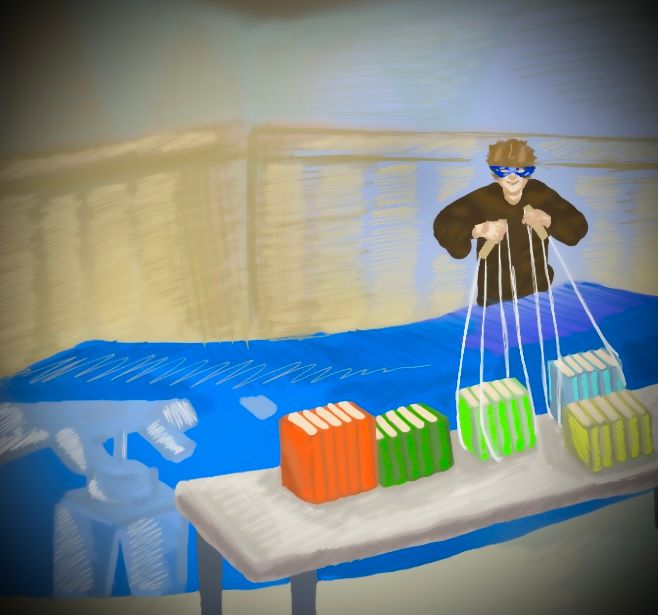
A spectre is haunting Stuyvesant High School. The spectre of free books. Stuy students have gotten used to the table by the Sophomore bar offering books, games, magazines, print, and more for anyone who cares. What is, on the surface, an innocent offer of material is, as this exclusive reporting by The Spectator will reveal, a deep hole bordering on conspiracy that raises more questions than it answers.
Our investigations began at the beginning, as most good things do. We first attempted to get in contact with whoever set it up. This endeavor proved to be much harder than we expected, since we initially thought that sending Principal Con Speer Acy many emails and, if that failed, banging on the door to his office would do the trick, but the most we got back was an automated out-of-office message of an angry secretary telling us to stop harassing him and to go to our classes.
Seeing that the administration didn’t want to speak to us, we thought that, if not the top, then maybe the bottom would have answers for us. When we barged into the English Department office and demanded a comprehensive list of anyone who had ever taken a book, we were laughed out of the room. When our reporters asked librarians, they were given equally unhelpful answers.
“I think Ms. Reeder suggested it last June?” librarian John Dewey mused as he took Chromebooks out of the cart. When one of our reporters caught Ms. Reeder in passing, she shrugged and told us that “we have a lot of extra books,” and for her part, she “wished she had come up with the idea.” We took that to mean that she was not the one behind it.
This discrepancy was deeply suspicious to us. Who was “we?” Why were the higher-ups refusing to talk to us? Why did none of the people on the ground know what was happening? Why were the files being withheld from us? As far as we knew, there were no victim names to redact. These are the telltale signs of a conspiracy afoot.
We held a stakeout of the free books table by the newly reopened Sophomore Bar to get some answers. Our reporters observed an English teacher, Brooke Wurm, carrying an unmarked cardboard box and taking out over forty copies of A Connecticut Yankee in King Arthur’s Court before walking away at approximately 2:45 p.m. He was startled when our reporters popped their heads above the Sophomore Bar one-by-one like Huey, Dewey, and Luey and asked him where he got those books.
“They’re old books from the English Department,” he said, looking at them sheepishly.
“So the English Department is behind it!” one of our reporters exclaimed, which prompted a confused glance before Mr. Wurm checked his watch–one of the signs of lying that WikiHow told us to look for–and excused himself by saying that he had a “very important and urgent meeting to attend.”
The next day, a good portion of the books was gone. We asked sophomore Annie May Fan, whom our reporters saw reading the book, why she got it, and she said that it was “peak American isekai,” a genre where characters are transported into a different world. From this, we learned that not only were new books being put out and being taken and read, but also that the teachers were in on the scheme.
Further investigation also revealed that the library was more involved than Mr. Dewey let on. Several of our sources confirmed that some books removed from circulation have ended up on the shelf. Senior Donning Kreuger, another reporter assigned to the case, is taking economics and asked librarian Ree Shelf how they could allow the appropriation and distribution of official resources into a black market. Mrs. Shelf defended the practice, telling Kreuger that withdrawn books would get recycled otherwise.
“If people want to read them,” she said, “why wouldn’t we give them away?”
“If people want free money,” Kreuger retorted, “why wouldn’t the government give it away?”
Mrs. Shelf blinked before telling him that “books aren’t money.” She did not seem to understand the urgency of the situation, nor the sanctity of our investigative work.
Kreuger’s economics teacher, Mr. Bonds, told him that it was “a normal donation system” when he asked the question in class the next day. We remain unconvinced. Students pay nothing for the books, the school makes no money, and yet the practice continues. What happened to the profit motive?
When we brought these findings to senior Speck Tater, a self-proclaimed student reporter, he seemed dubious. “It just doesn’t make sense,” he started, red with passion on the subject. “Follow the money, it’s always the money,” he said while pointing to a corkboard with pictures connected with red string. When we said that there was no money to follow, he paused for a second. “No money you know of,” he proclaimed.
This whole practice has slowly started affecting student behavior. Many English teachers expressed in slightly fearful, hushed tones that students would read and discuss books not assigned to them in class, a phenomenon previously believed to be strictly theoretical. Foundations of Literature teacher Barnes Noble said he recently saw a student sitting against a wall with a book during their free period. “At first I assumed they were hiding their phone in the book,” he said, “but then I walked over and realized they were reading. I didn’t really know what to do, so I just backed away.”
One Freshman Composition teacher who asked to remain anonymous told us that they were “so, so happy so many students were reading in their free time.” When we informed them that, in fact, a walk around the school could show that Pulitzer-winning biographies were being used as doorstops and thickly-bound, dusty tomes were being used as weights, they seemed unconvinced.
“No,” they said, looking up as if they were thinking of an answer, “maybe they just happened to set them down there? You know how kids are.” They did not elaborate on what they meant by that.
Then, they seemed to take solace in the idea that kids were taking the books at all. “We’re in a literacy crisis right now; any interaction with books is a win in my eyes,” the teacher added. We decided to end the interview on that conveniently poignant and provocative note before Kreuger could ask if that meant taking a book and selling it counted as interacting with it.