
The Super Mario Galaxy Movie: Too Many Stars, Not Enough Story
A review of The Super Mario Galaxy Movie with emphasis on its storytelling, character development, and its effectiveness as a sequel.
Reading Time: 5 minutes
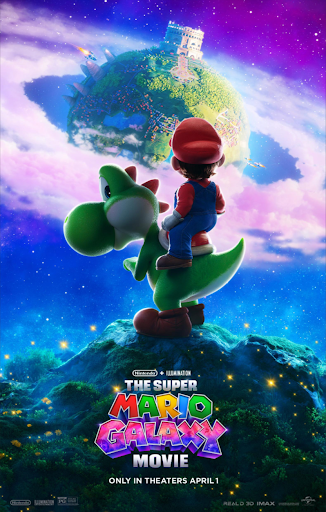
The Super Mario universe has been well curated ever since its first game release in 1985. The animated film The Super Mario Bros. Movie (2023) brought the franchise to life on the big screen, introducing the universe to a new generation while rekindling nostalgia for longtime fans. This April, its sequel, The Super Mario Galaxy Movie (2026), promises to expand that universe even further. While the film delivers on stunning animation and entertaining performances, it ultimately struggles with an overcrowded cast and an underdeveloped story, preventing it from matching the emotional impact of its predecessor.
The new movie follows the original group from the first movie—Mario (Chris Pratt), Luigi (Charlie Day), Princess Peach (Anya Taylor-Joy), and Toad (Keegan-Michael Key)—along with new characters like Yoshi (Donald Glover) and Fox McCloud (Glen Powell) on an adventure to save the powerful space protector, Princess Rosalina (Brie Larson), who has been captured by Bowser Jr. (Benny Safdie) for her powers. While this premise has strong potential, its execution makes the story feel rushed and thin. It lacks a lot of the emotional depth that could have made the narrative more impactful. For example, the film introduces the father-son relationship between Bowser (Jack Black) and Bowser Jr., as well as Princess Peach’s uncertainty about her past. These are meaningful ideas, but they are never fully explored; instead, they are overshadowed by the constant introduction of new characters and a reliance on references for longtime fans.
This becomes especially notable when compared to The Super Mario Bros. Movie, in which Mario and Luigi’s desire to prove themselves and support each other created a clear emotional core. That connection made the story engaging even for viewers who were not longtime fans of the games. In contrast, The Super Mario Galaxy Movie spreads its focus too thin, leaving many relationships underdeveloped and lacking impact. For instance, the father-son relationship between Bowser and Bowser Jr. is shown in depth for the first half of the movie, where it’s shown that the two of them miss each other deeply ever since Bowser was jailed in the last film. However, by the climax of this film, this relationship turns into the average, oversimplified villain-sidekick duo. Even Rosalina, around whom the conflict is centered, is constructed with surprisingly little depth. Her backstory is briefly introduced, but not explored in a meaningful way, reducing what could have been a powerful character to just being Princess Peach’s long-lost older sister. Similarly, the introduction of Yoshi to the team just felt out of place, as stated by Toad in the line, “Some dinosaur shows up, and he’s just part of the team now?” While the line is meant to be comedic, it also highlights a real issue within the film: there simply isn’t enough time to properly develop each character. Yoshi hardly plays a role in moving the plot forward and is mainly used for quick laughs or the occasional “aww” from the audience. As a result, the storyline feels crowded, and many characters lack the presence needed to leave a lasting impression.
In addition to its pacing issues, the film relies heavily on references and cameos from classic Nintendo games. While these moments can be exciting for longtime fans, they can also feel distracting and unnecessary. On the one hand, the musical score, composed by Brian Tyler, does an excellent job incorporating classic Mario themes in a way that enhances the viewing experience, but on the other hand, some cameos seem random and do little to support the story. For instance, the Mr. Game & Watch cameo during the final battle is a fun nod for fans but may confuse newer audiences. Likewise, the inclusion of Baby Mario and Luigi feels more like fan service than a meaningful addition to the narrative, especially since the scene is resolved so quickly and has little lasting impact. In fact, there is an entire location in the movie with countless Nintendo characters on screen for tiny and unnecessary cameos. The Gateway Galaxy—which is a location in the actual Super Mario Galaxy (2007) game—is used as an airport where different Nintendo characters, such as R.O.B. the robot and Pikmin from the Pikmin game series, are featured. These characters don’t contribute anything important to the plot and are shown merely to excite fans.
Despite these flaws, the film does succeed in several key areas, particularly in its animation and voice performances. The animation company behind this movie, Illumination, continues to excel in creating visually engaging worlds, and the action sequences in The Super Mario Galaxy Movie are especially impressive. The fight scenes are dynamic, creative, and full of energy, making them some of the most enjoyable parts of the film. One standout moment is the Peach and Toad casino battle, which is a direct homage to The Matrix (1999) with its rotating environments and stylized choreography. Another highlight is Mario, Luigi, and Yoshi’s intense first encounter with Bowser Jr., which results in an epic three-against-one fight scene that is beautifully executed. The film’s visuals are equally noteworthy. The vibrant colors, detailed textures, smooth rendering, and imaginative world design bring the Mario universe to life in a way that feels both nostalgic and fresh. A particularly memorable scene recreates the classic 8-bit side-scrolling style of the original NES games.
The voice acting also plays a major role in the film’s appeal. Jack Black delivers another entertaining performance as Bowser, bringing humor and personality to the character through his versatility in being able to make Bowser intimidating in some parts yet funny in others. Donald Glover adds charm to Yoshi, perfectly replicating the dinosaur’s chirpy noises from the original Super Mario Bros. games, while Glen Powell brings a confident and charismatic energy to Fox McCloud. These performances help maintain the film’s entertainment value, even when the story itself falls short.
On a broader level, The Super Mario Galaxy Movie reflects the growing trend of video game adaptations expanding into cinematic universes. With its inclusion of characters from different franchises, such as Fox, the film hints at the possibilities of a larger interconnected Nintendo universe. While this idea is exciting, it also raises concerns about balancing fan service with strong storytelling. If future films prioritize cameos and crossovers over character development and cohesive narratives, they will risk losing the emotional depth that made earlier films successful.
Ultimately, The Super Mario Galaxy Movie is an enjoyable but flawed sequel. It succeeds in delivering impressive visuals, exciting action, and strong voice performances, but its overcrowded cast and underdeveloped story prevent it from reaching its full potential. While it may satisfy longtime fans of the franchise, it falls short of the emotional resonance and narrative strength that made the first film so memorable. As the Nintendo cinematic universe continues to grow, future installments will need to find a better balance between expanding the world and telling meaningful, character-driven stories.