The Problem with One-Size-Fits-All Learning
The rigid, uniform structure of many tutoring centers often leaves students feeling overwhelmed and disconnected from their public school learning, lacking the personalization that could truly enhance their academic understanding.
Reading Time: 5 minutes
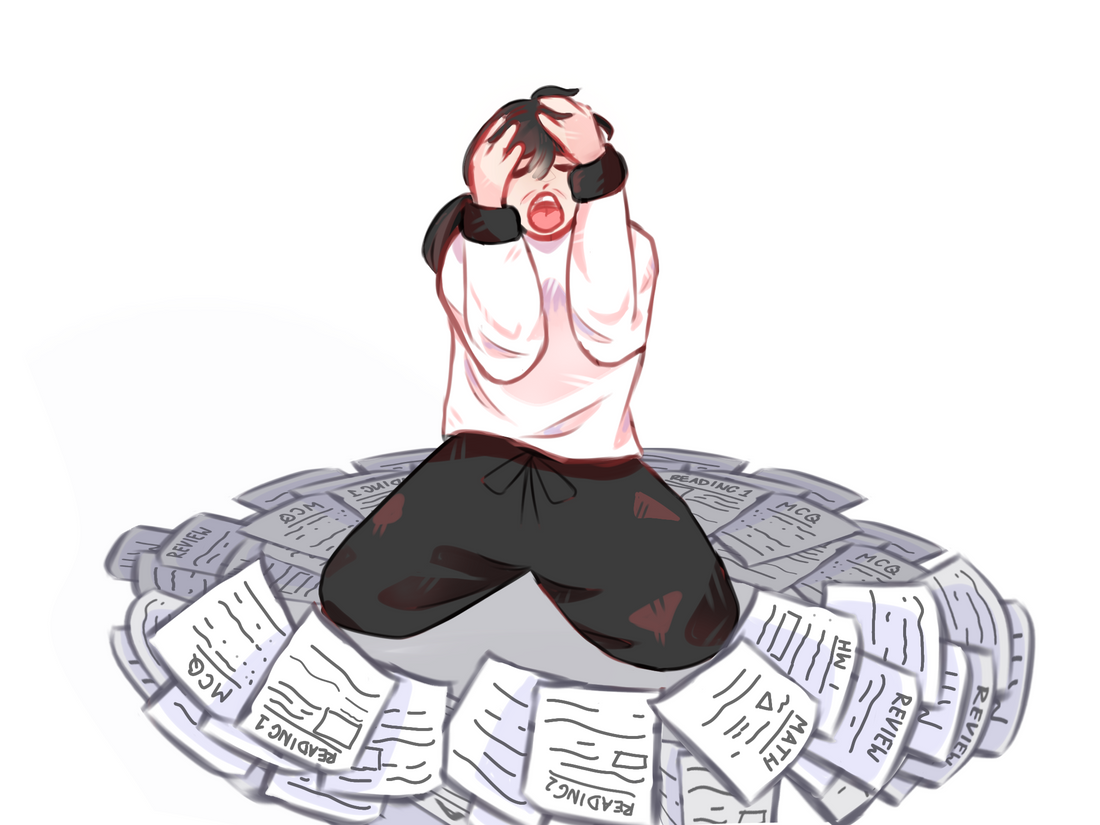
For years, my Saturdays were spent within walls that always felt too close together, where the dreary, beige ceiling was interrupted only by the occasional flickering of nauseating yellow lights. I stared at the endless worksheets covering my cramped desk, struggling to comprehend a single letter amidst the droning, irritated voice of my least favorite tutor. Around me, other students stared blankly into space or flipped pages with quiet determination, racing against the clock and erasing miscalculations before a teacher could catch them from behind.
I am one of thousands of kids who spent a large part of their childhood at tutoring institutions such as Kumon or the Russian School of Mathematics. To parents, the promise of these centers is compelling: a competitive edge in school through highly personalized, accelerated lessons. For that promise, families devote hefty financial investments of between $2000 and $4000 per child each year. On paper, the system itself seems solid—uniquely crafted curricula, prize rewards, small student-to-teacher ratios, and a community of peers. The repetition and standardized processes embedded within these programs claim to teach kids more content and quicken the pace of learning. However, as I look back on the countless hours spent drilling formulas into my head and solving equations until my brain went foggy, I question how much I really progressed in these centers—and how much of that knowledge I still carry with me today. At the center of this problem lies a significant flaw: the assumption that one size of learning can fit all.
Each of these institutions crafts a uniform curriculum for all students, typically organized into different mastery levels. A student’s experience begins with an evaluation to determine the individual’s skill level, allowing subsequent lessons to build on that foundation. This practice falls short because students are forced into a method of learning that lacks personalization, catering only to the organization’s teaching standards. This fails to account for important differences in how students learn, whether it be their pace, strengths, or repeated weaknesses.
For example, the Russian School of Mathematics teaches around seven students at once, with each lesson paced uniformly so that all content is covered and equal time is distributed per topic. This neglects individual learning paces and needs, making it harder for students to actually retain material when everyone is pushed through the same curriculum, pace, and practice problems. I was always scared to ask for help because I compared myself to the quickest student in our classroom, who later admitted to me that she took it upon herself at home to catch up, spending hours drilling numbers into her head just to perform well during class. My instructors answered questions, but they did so with the assumption that we already understood foundational concepts that I had never really mastered. Parts of the Russian School of Mathematics’s curriculum depended on students having already internalized essential skills to apply them to more advanced lessons. In a report by the Sydney Morning Herald, Chief Executive of the Australian Tutoring Association Mohan Dhall points out that, unlike public school teachers who receive professional training in evidence-supported instructional standards, private company tutors operate in a widely unregulated area with minimal accountability standards. As a result, students are left scrambling to catch up at home just to keep up with the pace of each lesson. The tutoring experience ends up feeling just as impersonal as public school—only more difficult and often pointless.
This impersonal nature of teaching is further problematic because it is heavily misaligned with public school education. While fifth graders learn to multiply fractions and calculate the area of a three-dimensional object in school, they may encounter an entirely different level of math at these tutoring institutions. After each student’s initial evaluation, the pace and course load follow a highly specialized curriculum and are separated from what students are learning in the classroom every day. Just last week, I spoke with another student who had been in my tutoring class a few years ago. We both realized that much of the material we learned back then is only becoming relevant to us now as juniors taking AP Precalculus. At the time, most of the material flew over our heads because it was completely irrelevant to the eighth-grade Regents exams and finals we were focused on.
Beyond the problematic curriculum gap, the environment of these tutoring centers can make the learning experience further unproductive and inefficient. Instructors either hurry from student to student or teach many at once, all within a few hours. The teaching feels impersonal, and the instruction is not meaningful. Additionally, many students arrive at these institutions carrying the weight of academic pressure from their families. Parents enroll their kids in these programs to give them an academic edge, but as students grapple with unrealistically high expectations, this process becomes an obligation rather than an enriching opportunity. When students become confused, they hesitate to admit it because they fear falling behind or disappointing someone. Moreover, these institutions measure growth in numbers by looking at performance percentages on homework, classwork, and assessments. Thus, students resort to shortcuts that keep those numbers up, even if their level of understanding does not match. Over time, as these gaps in understanding only widen, the hours spent in tutoring feel less like a learning opportunity and more like a weekly burden to tackle.
Nonetheless, it is essential to acknowledge that these programs’ fast-paced challenges can be effective for certain students. Learners who are comfortable with independent practice of material and foundational concepts may benefit from accelerated pacing and repetition. For these students, progress benchmarks measured by levels and percentages can create motivation and a tangible sense of accomplishment. These numbers can fuel the drive to refine concepts at home and excel upwards. However, this success is limited to a specific subset of students, which leads back to the fundamental problem: one size of learning does not fit all. These programs are built around a singular instructional model that assumes all students can learn productively under uniform pacing and repetition. When these programs prioritize efficiency and advancement over adaptability and conceptual depth, students whose learning styles diverge from that of the model garner minimal academic benefit.
When it comes to education, the effort cannot be half-made. Even if they are not public schools, these tutoring organizations significantly shape how students learn, and that responsibility must be taken more seriously. Reforming these programs does not require abandoning existing curricula, but they must be more balanced and personalized around each student’s individual needs. Enriching, meaningful learning should not be measured solely by how quickly a student progresses through levels but rather by whether they truly understand and can apply the concepts they are taught. This could include regular consultations with students, allowing instructors to better understand what students are currently struggling with in school instead of assuming everyone is learning the same material and introducing confusing, unrelated content. A wider and more flexible curriculum that takes public school learning lessons and material into consideration could also allow students to focus on topics that match what they are learning in class or what they will encounter in the next grade up. Tutors must be strategically divided to aid a consistent group of students. In this way, these tutoring centers would be able to continue teaching while thoroughly supporting students and their comprehensive learning.