The Atrophy of Activism: Capitalism Works—Their Activism Doesn’t
Sarah Paulson’s outfit in the 2026 Met Gala exposes how modern activism has decayed into nothing more than a symbolic performance.
Reading Time: 6 minutes
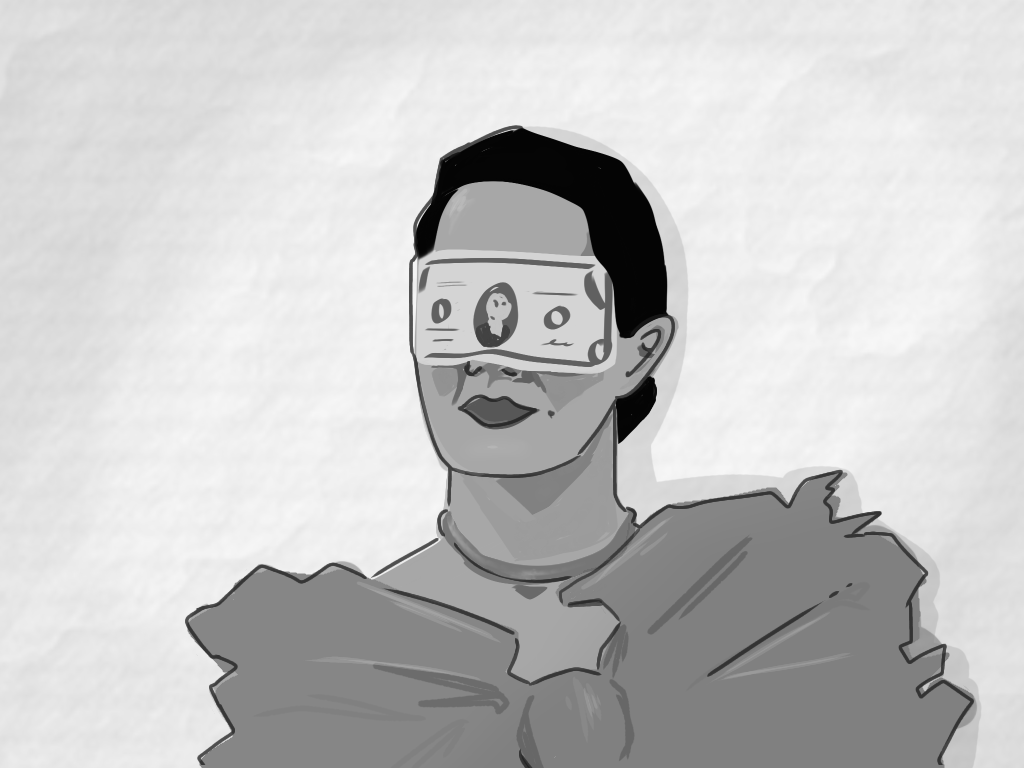
Most sensible people spend their Monday evenings engaged in modest habits that keep civilization from collapsing. I, however, made the questionable decision to watch the 2026 Met Gala. As the procession of celebrities drifted across the screen, each adorned in fabrics that seemed woven from pure, unadulterated vanity, I found myself, perhaps out of boredom or a misplaced sense of civic duty, attempting to critically analyze the event.
The spectacle was predictably overwrought, but one moment stood out for its unintended honesty. The turning point arrived with the entrance of Sarah Paulson, the acclaimed Emmy-winning American Horror Story actress who, in recent years, has taken to political commentary with the serene confidence of someone who has never been troubled by the burden of understanding. Her choice of attire—a custom piece by the avant-garde studio Matières Fécales—was cognitively dissonant. It featured a structured leather mask of a single U.S. dollar bill, which she clumsily used as a weapon to criticize the top one percent. The mask completely covered the upper half of her face, its crisp edges extending past her temples to form a stark barrier over her eyes.
From here was the most curious spectacle of the event. A wealth of resources, centralized at one of the most exclusive and tightly curated events on the planet, was weaponized against the very system that makes such events possible. It was a tableau of such exquisite, structural irony that one may feel almost grateful for it. The performance relies on the exact mechanisms it purports to condemn, which ironically proves that such a stance does not challenge the distribution of capital. What these performers fail to confront is that value itself cannot be legislated from existence; rather, it must be produced, exchanged, and earned.
This, I realized, was not true activism, nor a serious engagement with economic reality, but an optical illusion designed for a gullible audience. It was pure theater. And like all grand theater, it demands we suspend our disbelief. The problem, of course, is that disbelief is precisely what ought to be maintained when an individual decries the concentration of capital while simultaneously relying on the massive pooling of luxury capital to stage the message.
That is to say that Sarah Paulson fundamentally misunderstands capitalism at its core. She condemns the one percent as evil, never recognizing that her attack on wealth inequality inevitably becomes an attack on the free market itself—a system she miscasts as the engine of inequality rather than a complex structure of incentives. However, the problem extends deeper, and her performance is merely the most flamboyant example of a growing trend among the performative left.
The same pattern appears in the anti-consumerist rhetoric that relies on the efficacy of modern logistics to reach its audience or in the critiques of corporate greed that ignore how mass production is the exact mechanism that revolutionized advanced technology for the masses. The landscape of contemporary activism is littered with such contradictions because the activism itself has been redesigned to function as a luxury status symbol, manufactured by and for the very capitalist machinery it pretends to subvert. The proliferation of “eat the rich” social media performances makes this clear. These displays are engineered for circulation, not conviction, and operate within the same attention-driven ecosystem that governs every other form of online content. Anti-consumerist influencers and self-styled radicals are, quite simply, frauds pioneering the lucrative market of performative activism. They stage their revolutions against global capital while depending entirely on the miracle of advanced international logistics and mass production to broadcast their message. Having divorced advocacy from material alternatives, they have proven themselves to be actors engaged in a low-effort, high-status spectacle designed to signal virtue to a captive audience without ever altering the underlying economic reality. Where traditional activism requires genuine sacrifice—demanding time, effort, and often immense personal risk—this modern iteration asks for none of these things. Today’s crusader needs only the correct vocabulary and a showy display. A slogan on a tote bag, a carefully worded post on social media, or a fleeting gesture of outrage at a dinner party is now entirely sufficient to secure a seat at the table of the virtuous. It is activism without cost, which is to say, activism without value.
This is the moral theater staged by an upper class that has discovered a convenient truth: indignation is a far cheaper commodity than any workable alternative. Public declarations of solidarity are routinely from distance comfortably measurable in the dollar, outsourcing responsibility to the crowd when, in reality, no society has ever been lifted by anything other than direct, individual effort and cooperation.
The upper class treat the fruits of modern capitalism as if they occur naturally, entirely separate from the market incentives that actually produce them. Yet, these loud critics of capitalism refuse to explain how a non-market structure would generate the very goods and conveniences they take for granted. It cannot. They demand structural change while remaining utterly insulated from the economic realities affected by inequality and required to sustain reform.
This absolute isolation from reality is precisely where the fundamental laws of market economics assert themselves with brutal clarity. Markets succeed because they are the only mechanism able to align moral intentions with a material reality. In contrast, the performance of recent activism functions because it attaches value to appearance and rewards those who bear nothing. It is a system in which moral currency is printed freely and without any backing. For instance, when millions of people post a black square on social media without donating or volunteering, they receive instant social validation for the minimum effort possible. This superficial engagement allows such participants to feel righteous while leaving the underlying crisis completely untouched. Hence, their activism has atrophied and become soft, ornamental, unserious, and worthless.
The deeper irony is that the free market system, so routinely maligned by these performers, remains the only system in the modern world rooted in the morality of production. Markets function effectively because they rely on organic price signals to communicate worth. In a functional system, value requires a gold standard, including the tangible proof of labor, legitimate skin in the game, and a willingness to face the consequences of loss. True capitalism is an engine of a dynamic spontaneous order and ultimately lifts entire populations out of poverty by building industries, creating jobs, and funding the technological and scientific breakthroughs that define modern life. The competitive market is, in short, everything that performative activism is not, for the latter is tangible, the former an illusion.
The contradictions on display are the logical endpoints of an activist culture that is based on empty signifiers. Righteousness has ceased to become a force of change and has transformed into a luxury pastime for the comfortable. Yet, a society cannot substitute posturing for production indefinitely without paying a steep price. As Ayn Rand once said, “You can avoid reality, but you cannot avoid the consequences of avoiding reality.”
Ultimately, the result here is a completely distorted cultural marketplace—frankly, an inauthentic aesthetic. The deeper problem is that a society cannot indefinitely confuse symbolism with substance, as production precedes distribution, and reality precedes rhetoric. Hence, a culture that rewards moral grandstanding over material contribution will eventually find itself governed by people who can do neither. The vacancy left behind this self-righteousness is structural. And the longer we allow the performance to masquerade, the more inevitable the reckoning becomes.
Alas, none of this is an indictment of activism itself. Genuine activism is the slow, disciplined work of improving the world through real costs and accountability; it’s a practical, ever-evolving effort, grounded in the simple truth that society only changes through what actually works. Examples include charity efforts that increase access to local resources, volunteer networks for mutual-aid programs, and long-term policy work—all of which demand real commitment rather than curated outrage. True activism is good because it stays connected to reality and forces people to take responsibility for the consequences of what they demand. My criticism is only reserved for those who imitate such a posture of activism while refusing its price, for a society cannot afford to confuse the performative gestures with the real work required to move things forward.