
Substituting: Substantive or Sub-optimal?
When students discover their teacher is absent for the day, high expectations and excitement often follow, but the reality of effectiveness in substitute teaching unravels a far more complex story.
Reading Time: 7 minutes
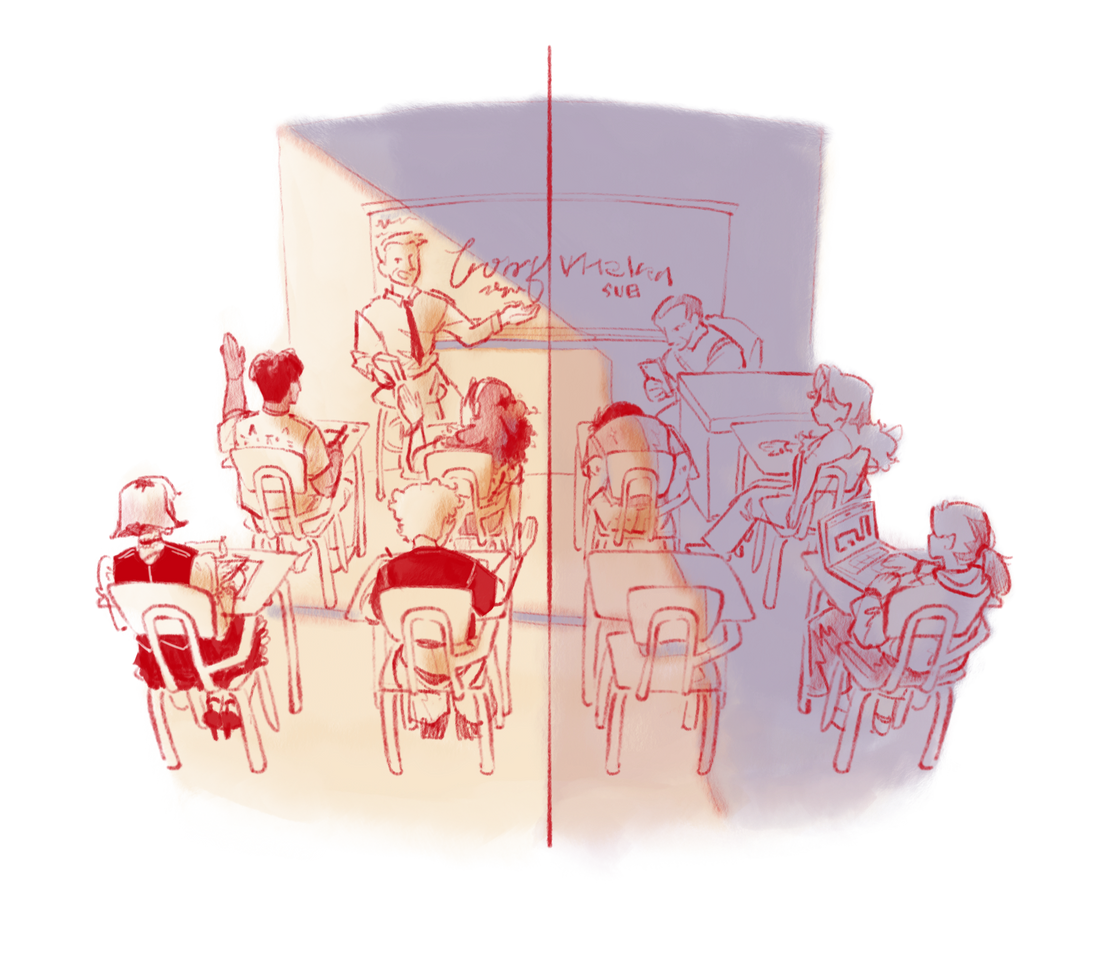
There is a familiar, internal “yes” every student has whispered subtly to themselves out of relief when they walk into class and see the unfamiliar face of a substitute teacher. The previously anticipated reality of worksheets, weary slideshow presentations, and teachers’ instructions is replaced with visiting unblocked games on Chromebooks and a room full of chatter. In a school environment built on structured curricula and continuity, even a single day without a regular teacher can shift the dynamics of a classroom—though it calls into question the effectiveness of classes covered by substitute teachers.
Substitute teachers are often used to provide physical supervision, though long-term substitute roles can involve full instructional responsibilities. “I am currently covering Ms. Dwyer’s English classes through the end of June, [as] a long-term substitute assignment. I am taking students on a field trip to see The Great Gatsby tomorrow, and am in the middle of grading papers and making lesson plans,” substitute teacher Kathleen Goldpaugh shared. In some situations, substitute teachers take on full teacher responsibilities, including grading assignments, planning lessons, and continuing the curriculum. However, Goldpaugh’s experience represents a long-term substitute assignment, which is not typical for most day-to-day substitute teaching roles, highlighting the issue of how the substitute system cannot fully replicate teacher instruction.
Many students feel more free and relaxed when their regular teacher is not present in the classroom. “Having a substitute teacher is great; it’s productive since students need a break from the stress, however, only in moderation. Especially when it’s unexpected, the day feels much more enjoyable because there is less pressure,” freshman Musfirat Shabah explained in an email interview. Many students view substitute teachers positively because substitute-led classrooms often create a calmer environment, as they are not always expected to perform at the same structure and academic expectations as regular teachers.
However, research suggests that substitute teachers can cause academic consequences. According to a 2024 study published in European Societies Journal, a school fixed effects model showed that an increase in teacher absenteeism of five percent cut students’ examination grades by 2.3 percent of a standard deviation, while increasing the dropout likelihood by 0.6 percent. In other words, the increase in teacher absenteeism is associated with diminished academic performance in students.
Students expressed that they anticipated the research findings, and were not surprised by the data. “It does not surprise me a lot that there is a correlation between teacher absence and students’ grades,” senior Jerry Qiu said in an email interview. Days when substitute teachers are present can have destructive effects on students’ education and their preparation for exams. “Some teachers teach rigorous curriculums that have little wiggle room, and missing one day can be detrimental to understanding the unit. As a result, it’s very easy to fall behind in the class. Some teachers expect you to self-study the content missed as a result of the teacher’s absence, but let’s be honest, not a lot of people will be going home and learning the missed content on their own,” Qiu added. These absences usually mean that students and teachers must adjust to catch up in the Advanced Placement curriculum, especially considering that states like New York begin school in September, while many others begin in August and therefore have more time before exams in May. This expands on the limited time teachers have, so absences can hinder students’ progress and ultimately lead to bigger gaps in student learning. Students may fall behind when lessons are missed, as many do not independently review material covered in a teacher’s absence.
Freshman Cian Gunturk addressed the study similarly: “I’m not surprised that examination grades would drop, especially as days with substitute teachers tend to be less productive and more awkward.” These responses further nurture the concern for how learning will continue when teachers are absent, and reinforce the limitation of having a system that values having someone physically present instead of educators who can continue with the learning content.
In subjects that rely on structured lab work and tight timing, even short absences can slow student progress and make covering lessons much more difficult. “Absences can be so disastrous and lose me so much time because of lab schedules and testing schedules that I frequently work through serious illnesses rather than take enough time to get better,” biology teacher Dr. Maria Nedwidek-Moore wrote in an email interview. Her experiences highlight that teacher absences are more disruptive than they may appear, and that teachers sometimes make sacrifices to ensure that they miss as few days as possible.
While the regular teacher may assign work that students are expected to complete, days with substitute teachers still trigger inconsistency in the teaching pace, as substitutes are often unfamiliar with teaching methods, the curriculum, and the progress of the students. Many students often put aside worksheets to complete at home when there is a substitute, instead of working on it throughout the period because the main teacher’s absence reduces their motivation. Additionally, teachers may occasionally experience unplanned absences, so they are unable to create worksheets for students or notify substitutes with crucial directions. “I don’t think substitute teachers have training that the regular teacher would have, in the sense that they likely wouldn’t be able to answer a question referring to the learning material or something specifically related to the assignment. But they could answer a few simple questions if you wanted advice on something like grammar, classroom logistics, or what we need to do,” Gunturk said. This raises questions on how effective the system of substitute teachers is, especially when students question substitutes’ abilities to deliver meaningful instruction.
Students have also raised concerns about the role substitute teachers play in the classroom, emphasizing worry about whether they can uphold the same level of authority as regular teachers. Shabah argues that well-prepared lesson plans can support substitute teachers in ensuring a productive learning environment even when a regular teacher is absent: “The ability of the substitute doesn’t matter; it’s the ability of the teacher that counts, so I don’t believe in ‘blaming’ substitutes for ineffective learning days. If you teach students well, provide assignments with good content, and make them respect you, then your class will have [few] issues with behavior. This helps balance the need for a break and to stay on track in learning material.” Shabah’s perspective suggests that substitute teachers are not intended to replace a teacher’s curriculum, but rather to be responsible for supervising students in the classroom. These patterns reveal that the current substitute system has a clear structural limitation: it isn’t designed to fully maintain the same level of continuity and instruction as a class led by a regular teacher.
Additionally, substitutes are unfamiliar with Stuyvesant’s routines, leaving the responsibility of explaining normal procedures to students “Also, it feels like a lot of the substitutes don’t even know basic information about the school, like what the warning bell sounds like, or how a typical class at Stuyvesant is structured; a lot of the time it is up to students to inform the substitute of important information,” Qiu added.
The “substitute teacher effect” is a phenomenon where students misbehave more frequently when a substitute teacher leads the class, producing challenges for new instructors in managing the classroom. Gunturk acknowledged that this pattern is true to an extent, although it does not seem to be universal. “In my middle school, it seemed that the class was rowdier around substitute teachers. Substitutes often seemed to lack control over the class. In contrast, Stuyvesant students seem to be much more diligent and stay within the rules when the teacher isn’t present, so this [substitute teacher effect] doesn’t seem to apply in every scenario, and it heavily depends on the context,” he noted.
Other students reported a different experience when observing students’ behavior under a substitute teacher. “We generally do not demonstrate essential skills such as time management or self-discipline. I feel like getting to use our phones is a sort of reward, and as a result, we prefer to use our phones at any given opportunity over doing something more productive,” Qiu shared. Students may see having a substitute teacher as a lower risk of consequences for misdemeanors, such as not following the school’s phone ban, which can lead to students deviating from established classroom expectations.
The current system does not always provide effective structures that ensure students remain accountable when regular teachers are absent. Dr. Nedwidek-Moore added, “My biggest worry is students being late or cutting class when I am out, particularly if there is an important deadline I want to hold them to.” This concern shows that the impact of teacher absences goes further than classroom management, as it becomes harder to hold students liable when teachers are not present. As a result, this reflects a broader issue within the system, where teacher absences are managed through temporary classroom supervision instead of continual,meaningful support.
Nevertheless, substitute teachers remain crucial in keeping classes in session as they provide a way for schools to adapt to situations where teachers need to take a certain amount of time off for a variety of reasons. Schools rely on substitute teachers to cover teacher absences because there is a limited number of practical alternatives to manage the classroom during those periods, despite their drawbacks.
The contrast between the expectation of a leisurely day when a substitute teacher is present and the reality of its detrimental effects on students and their disrupted learning reveals the flawed substitution system in the education department. This disruption points to an underlying issue within the education system: a reliance on temporary staffing that prioritizes physical classroom coverage, rather than uninterrupted learning experiences. Instead of focusing on getting a substitute teacher to be physically present, overcoming this challenge requires improving lesson designs from regular teachers, having contingency plans, supporting qualified substitute teachers, and fostering a culture of student responsibility. “As I have mentioned, the responsibility does not lie within substitute teachers. Rather, days with substitute teaching reflect how well a class is designed to run independently, instead of the individual abilities of the substitute,” Shabah explained. Overall, disruptions from teacher absenteeism in learning continuity reveal an education system that has yet to empower every single learning moment, regardless of who is leading the classroom.