
Stuyvesant’s Sophomore Bar Closes
Before AP exams were administered, the Sophomore Bar was announced closed for students.
Reading Time: 4 minutes
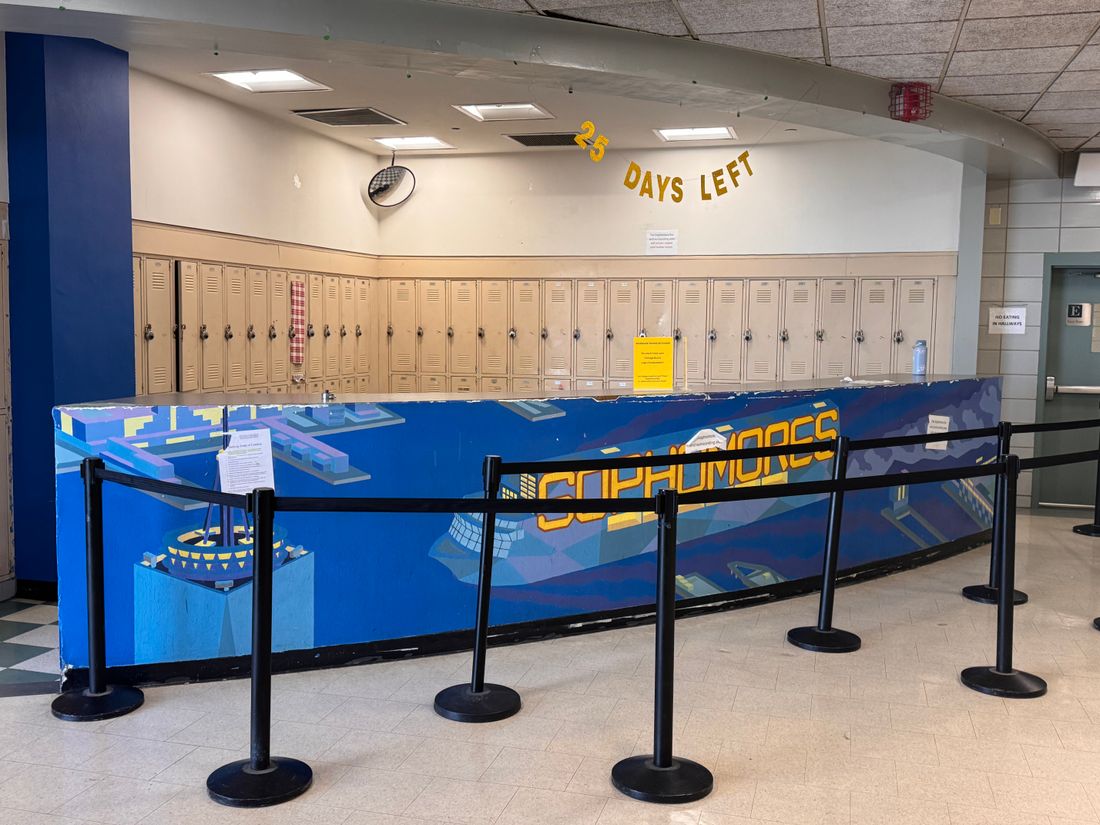
The Stuyvesant administration decided to close the Sophomore Bar around April 13. Located on the sixth floor near the English Department office, the area was previously a designated space for sophomores to spend their free periods, similar to the Senior Bar or the Junior Atrium.
The decision to close the Sophomore Bar followed persistent issues with cleanliness and behavior. “When I would walk by or try to work in the area, I’d hear and see things that were not school appropriate,” English teacher Minkyu Kim said in an email interview. “And I often saw food containers, spills, and empty cans strewn around.” This clutter created a daily burden for custodians who struggled to clean the area.
Staff members also noted that students used the Sophomore Bar to avoid attending their classes. “I think that some students have gotten the impression that it’s a kind of lawless zone, and somewhere where they can hide behind the Bar, away from any kind of scrutiny or supervision,” Assistant Principal of the English Department Eric Grossman said.
Some students believed that the Bar did not hold a distraction to the faculty. “The Bar was always well maintained and peaceful with minimal issues that could quickly be resolved with the members of the English department checking up a few times every period and to also remind us to not be too loud,” sophomore Elizabeth Ock said in an email interview.
Other students acknowledged that the atmosphere of the Sophomore Bar often became problematic before its official closing. “It was really calm sometimes, but the more people there were, it could get really rowdy,” sophomore Reagan Joshi said in an email interview. “There was always something that happened every few months that got us banned from going, like someone breaking a locker, and sometimes they added a teacher to watch us and make sure it stayed clear.”
Nevertheless, disorderly behavior has also impacted Sophomore Caucus and its operations to support the student body. “While putting up the decorations [for a caucus event], we witnessed kids jumping up and down at the Bar and taking things down. Imagine that one incident and how we felt really disappointed,” Sophomore Caucus Co-President Elly Wu Feng said. “So just imagine what the AP and other teachers have to go through every day, seeing the kids and what they do at the Bar.”
This misconduct led to friction with the faculty in the English Department. “The increasing feeling that we’ve had to police that area and constantly be telling you kids to quiet down or stop doing dumb and disruptive things, or go back to the class that they’re supposed to be in has been an increasing distraction,” Grossman said. He further elaborated that other English teachers had devoted free periods to supervise the Bar.
The administration ultimately decided to close the space days before AP exams began in the sixth-floor gym and throughout the testing period to avoid the confusion of constantly opening and closing the area. “The department and I agreed that it would make more sense just to kind of let it go through the exams,” Grossman said.
Since the closure, teachers have observed a more peaceful environment on the sixth floor. “The Bar is shut down at the moment for AP exams. I overheard a group of students walking through the area shush each other out of respect for test takers,” Kim said. “If nothing else, it’s cleaner now, which is respectful to our maintenance staff.”
Sophomores explained how they interacted with one another during free periods despite the closing of the Bar. “My friends and I now spend our frees and lunch on the [seventh] floor or outside which is definitely inconvenient,” Ock said. “Without a dedicated space, other sophomores are similarly taking space in other areas which can be disruptive to other classes.”
Due to the closure of the Bar as a response to behavioral issues, some students feel it has had detrimental effects on their gatherings. “I felt the impact of this because this really was the main hangout spot for me. My friends and I had just moved to the cafeteria. It will take a day or two to coordinate with your friends where to move next,” Sophomore Caucus Co-President Tenzin Chosang said.
On the other hand, other students felt that the Bar did not affect much of their interactions among friends. “[My friends and I] mostly go to the cafeteria during my lab frees, and I feel like during passing periods, the normal faces I’d see hanging by there are still near the gym or hallway on that floor, as close as possible,” Joshi said.
Some feel that change is needed when a punishment is given for an entire grade. “We do feel more communication is needed for matters like these because I’ve heard from some of my friends that they think this is really unfair, especially because they don’t really know why this happened.” Chosang said.
Methods of clear communication between faculty and students were brought up. “We might issue a statement to our grade explaining why it’s closed and be transparent,” Feng said.
The Stuyvesant administration will meet on May 20 to determine the Bar’s future after AP exams, according to Grossman. Currently, the department has proposed one solution of changing the Bar’s function. “One idea that we were discussing is using the area as a space for English teachers to conference with students,” Grossman said. “I think more conferences would happen if there was a designated spot for that.” He explained clearly that this proposition is not intended to take students’ space, but rather it serves as a way to help students in their English work.
Nevertheless, the issue of the Sophomore Bar is still under discussion and further notice will be updated. “Mr. Grossman and teachers, they’re really supportive of us students and they do want the best for us, so them shutting down the Bar isn’t a move discouraging us from socializing at school,” Feng said.
The school faculty also expressed a similar view on the matter. “Our goal isn’t to shut students down,” Grossman said. “The goal is to support students.”