
Sharing Stories: Farewell to Ms. Fletcher
Ms. Fletcher reflects on her time at Stuy, what makes it so special, and what she plans to do in retirement.
Reading Time: 6 minutes
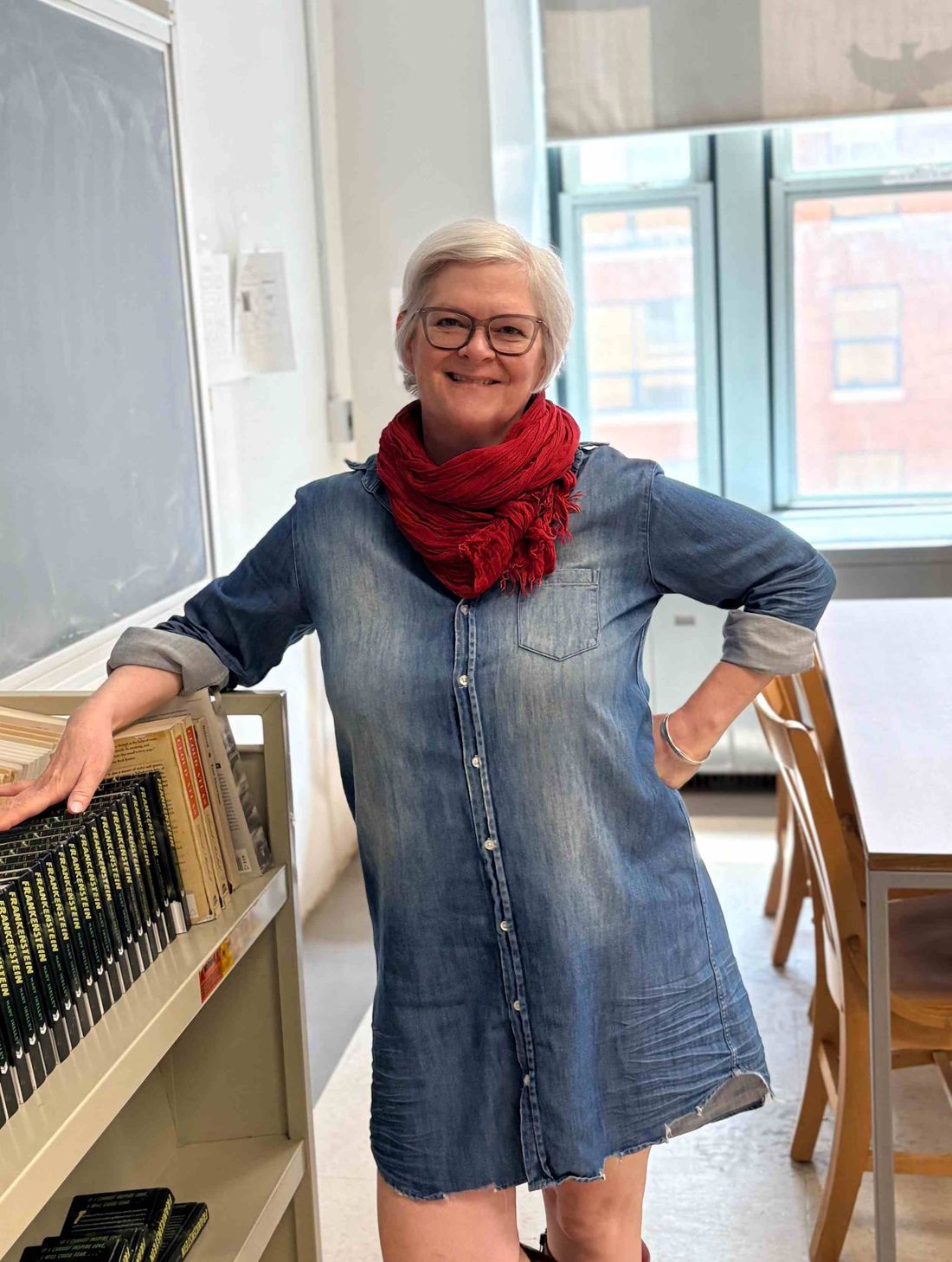
Name: Katherine Fletcher
Subjects: Freshman Composition and Great Books
How long have you been teaching at Stuyvesant?
I started teaching [at Stuyvesant] 30 years ago. However, it has not been a continuous run because I took a semester off after my first child was born, and then I took four years off after my second child was born. So, while I started teaching here 30 years ago, I have not been teaching for 30 years.
What classes have you taught and currently teach?
I have taught a lot of classes! The American Short Story, Fiction Writing, Writer’s Workshop, Freshman Composition, Foundations of Literature, Great Books, and American Literature to juniors. Now, I teach Great Books and Freshman Composition.
What has been your favorite class to ever teach?
I would say the favorite classes I’ve ever taught are Fiction Writing and Great Books. I taught fiction writing for a number of years but I stopped well over a decade ago. It was just so much fun. As far as Great Books, it has been a really rewarding class to teach for the last decade.
Do you have a specific moment or time in your life when you fell in love with reading and writing, or one or the other?
I grew up in a very bookish family. My father was an English professor and my mother was a children’s librarian, so my sisters and I just read books all the time. My favorite thing to do in childhood was to go to the library and come home with a huge stack of books. There was no internet obviously, and we weren’t allowed to watch TV. So, on Saturday mornings, I would get up and just stay in bed all morning eating chocolate chip cookies and reading books. As far as writing, I would not say that there is any point where I fell in love with writing. I don’t really consider myself a writer, that’s never been one of my ambitions. What I’ve always loved is books, talking about books, and talking about books with teenagers.
Is there anything in your childhood that was particularly formative in your life?
My grandmother’s farmhouse in Maine. Starting from when I was a toddler, my family would spend the summer in Maine and it was just paradise to me. I grew up in Atlanta, Georgia, and then moved to Boston when I was a sophomore in high school. I always felt a bit out of place in the South because my parents were both Northerners, and then moving in high school was really hard. Maine was always a comforting constant in my life.
When did you know that you wanted to be a teacher?
I started thinking about teaching high school, probably in college. There wasn’t this pressure to know what your career is going to be and to land on your feet the moment you graduated like [there] is now and [which] I see with my daughter. So, immediately after college, I got a job working at a grocery store, which was fine, then I dabbled in publishing, which wasn’t for me. Then, my best friend from high school and I moved to New York on a whim, and I got a job working at the Brooklyn Historical Society. My career was kind of random for a few years. But at that time, I started to develop an awareness that I wanted to be a high school English teacher. So, I went to graduate school at Teachers College [at Columbia University] and my student teaching placement was at Stuy. I remember feeling so relieved and so lucky because I knew that it was exactly what I wanted to do. I was good at it, I loved it, and it just felt like the right thing for me to be doing. I used to be on the subway in the morning going to Stuy and I would actively look around me and feel sorry for the other people on the train because they were not going to the job that I was going to. And it has sort of always felt that way here. It’s been a really wonderful place to give my professional life to.
What do you think contributes to you feeling that way here?
Stuyvesant’s energy can be attributed to what happens when a lot of really smart people are in the same space together. I learned pretty early that there were Stuyvesant students who were smarter than I was and would ever be. And I always loved that. It felt like a privilege to know that I could learn from them. I always felt from the very beginning that I was among peers. Not that I was the teacher and they were the students and I was gonna impart knowledge to them, but that there was this really exciting feeling of learning from each other and I have always felt that way. That’s what makes it so special.
Do you have a specific moment at Stuyvesant you’ll always remember?
Literally hundreds. Being here on 9/11 was very intense. Obviously, the pandemic was a really life changing upheaval. But it’s the very small things that I will always remember. It’s hard to even isolate a story because there are just so many stories. That’s something else that made it possible to be here for so long. It’s never boring.
What do you think is the biggest thing that’s changed at Stuyvesant since you started here?
The phones. They are really bad. Phones are an impediment to a lot of good things about learning. It makes me happy that I was able to witness what it was like here post-phone ban. Phones didn’t creep into the fabric of daily life here until after the pandemic. After the pandemic, everyone had so many other things to worry about that policing phone use was not on anyone’s radar. But then, you just see everyone walking down the hallway staring at their phones like zombies, which was really not good. I’m pleasantly surprised at how well the phone ban has worked. That makes me happy.
What advice would you give to the next English teacher just starting out?
Before you know anything about the craft of teaching, what you have to do is work as hard as you can, and genuinely care about your students as individuals. If your students see that, then you will be fine, the teaching skills will follow. I’ve always found that Stuyvesant students are incredibly generous and forgiving of teachers if the students feel respected. Early in my career here, I was tasked with teaching Latin. The principal at the time caught wind of the fact that I had taken Latin in college, but what she ignored was that I barely passed. But I was told that if I wanted to keep my job, I had to teach Latin. So the approach that I took to this was, I said to my class: “I don’t know Latin, you don’t know Latin, and we are going to learn Latin together.” So we did! It was great and that was a really wonderful lesson for me. It’s not a good idea for a teacher to pretend that they know more than they do. So my advice to teachers is work really hard and really care about your students.
What is the biggest lesson you’ve learned working here?
I can’t identify the biggest lesson. But one lesson that I have also learned is that working alongside kind, interesting, funny, and smart people will add years to your professional career in the best possible way. I wouldn’t have been able to stay here as long as I have without the other English teachers.
Favorite book?
To the Lighthouse by Virginia Woolf.
Favorite book to teach?
Pale Fire by Vladimir Nabokov. And I have Mr. Grossman to thank for that entirely! I would never have read that book if it hadn’t been part of the curriculum of the class when I started co-teaching with him. It took several years for that book to take up residence in my heart. But it really has, and it is a really fun teach.
Favorite movie?
This is very embarrassing, but my favorite movie is Titanic. It’s not a great movie, but it is my favorite movie.
Superpower you would want to have?
Flight. Or teleportation.
What are you looking forward to as you look into the next phase of your life?
I am looking forward to long walks, long books, visiting my two children who live in California and Atlanta respectively, spending time in Maine with my husband, not getting up at 6:30 in the morning, [and] cooking. The first question that people have for me when they learn that I’m retiring is: “What are you going to do?” There’s so much to do! And I’m not all concerned about how I will spend my time.