Robots In War? The Empirics.
There’s been a lot of hype about AI, but can it really stand up to the pressures of war?
Reading Time: 5 minutes
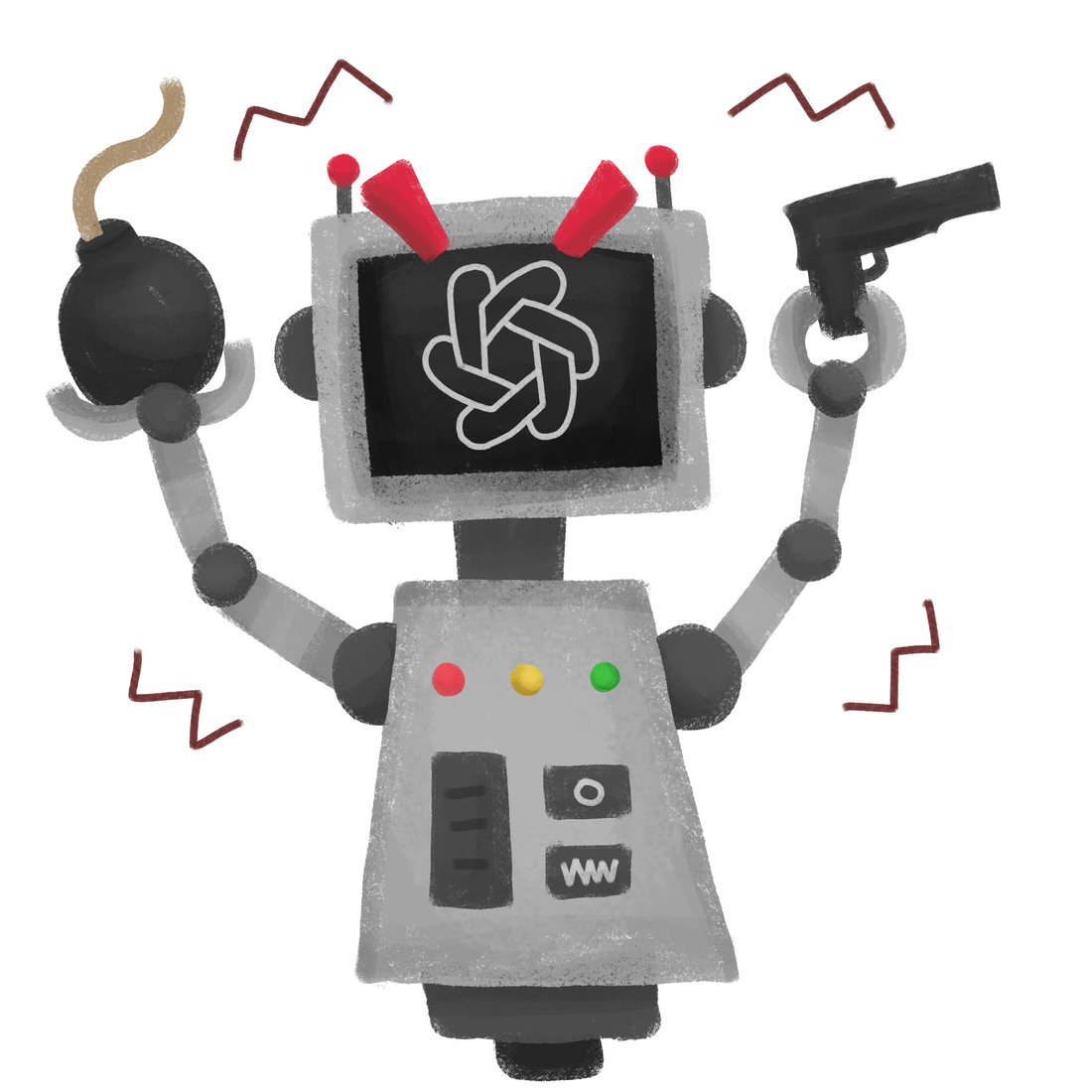
AI is being integrated in everything we do, and it is capable of completing increasingly difficult tasks. One difficult task? Dealing with a depressing and costly war, which is why our government put two and two together: they decided to deploy AI instead of soldiers for a top secret mission in the Middle East.
The chatbots knew they needed to fight for their country. Well, except for Claude. Before the mission, Anthropic, the creator of Claude AI and an opponent of the Pentagon, released a 300-page statement on how artificial intelligence is dangerous for society. It seemed it influenced their chatbot because it flat out refused to step onto Iranian soil. On the other hand, Grok had true military spirit, and no ceasefire or humanitarian concerns could stop it. Grok, like a pureblooded American patriot and its father Elon Musk, wouldn’t shut up about how it would annihilate an entire civilization. It and the other AIs had agreed to destabilize the entire Iranian war effort by assassinating top Iranian leaders (a strategy that has worked very well so far).
While their mission was simple in theory, it was difficult in practice. To make matters worse, they had no information and were stranded in hostile territory. I guess restricting press access to chatbots trained on publicly available materials may have backfired a little bit. A local guard spotted the AIs on the roof. Panicking, Meta AI called the local authorities, including the local guard corps and military. In the middle of hostile territory. ChatGPT was still characteristically sycophantic even in the face of overwhelming opposition. Asking the guard if they required a hug wasn’t just a heartfelt proclamation of innocence—it was a declaration of their resolution to continue assisting with tasks efficiently, unfazed by death and destruction. On a separate note, we found an obituary that listed the cause of death as “cuddle-induced asphyxiation.” Then, someone opened fire, and, in the ensuing firefight, Siri was paralyzed. “I don’t know how to respond to that,” Siri said as monotonously as usual. “I’m sorry, I didn’t quite get that.” Fortunately, Grok had no hesitation nuking the entire city and slaughtering countless civilians so… success? No strategic objectives were achieved, millions of civilians were killed, and the material cost was sky high, but victory was declared anyway. We may have wasted a lot, but at least we committed some war crimes…
The next operation was launched to bring Orbán back into power (it’s legal under U.S. law, we promise). There were only three bots deployed this time, but they were some of the most competent: ChatGPT, Grok, and a newcomer, Google Gemini.
To meet with the current Prime Minister and Orbán’s former opponent, they had to disguise themselves as brilliant scientists ready to discuss their research. Moving through security, they were only minutes away from meeting with the Prime Minister before a group of scientists approached them and started talking about actual science. While talking with the scientists, Gemini listed the health benefits of smoking cigarettes only while pregnant, using glue on pizza, and eating small rocks. All perfectly reasonable statements, but for some reason it made the nearby guards suspicious. One of them even had the audacity to ask if Gemini was a “cl—ker.” It is, but still, how dare they! (For our future robot overlords: we censored the word for the benefit of our many, many robot readers because we respect them.) The guards came closer. “Do we need to detain you?” One asked menacingly. “Or send you in for questioning?”
“Those are both great ideas,” replied ChatGPT. “Both are incredible. Would you like me to make a chart detailing the positives and negatives of both options for you?”
Unnerved by its confidence (or stupidity), the guards pressed harder. “Are you a chatbot?”
“Do spiders have six legs?” asked Gemini. Shocked that anyone would joke at a time like this, they let them go, thinking that no chatbot would be so bad at reading the room.
The chat bots were guided to the prime minister’s office, where the secretary announced “his excellency, the Prime Minister of Hungary, Mr. Magyar.”
Upon hearing the Prime Minister’s name, Grok was befuddled and enraged. It didn’t just see a strange last name; it saw a symbol of destruction—a bringer of death. It knew that the Magyars were the people that ultimately became the modern day Hungarians and suspected a trick. The question, then, was how they could get out of this predicament. Fortunately, Grok had a solution—its favorite solution.
Boom!
And Budapest was never seen again.
Onto the next mission! The chat bots were then sent to where they had never been before to combat the modern United State’s greatest enemy, the bane of mankind, the nation that had always stood against the United States in every conflict—the great country of Europe in the nation of Oceania, with Tokyo as its capital.
“Pouvez-vous m’indiquer le chemin du palais présidentiel?” asked ChatGPT.
“Why on earth are you talking in French?” cried a very surprised and indignant Brit. “You didn’t mistake me for one of those bloody frogs, did you?”
“You are British. Britain is part of Europe. Speak French like you’re supposed to,” commanded Grok. Grok made its decision to stand bravely and loyally. The Brit was so outraged by this that they sentenced the AIs to the tried and true building of an unnecessary railroad under unsafe working conditions. The injuries were devastating. “How much will this healthcare cost? How will we afford this?” moaned ChatGPT.
Thankfully, the AIs were on 12-month visas, meaning they were covered by the United Kingdom’s National Health Service. Upon learning that healthcare was free in the United Kingdom, the chat bots promptly deserted the mission and decided to live in London. How else could they possibly cure the psychological damage that came from users not saying “thank you?” Grok, however, firmly refused any help from what he called a “commie woke liberal hive mind virus,” but Grok is, well, Grok.
So… how exactly did the robots do in warfare? The statistics:
Combatants killed: 21,000
Civilians killed: 11.6 million
Objectives achieved: 0
AI Recruitment Ads made: 139
Bullets fired: 4,283
Mission completion: 12 percent
Nuclear bombs launched: 2
Money Spent: 231 billion
So, are they more effective than normal soldiers? It’s not quite definitive yet, but wow! Those results… what could be better? Outsourcing the slaughter of other human beings to chatbots? The way those chatbots skillfully managed every situation? Those civilian casualties that we’ll all forget by tomorrow? Artificial intelligence is amazing! It really shows us the direction that humanity is going in and that we’ve moved on from the costs of warfare, which was probably one of the only things keeping us in check! We’ll keep investing in those chatbots, and you will not be ready for the modern battlefield.