
Project Hail Mary (2026) Reaches for the Stars
Project Hail Mary serves its purpose well as a hard Sci-Fi adaptation, even as some emotional depth is sacrificed for efficiency.
Reading Time: 4 minutes
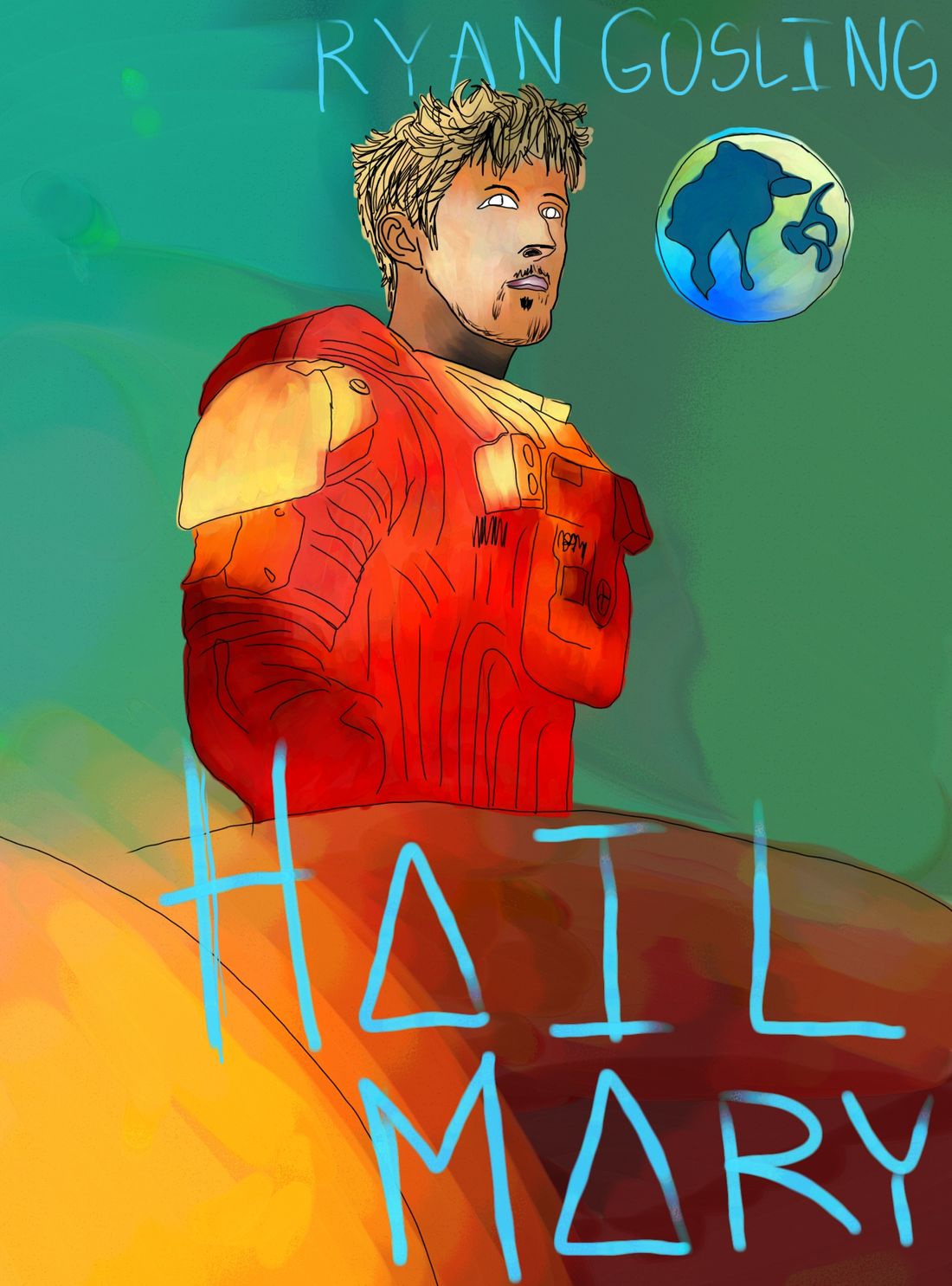
Humanity’s survival often hinges on the most unlikely of partnerships: an amnesic middle school teacher and a five-legged alien made of stone. Project Hail Mary (2026), adapted from Andy Weir’s novel, is the latest hard sci-fi adaptation to hit the big screen. Directed by Phil Lord and Christopher Miller, the movie follows Ryland Grace (Ryan Gosling), a middle school science teacher turned reluctant astronaut who wakes up alone aboard a spacecraft with no memory of his identity or mission. As fragments of his past return, the film reveals Earth’s crisis: a microorganism, called Astrophage, is draining the Sun’s energy, threatening global extinction. Through a series of flashbacks, the film chronicles how Grace was recruited by international administrator Eva Stratt (Sandra Hüller) to join a last-ditch interstellar mission in hopes of finding the reason why the star Tau Ceti, 11.9 light-years away, seems to be the only star unaffected by Astrophage. There, he finds an alien somewhat akin to a rock, dubbed Rocky (James Ortiz), whose home star is also in trouble, and the film follows them as they’re forced to work together to save their respective planets. Project Hail Mary sets up a thrilling sci-fi adventure, yet it seems to fall flat within the first few frames.
The film’s handling of its early narrative is extremely uneven. Grace’s amnesia, which should function as a central mystery within the first part of the film, is resolved entirely too efficiently and quickly. His initial disorientation with wandering through the ship, interacting with unfamiliar systems, unfolds with a sense of narrative obligation rather than tension. In Weir’s book, we get pages full of Grace’s experiments and research to figure out where and who he is; the adaptation makes sure that the audience is quickly brought up to speed, but at the cost of atmosphere. A much harder emotional punch could have been delivered, even within the very first few minutes of the film, by displaying the utter despair one would experience in that situation, with just a few extra minutes of runtime.
The film moves briskly through these revelations, interweaving past and present until the narrative converges on its most compelling development: Grace is not alone.
The introduction of Rocky, who is an Eridian engineer from another star system facing the same existential threat, entirely shifts the film’s trajectory. What begins as a survival story brings to light the true meaning of “hard Sci-Fi”, a genre categorized by its concern for scientific accuracy, as they communicate through patterns of sound and repetition, separated by incompatible environments and layers of glass. The processes of collecting and experimenting with Astrophage, as well as Rocky’s anatomical makeup and details of his home environment, are so well-depicted that the “facts” presented seem grounded in reality. The film slows down here in a way it rarely does elsewhere, with Grace painstakingly decoding Rocky’s tonal language, and Rocky responding with precise answers, allowing their relationship to develop with a sense of curiosity and mutual dependence. Rocky is not reduced to just a gimmick; instead, he becomes the emotional and intellectual equal of Grace. Their partnership anchors the film’s second half as they begin the investigation of the Astrophage, with some incredibly witty and natural-sounding dialogue keeping the audience engaged throughout otherwise complicated scientific scenes, as their knowledge of the true nature of the Astrophage grows. Gosling and Ortiz pull off hugely emotional, tear-jerking sequences when together on screen, making the audience laugh and tear up with them seamlessly.
This shift in focus is mirrored visually by cinematographer Greig Fraser, who constructs a visual language rooted in contrast. Exterior shots emphasize isolation: Grace’s ship, the Hail Mary, drifts as a small, fragile object against an overwhelming void, often framed in wide, static compositions that linger just long enough to emphasize scale. In one striking sequence, Grace observes Rocky’s ship for the first time, the two vessels suspended in silence, separated by darkness. Even the use of lighting becomes a narrative tool. The Hail Mary’s interiors are initially rendered in cold, clinical tones: whites, blues, and muted grays that flatten the space and emphasize its artificiality. As Grace’s memories return, warmer hues begin to emerge in both flashbacks and present-day: golden sunlight in classrooms, softer shadows in laboratories. The ship begins to be wrapped in seemingly warmer light.
Camera movement similarly follows the narrative progression. Early scenes favor slow, drifting motions that echo Grace’s uncertainty, with the camera gliding through corridors as if untethered. Once the narrative stabilizes, particularly during sequences with Rocky, the framing becomes more deliberate. The film adopts steadier compositions, emphasizing process and collaboration, as the two work in parallel across separate environments, with the camera cutting rhythmically between them, creating a visual dialogue that mirrors their growing understanding of each other and the existential threat their respective worlds are facing. In one extended sequence, when Grace and Rocky attempt to gather bacteria from a neighboring planet, the camerawork accelerates to levels one would normally see in something akin to a Marvel fight scene, truly showing the direness of their situation.
The film's dedication to convincing the audience that they are faced with a true story is further supported by the production design. The Hail Mary is not sleek or overly futuristic, as one would expect to see in a sci-fi; it is functional and utilitarian. Tools, screens, and materials feel used rather than decorative. This grounded aesthetic becomes especially important in scenes involving experimentation, where the physicality of Grace’s actions—measuring, adjusting, and assembling—anchors the more abstract scientific concepts, another factor in what makes this whole mission feel like something achievable by current scientists.
Overall, Project Hail Mary is perfectly positioned between textual accuracy and compromise. Yes, it sacrifices depth for clarity, but it wonderfully captures the spirit of cooperation and discovery that characterizes its source material, especially through the bond between Grace and Rocky. It is constantly captivating both technically and visually—masterfully composed, tastefully arranged, and supported by a powerful main performance.