Just to Be Sure
Exploring the line between self-checking and self-doubt, especially on tests.
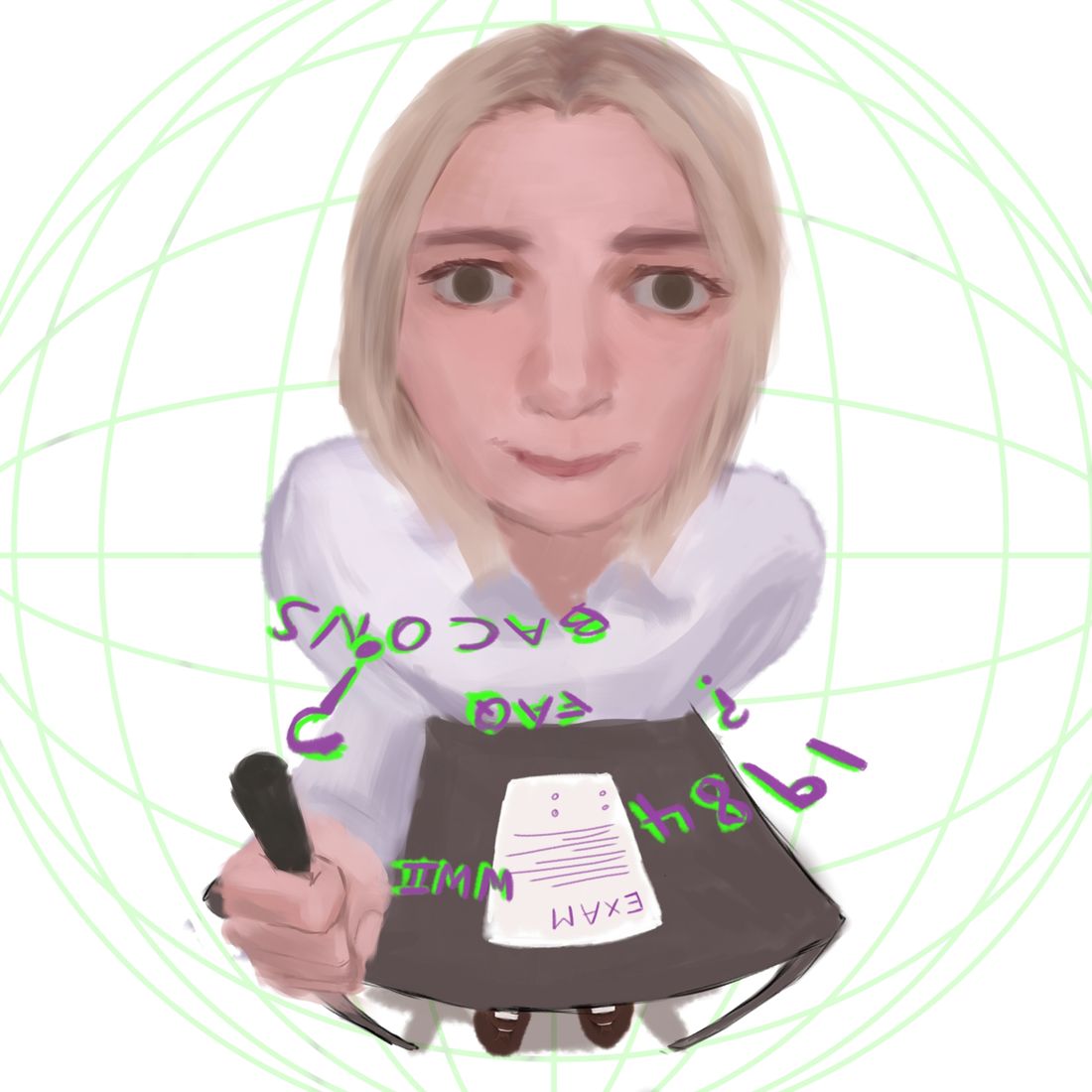
Freshman year, second semester, Honors Geometry, first test. I knew the material, I understood it all, and I did relatively well the previous semester. It should’ve all been fine.
But I panicked. Badly. It felt like my brain turned off about 15 minutes into the period. I couldn’t focus on the words on the page. I kept turning my head to look at the downward-ticking clock, my hands shaking so badly that I didn’t know what to do. All I could think about was how I was supposed to be good at math.
I did not do well on that test. I failed. It’s the only failing grade I’ve ever gotten in high school.
A few weeks went by, and suddenly it was time for the second test—the last test of the marking period. I studied so much, doing every practice problem in hopes of feeling completely prepared. I was trying to eliminate every possible reason for panic. But it happened again.
When report cards came out for that marking period, my lowest grade—by far—was math. I’d never had a grade that low in my life; the fact that it was math, a subject I typically do well in, and that I had tried so, so hard to fix whatever was wrong the previous time, really stung. The rest of the semester became a continuous effort to bring that grade up by 10 points for the sake of my GPA. Even though I knew that those two tests were anomalies, they still became part of my testing history. I haven’t tested that low again since, but it’d be disingenuous to say that I’ve escaped the problems that caused those grades.
Years later, testing is still a contradiction for me. I’m generally a good test taker, but sometimes I react to tests as if I have no reason to trust myself. I study effectively. I usually know the material, and can demonstrate what I know well. When the PSAT came around in October, I had little reason to worry. I had done well on the SAT in August, taken a practice PSAT the week before and gotten a perfect score, and felt prepared. But during the actual test, I constantly second-guessed myself, changing answers and then changing them back, and spending far too long on questions I normally would have answered quickly. Nothing had actually changed about my preparation or ability—my perception of them had. I had evidence I could do it, but I still treated my answers with suspicion.
This year, I had another episode of second-guessing while taking my first history test. I felt pretty confident going into the exam. It was material I had studied heavily and the questions were in my favorite format, short answers, which helped me focus on something specific. As I was answering the first question, though, I felt a twinge of nervousness. I had thought about an answer to a prompt similar to this one prior to the exam. I knew how I would’ve answered the question in a different setting, but it seemed like that answer, which was what I actually thought, wasn’t going to score well in the context of the test. I felt that my details were too repetitive and that my argument relied too heavily on simply disproving the other possible answers rather than on its own merit. Although I moved on to other questions when I was finished with that one, it weighed on my mind for the rest of the test.
And then, the warning bell rang. I decided to try that question again, even in the last five minutes. I erased my previous response, but erasing was messy and ugly and not well suited to my pencil’s tiny eraser. I wrote a new answer in those five minutes. Although it wasn’t what I truly believed and I didn’t even think it was the best way to write it, it seemed to fulfill the requirements better. By the time the end bell rang, I was so worried that my rushed eraser and pencil marks in combination with my questionable high-speed handwriting meant that my whole response was illegible. The rest of the test ended up being fine, but I kept thinking about that question for a long time. I hadn’t been trying to correct an answer that was objectively wrong; I was trying to eliminate the possibility that an answer I believed in could be scored poorly. My decision to erase and try again, even though I was risking having no answer at all, was about finding certainty in my grade, not my thinking.
What happened on that history test wasn’t due to a failure of self-reflection. In fact, it was almost the opposite. The problem wasn’t that I thought about my answer for too little time; it was that I thought about it until I could no longer trust my original judgment. I rely on this kind of self-reflection constantly. I revise when I write, fine-tune subtle aspects of my speeches before a tournament, and check my work on a math test. Usually, looking back at my own thinking helps me find something I missed so I can work to make it better. But on that history test, I wasn’t finding anything new. I was looking for a reason to doubt what I had already decided. At some point, “I should check this” became “I cannot trust this until I check it,” and more reflection created the uncertainty it was supposed to resolve.
I also don’t think nerves and self-doubt are quite the same thing. The geometry test was mostly panic: my emotional response overwhelmed my ability to work. The PSAT was different. I could still do the questions, but I kept questioning whether I was doing them correctly. And on the history test, that doubt actually changed what I did. I wasn’t unable to answer the question; I just stopped trusting the answer I had already reached.
Part of what makes this difficult for me is that I am used to doing relatively well in school. I know I can be a decent “performer” come test day, and most of the time, I have plenty of evidence to support that. But that can make an unusual result feel even more significant. When I do poorly, I don’t just see one bad test; I start looking for an explanation. Did I misunderstand something? Was I less prepared than I thought? Did I overestimate myself? A result that should be one piece of evidence can start to feel like evidence against everything I thought I knew about myself.
That’s also why I don’t think the solution is simply to stop questioning myself. Sometimes—well, actually, a lot of the time—I have found that it is a good idea to step back, look at the situation as a whole, and refine what I’m doing. The difference is whether I’m checking because I have found something that needs to change or because I’m uncomfortable with the possibility that I might be wrong. There comes a point when checking stops adding anything new, but I don’t always know when I’ve reached it.
When I was taking that history test and heard the warning bell, I could’ve just committed to my initial response, or just changed one or two small details at most. I could’ve decided that, even if I wasn’t completely certain, I had enough reason to believe that my original answer was the best one I could give. Instead, I decided that the possibility of being wrong was more uncomfortable than the possibility of changing an answer I actually believed in.
That is what I’m still learning: I don’t need to be certain about something to have enough reason to trust my own judgment. School—and maybe life in general—keeps asking me to make decisions with incomplete certainty. Is this answer good enough? Do I actually understand this? Should I change this? Have I checked enough? I will probably always be able to find another reason to check again. The harder part is figuring out whether that next check will actually tell me something I don’t already know, or it will show me that I’m just looking for reassurance that I can never quite get. Sometimes, I won’t be certain. I’ll just have to decide that I know enough to move on.