
Finals on Regents Week: Is it the Best Option?
Students and faculty discuss the benefits of hosting finals on regents week. Art/Photo request: Student stressed about upcoming exams
Reading Time: 3 minutes
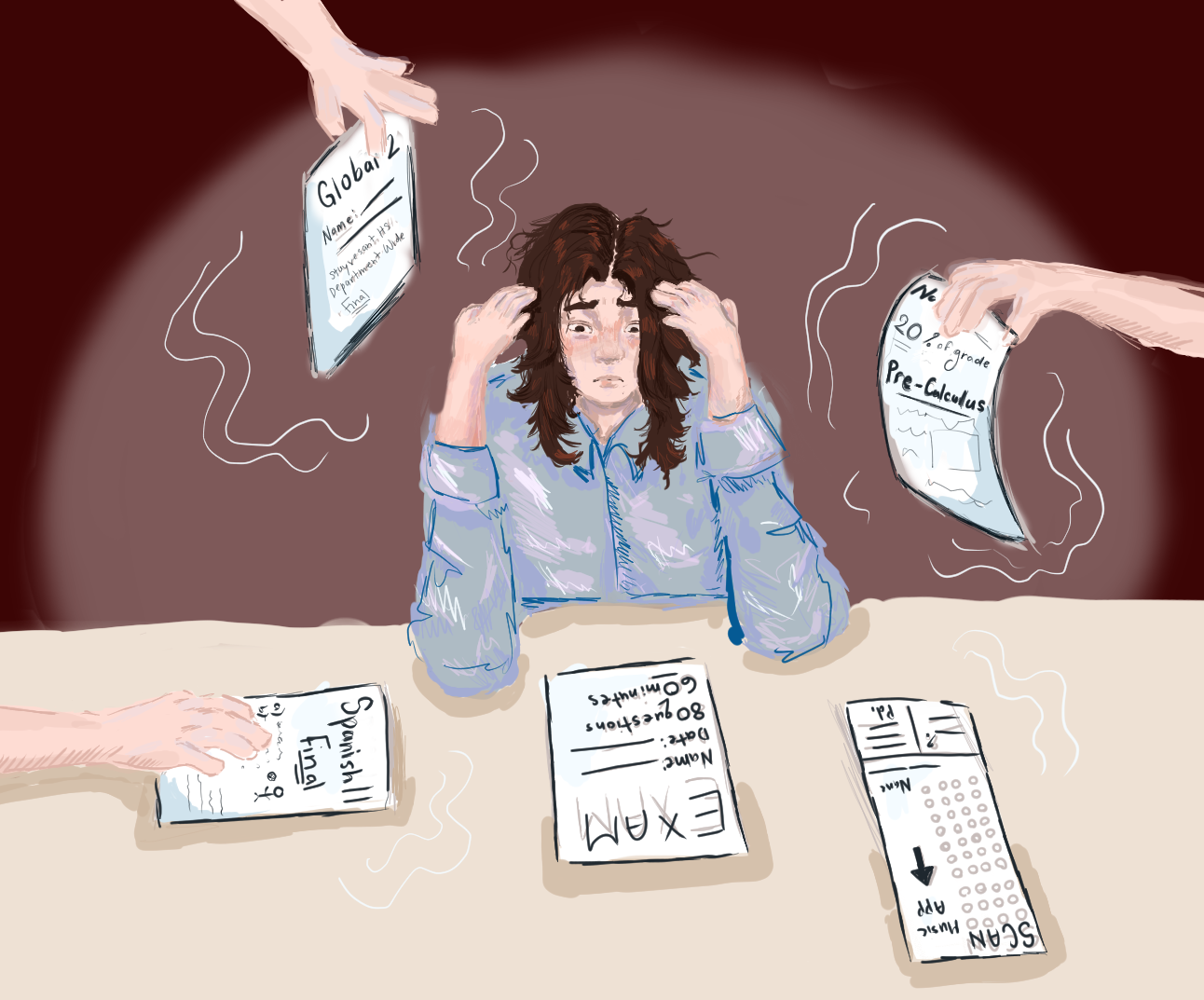
Stuyvesant hosted department finals from Tuesday, January 20, to Friday, January 23. The subjects for the finals ranged from Geometry for freshmen to AP Computer Science A for juniors. However, the Stuyvesant community has debated whether or not it is a good idea to host finals during Regents Week.
Students generally agree that having finals during Regents Week can be convenient for studying. The free time during Regents Week gives students a sense of relief when they otherwise would be flooded with schoolwork. “We don’t have school or homework in the way of studying for the tests,” freshman Kaiya Stanton explained. “This [scheduling] does help you study better because you have more time, and you get to have multiple days in between tests,” Stanton added. Students being able to study more thoroughly with decreased stress is especially necessary for doing well on their final exams.
However, while it is evident that free time can be productive, other students view the scheduling as untimely. With the time off, some may choose to leave the borders of the state or the country. “I feel like finals could have been done during class because a lot of people might go on trips during Regents Week,” said sophomore Kiki Yang. The placement of finals during a week of no-attendance days can inconvenience those who have prior engagements or obligations. Though these days do not technically serve as an actual break on the NYC DOE calendar, many students wish to take advantage of having no classes to rest.
In addition to students’ opinions, department heads also have detailed perspectives on the scheduling of final exams. Global Studies and AP World History teacher Hing Li provided insight into the decision to host finals during Regents Week. “I prefer having [the final] happen at the same time because that's how college is like […] it removes any sort of outside influence,” Li mentioned. Hosting finals during Regents Week prepares students for the future because it mirrors the structure of the college exam period. In addition, having students take these uniform exams at the same time prevents cheating through revealing questions and answers to peers.
Assistant Principal of Mathematics Eric Smith explained how the math department’s finals are organized. “Math teachers and I meet to review curriculum, write and review questions, and finalize the exam itself […] Our primary concerns are addressing the major topics in the course and ensuring that the exam can be completed in the time allotted,” he said in an email interview. “Classes are not in session, and we have the time to give exams that are longer than 40 minutes,” he added. Department heads carefully take into account student capacities when determining the format of the final, ensuring that the exam is fair for all students.
However, there is a downside for the teachers. Exams must both test a student’s academic ability and also suit the student body as a whole. “Because we have to score over 2000 exams very quickly, the majority of the questions are multiple choice,” Smith stated. The sheer volume of students in Stuyvesant plays a role in the work done to craft an exam that must be graded in time for report cards. After Regents Week, teachers only have a few days to finalize grades, including grading hundreds of these departmental exams. Even though the exams are multiple choice, grading is time-consuming. “Organizing all of the exams takes a lot of work,” explained Smith, who ultimately finalizes the exams.
Though final exams are stressful for most, holding them during Regents Week gives students time to study, faculty time to grade, and prevents cheating. While students do place much importance on their finals, it is important to note that the teachers who administer them do not solely define individuals by their scores. “It’s [only] a part of your grade. We see you holistically,” Li concluded.