
Chasing the Challenge of 5-Minute Charging
Charging an electric car in five minutes requires advances in battery chemistry, charging power, and electrical infrastructure to safely deliver and manage huge amounts of electricity.
Reading Time: 4 minutes
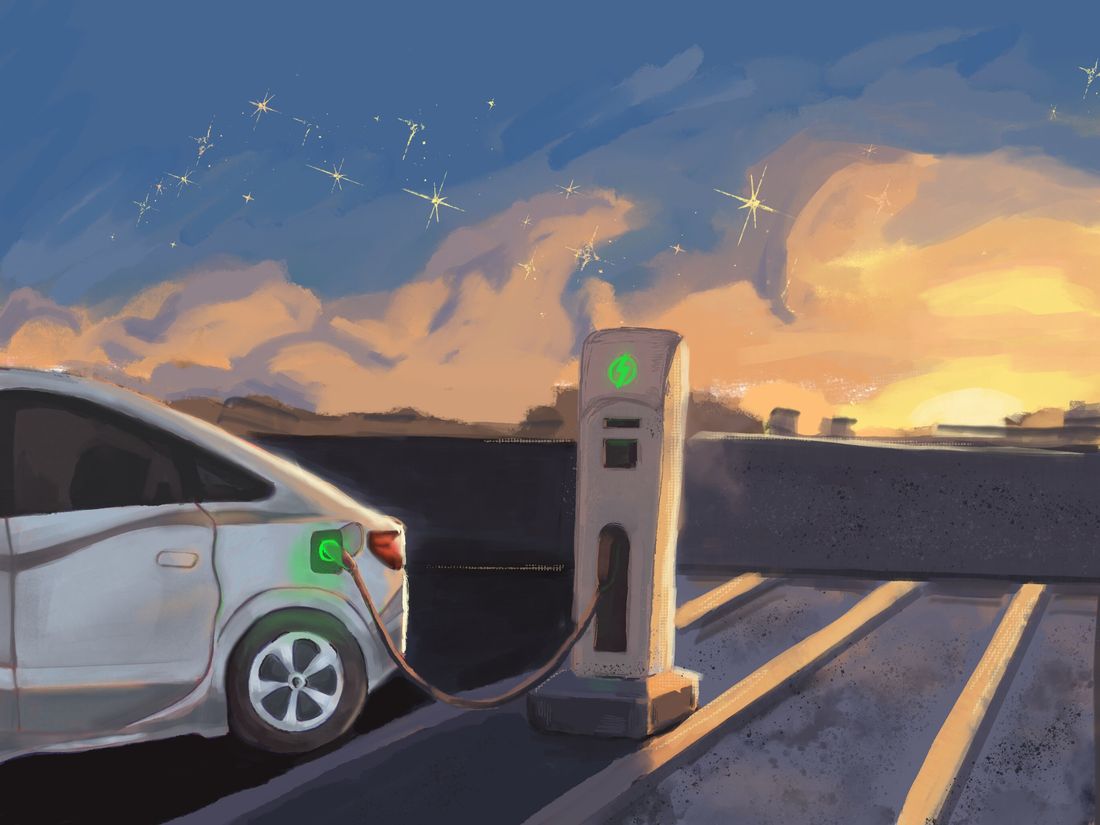
Filling up a car at the gas station is a simple five-minute job. With an electric vehicle (EV), however, that same five-minute top-up can take hours. Most EVs today are Direct Current (DC) fast-charger compatible. DC fast chargers can add significant range in less than an hour, but their charging is still slower than filling up a gas tank. Let’s understand why.
Firstly, we must look at charging power. Electrical power is the rate at which energy is delivered:
Power = Voltage × Current.
Voltage is the electrical pressure that pushes electrons through a circuit, while current is the amount of electric charge flowing through a circuit. A useful analogy for the power equation above is water flowing through a pipe. Voltage is similar to the water pressure, current is like the amount of water flowing, and electric power is like the amount of energy that the water flow delivers each second. To charge, we need to push more electrical power into the vehicle.
At first glance, it seems that if we want to increase power, we can just increase the voltage and current. However, there is a catch. When electricity flows through a wire, the electrons encounter resistance as they move through the metal. This resistance causes some of their electrical energy to be converted into heat, known as resistive heating. The greater the resistance, the more heat is produced. Because resistance increases with the square of the current, doubling the current quadruples the amount of resistive heating. Instead, manufacturers can increase voltage and reduce current, achieving more power while facing less resistive heating. At 250 kW, a 400-volt system would require about 625 amps of electric current, while an 800-volt system would require about 313 amps. 800-volt architectures can handle higher charging power while facing less resistance and heat. Heat is still produced, but less current means less heat is generated in the first place.
But the charger is only part of the problem: the batteries also need to keep up with these increased charging rates. Most EVs today use lithium-ion batteries, in which lithium ions move through the battery from the cathode to the anode, where they are absorbed by layers of graphite. As charging rates increase, lithium ions have to move through the electrolyte and into the graphite more quickly. If the graphite cannot absorb the ions fast enough, some metallic lithium can instead accumulate on the surface of the anode in a process called lithium plating, which reduces battery capacity and shortens battery lifespan.
Another problem preventing fast EV charging is the heat generated during charging. Resistive heating and the battery’s internal chemical processes both generate heat during charging, and excessive temperatures accelerate battery degradation. Thus, the battery must be kept within a relatively narrow temperature range, ideally 68℉ to 77℉. Charging faster means pushing more power and therefore heat into the battery, making this balancing act between speed and battery health even more difficult.
Additionally, a charger able to deliver 250 kW does not actually charge a car at 250 kW from zero percent to 100 percent. Early in a charging session, the battery has plenty of room to store incoming energy, so it can accept a high current. As the battery fills up, the voltage of its cells rises. Eventually, the cells get close to their maximum safe voltage. At this point, continuing to send the same current would push the cell voltage beyond its safe limit and could damage the battery. The charger must hold the voltage steady and gradually reduce the current, a process known as constant-current/constant-voltage (CC-CV) charging. As the current decreases, charging power is lowered, so the charging rate gradually slows. This makes it difficult to increase charging speed as the battery nears full.
Despite these challenges, we are pushing the limits of faster charging every day. CATL and BYD, two major Chinese battery and EV manufacturers, are intensely focused on developing advanced ultrafast charging systems. BYD's 2025 Super e-Platform, for example, targeted roughly 400 km (250 miles) of range in five minutes. Newer systems have pushed charging power toward 1.5 megawatts, enough to fully charge an EV in under nine minutes, up to 10 times the power of many current fast chargers.
But there is one final problem: we don’t have the infrastructure needed to supply all that electricity.
A 1.5-megawatt charger can deliver six times the power of a 250 kW charger. A station with many vehicles charging simultaneously could put substantial demand on the local electrical grid. This is especially challenging in the United States, where more than 70 percent of the country's grid infrastructure has exceeded its original 25-year lifespan. To support the demand for widespread ultra-fast charging, we will need new electrical infrastructure. The Department of Energy estimates that upgrading the grid could require an additional $3-7 billion in investment each year until 2030, while new infrastructure could take up to 15 years to complete. China has been building charging infrastructure much more rapidly. They have over 4.8 million public charging stations and are growing that number by almost 50 percent every year, compared to the roughly 200,000 publicly available charging ports in the U.S. This infrastructure advantage is one factor that has helped China support a much larger EV market and pull ahead in the EV race.
Every part of the EV charging system—the charger, the battery, and the power grid—has a limit on how much energy it can handle. Five-minute charging is no longer purely theoretical, but making it practical on a large scale means pushing all these limits even further. Investing in the electrical grid and charging stations would make EVs more convenient to use and support wider EV adoption. Faster charging ultimately is not about solving one specific problem with the charger or battery, but about improving the entire system around electric cars and sustainability.