Breaking Injustice Requires Breaking Rules
We must build the next generation into one ready to fight for democracy, our rights, and our communities, and a generation of political advocates won’t come from weekend protests or civil discussions alone.
Reading Time: 7 minutes
America is unique. Our history is shaped by successful protest and civil disobedience from society and students, and yet the future of American rights is threatened by those in power. Our democracy and Constitution are being threatened by our current government, and yet they have historically been and continue to be the driving force of protest. America is not a fascist or totalitarian state; we have a deep history of systematic injustice, but we also have a system of protest and change that has persevered throughout our nation’s 250 years. As such, it is imperative that, as American citizens and, more importantly, as American youths, we carry on the legacy of youth protest and advocacy that brought about change and justice for human rights, the environment, and equality, and do so with as much passion and strategy as we can. At this moment, as students in high school, participating in large-scale, peaceful protests and walkouts is one of the biggest ways students can contribute to political change.
“But why do we need to miss school to make a point?” might be the most asked question amongst Stuy students leading up to any political walkout. Organizations like Stuy Strikes for Climate or We the Students Stuy have planned walkouts in the past and have seen reluctance amongst students to walk out of school, even for causes they largely agree with. This reluctance comes from doubt in the necessity of walking out to make a political impact. Students asking why walkouts are necessary aren’t doubting the urgency of the problems at hand, but rather, why such comparatively extreme measures like walking out are necessary when alternative political engagements like weekend protesting or political, intellectual discussion exist. But as more political rights are threatened by the government with each passing week and democracy is continuously challenged by our government, organizing the most impactful protest or collective action possible becomes crucial.
What makes a protest important is its impact on the protestors and the press. Protestors should leave feeling driven to continue fighting, and press coverage should show this fight and anger to the public. As such, determining how to maximize protest impact requires maximizing press coverage and attendance.
The issue with only protesting outside of school hours is that it is expected and subsequently sidelined as unimportant: rallies and protests are constantly held on weekends for one cause or another, and, more importantly, they fail to engage in civil disobedience. Civil disobedience—peaceful, nonviolent noncompliance with certain rules or laws—is unexpected and gains the attention of the press, decision-makers, and potential attendees. Last year, when We the Students planned a walkout, over 500 students attended from 30 schools, gaining media coverage from the World Journal, Pix11 News, the New York Post, the Daily News, and Chalkbeat. Many of these articles focused on the fact that students had walked out of school in order to protest. In contrast, student rallies or youth weekend protests don’t gain nearly as much media attention, as no rules are being broken; there is no shock value and no sacrifice. A walkout demonstrates the extent of students’ anger and subsequently supports the press spreading word of such anger.
My fellow leaders of We the Students met in early April to decide if we should plan another walkout, or if rallies on the weekend, civic education clubs, and advocacy events were enough. We had hosted numerous discussion opportunities to learn about current events and how our world today fits into history, and discuss our varying ideas and their implications on us as students and Americans. We had engaged intellectually with our peers, teachers, and the political world. But as the Trump administration’s attacks on the Constitution grew more ruthless, we found that teens felt increasingly hopeless and less politically active as our voices were continually sidelined. The necessity of youth political participation and public attention grew dramatically. Walking out of school for what we believed in would garner the support of hundreds more students than any weekend, after-school protest, or discussion ever could—meaning more students would be able to find and strengthen their political voices, allowing our fight to gain more media attention.
As we decided whether or not a school walkout was necessary, we first looked at the facts: under the Trump administration, many immigrants in New York City, including students and youth, had already been detained and sent to ICE custody without trials or due process. This included student Dylan Contreras, who had immigrated legally and was participating in a routine immigration checkup when he was detained, as well as a mother and a seven-year-old who had, likewise, been detained and separated from another sibling during a legal, routine immigration check. Immigrants, both legal and illegal, as well as their families, no longer felt safe in New York City.
Particularly, though, Trump’s crusade against the press had intensified. His support of Jimmy Kimmel being fired on account of talking negatively about Trump was only the beginning, as he continued to file lawsuits “against news outlets whose coverage he dislike[d],” threatening to revoke their licenses, and gave platforms entrenched with misinformation in his favor, like Fox News and Truth Social, increasing support. His dismantling of the federal Department of Education delayed the distribution of federal student aid, stripped public schools of basic and critical funding, and enabled ICE raids in public schools. Meanwhile, his attacks on higher education—that is, minimizing forgiveness for student loans and taking billions in federal funding away from universities over largely unsubstantiated claims of antisemitism or largely racist claims against DEI usage—have only gotten more extreme over time.
Then, we looked at the feelings: our peers, friends, and the New York student community were growing increasingly hopeless as the federal government’s attacks continually aimed to make us feel powerless. Anger was, we noticed, increasingly replaced with forced indifference and a “well, nothing I do or say can matter,” mindset. No matter how many rallies we held on weekends and in-person or online opportunities for civic engagement and discussion we offered, the New York City student body maintained a disconnect from the anti-Trump movement without mass action that called on the city’s youth as a whole to participate. Students who already feel disconnected from political advocacy aren’t likely to attend a weekend rally or learning event—while these events are absolutely crucial to build an informed and empowered movement, they are not enough for a movement most effective en masse or when the youth at large, not just the especially politically-inclined, participate. In contrast, planning a protest on a school day makes political engagement accessible for students who otherwise wouldn’t participate in any form of activism: a group of their peers is already leaving school, and joining them is substantially less daunting than going to a protest alone.
So, we decided, a walkout was necessary; we didn’t want our movement to only protect the Constitution, immigrants, education, and free speech limited to the politically-inclined fraction of the student body. We wanted our movement to be welcoming and accessible to every student.
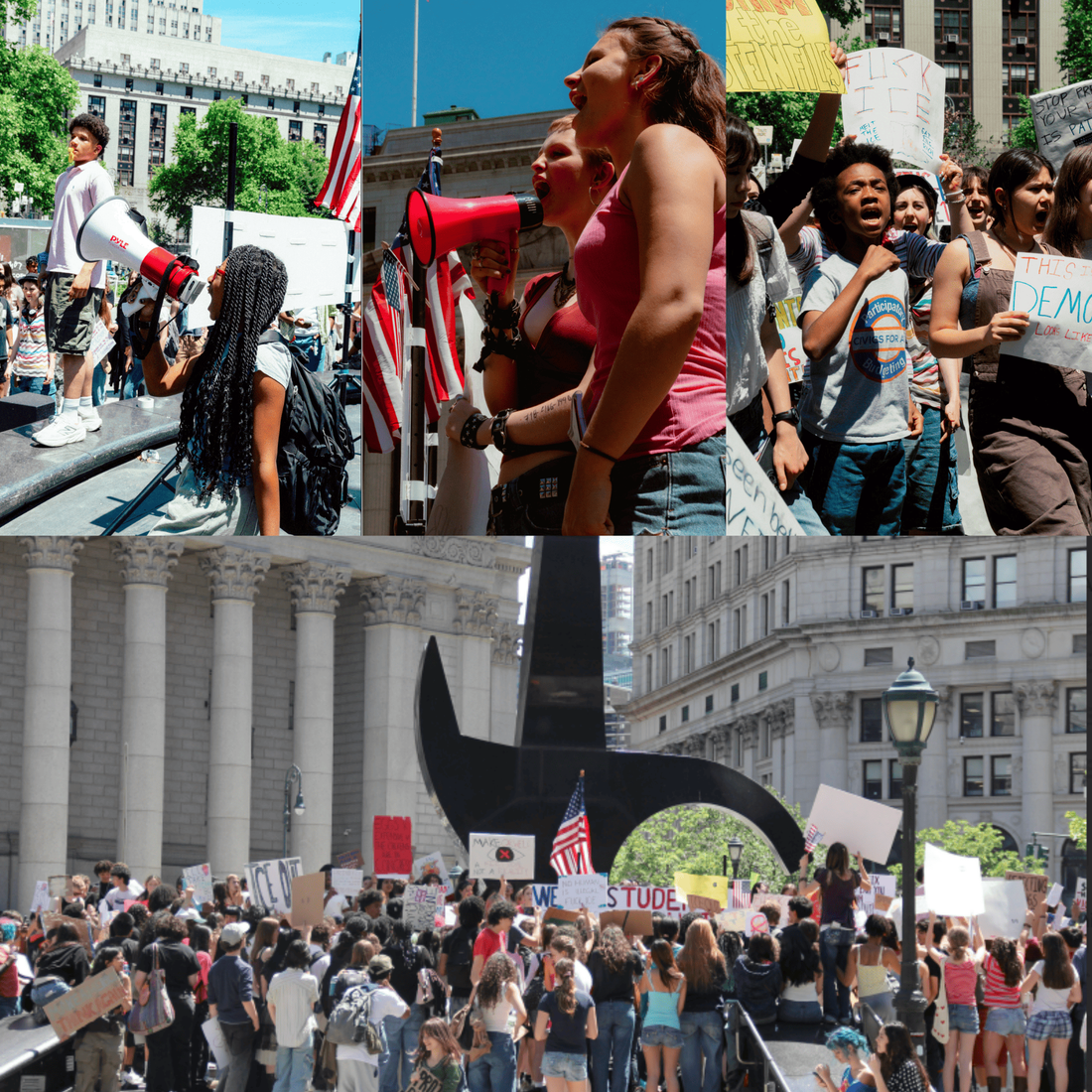
Around 60 Stuy students walked out of the building during the school day on May 29, picked up “NO KINGS IN THE USA!” and “IMMIGRANTS ARE WELCOME HERE!” signs as they left, and joined the around 560 other New York City students from over 30 different schools who had done the same for a student rally. They heard two student political poets, participated in sing-alongs led by singers and guitar players, listened to the organizers of the rally lead chants and give speeches, and, most importantly, were all invited to the microphone to lead a chant throughout the entire rally. This meant that between every speaker and poet who had grown confident in their political leadership and voice, another student who was yet to have fully grown into theirs was able to feel not only like a contributor to the movement, but also like a leader of it.
I walked away from the walkout feeling energized and deeply connected not just to the students who spend hours reading the news, following politicians, and attending protests every weekend, but rather, connected to all of my peers who are fed up, angry, and scared by the actions of the federal government. I felt less powerless than when the day began, and as I talked to some of the students from Stuy and other schools who had attended the protest, I learned that I was far from alone in this experience. As students saw their friends go up to the megaphone and get call-and-responses from hundreds of other students just as angry as them, many also rekindled a sense of power and ability to make change.
This is what walking out and protesting as teens is about. The idea that protest doesn’t accomplish anything because it doesn’t bring about immediate, short-term political change fails to take into account the immense impact and necessity of protest for grassroots advocacy movements. One student protest will obviously not take Trump out of power, nor reform any of his policies. But what it will do is build a generation with enough strength and hope for a better world to continue to fight for change.
The outcomes of walkouts and other youth acts of peaceful civil disobedience in America, in contrast with totalitarian or fascist histories, speak for themselves. No single protest has ever procured any single outcome, but at almost every peaceful protest, the movement of those willing to fight for justice grows, the likelihood or extent of press coverage grows, and eventually, pressure begins to weigh down on those in power. If the Civil Rights leaders and youth protestors had never sat inside of segregated establishments at sit-in protests and had instead followed the rules and protested outside, then there would not have been nearly enough shock factor, media attention, or mass participation to pressure leaders into enforcing integration policy. If thousands of Mexican-American students hadn’t walked out of school to protest their disadvantaged educational opportunities and had instead rallied on weekends or engaged in political discussion, they never would have won more educational opportunities. Walkouts work because they break rules and expectations.
American democracy thrives under dissent and hope and falters under powerlessness and inaction. If it takes walking out of school in protest to cultivate such hope and empowerment amongst teens and youth, then so be it. We must shape the next generation into one that’s ready to fight for democracy, our rights, and our communities, and a generation of political advocates won’t come from weekend protests or civil discussions alone.