
A Very Mardi Gras Junior SING!
Diving deep into Junior SING! 2026.
Reading Time: 6 minutes
Junior SING! 2026 certainly let the good times roll with a playful, heartfelt production themed around New Orleans’ Mardi Gras. Coordinated by Emma Ching and produced by Creative Producers Amelia “Mia” Basith and Milan Gittens, Technical Producer Melanie Xie, Music Producer Melody Kim, Dance Producer Pranav Purohit, and Administrative Producer Hilda Liang, the show featured an enjoyable amount of beignets and various humorous jokes. Despite some lack of character development and a slightly chaotic script, Junior SING! was a unique and atmospheric performance with plenty of personality.
Junior SING! revolved around a mysterious mishap in which a baker’s (Grant Izzett) prized beignets disappear as part of a psychic’s (Ananya Gupta) master plan to ruin Mardi Gras. Three friends, Olive (Margaret Castiglia), Violet (Vicky Shi), and Amber (Felicity Yu), investigate these strange occurrences while meeting locals and enjoying their time at parades and a jazz club. Although the plot was intriguing, there were moments in which the show lacked depth, especially in comparison to SophFrosh and Senior SING!. One of Junior SING!’s most notable weaknesses was its characters. Lead roles felt thinly written, giving actors little to work with beyond surface-level motivations. For example, Amber’s love of money was not clearly developed, though it was a major point of tension among her friends. Without clear characterization, the friendship dynamics between Olive, Violet, and Amber seemed to change from one conversation to another. Additionally, some actors were underutilized. Jaydon Mei, a standout actor in last year’s SophFrosh as Maleficent, took a smaller role as the mayor. Other cast members were unexpected standouts, such as Grant Izzett as Mr. Baker, who drew lots of laughs from the audience with candid jokes and ad-libs.
Many of these flaws can be traced back to the show’s script. The main trio, Olive, Violet, and Amber, had the potential for an interesting dynamic—a perfectionist, a free spirit, and a pragmatist navigating old tensions—but the writing rarely gave those tensions room to breathe or to evolve in any meaningful way. Olive’s character arc, which hinged on feeling overlooked by her friends, arrived too abruptly to land with real emotional weight, and Amber’s businesswoman coldness was never developed. The psychic, though entertaining as a scene-stealer, functioned more as a plot device than a fully realized antagonist; her motives reduced to vague self-interest rather than anything the audience could fully reckon with. From the opening scenes, it quickly became apparent that the plot of Junior SING! lacked direction, though the overarching story contained strong themes of deception, greed, and friendship.
The awkward introduction of new side characters such as Shrank Finatra (Alex Zheng) and Jillie Bean (Phon Myat Mo) added to the confusion of the chaotic script. The side plot between Shrank Finatra and Jillie Bean was endearing and did generate memorable points of interest throughout the production. However, it leaned heavily on Heated Rivalry references to gain the audience’s attention, which felt random, and the connection to Russia and Canada felt forced. Many of the jokes in the script had this same issue, often relying on cheap references to niche Internet drama; mentions of “recession indicators” were well-received and contextual, but referencing Sydney Sweeney’s infamous American Eagle ad campaign while explaining a family recipe for beignets seemed to throw off the audience. Similarly, Violet’s throwaway line following Jillie Bean’s vocal triumph over Shrank Finatra, “Clavicular frame mogged by ASU frat president,” was taken out of the context that made the original meme humorous. Original jokes tended to land better, but were sparse; Mr. Baker’s beignet six-pack was refreshing and far more thematic than the majority of Junior SING!’s jokes. Cameos from Physics teacher Jeffrey Wan and Social Studies teacher Zachary Berman also added levity to the show.
A high point of the production was Mr. Baker’s recurring antics; his stage presence and audience interaction were arguably the most memorable parts of the show. Unfortunately, Mr. Baker’s parts outshone much of the rest of the script and seemed to be the only points of clarity in an otherwise underwhelming series of events. Important plot points, such as the Mardi Gras sabotage, were not emphasized and received with more confusion than intrigue. The big reveal at the end of the show that the psychic was involved in the sabotage was anticlimactic and predictable, and the resolution was rushed and unsatisfying. The script was ambitious and allowed for some level of engagement with the story, but the execution ultimately undermined the ability of the audience to be absorbed in the world that Junior SING! attempted to create.
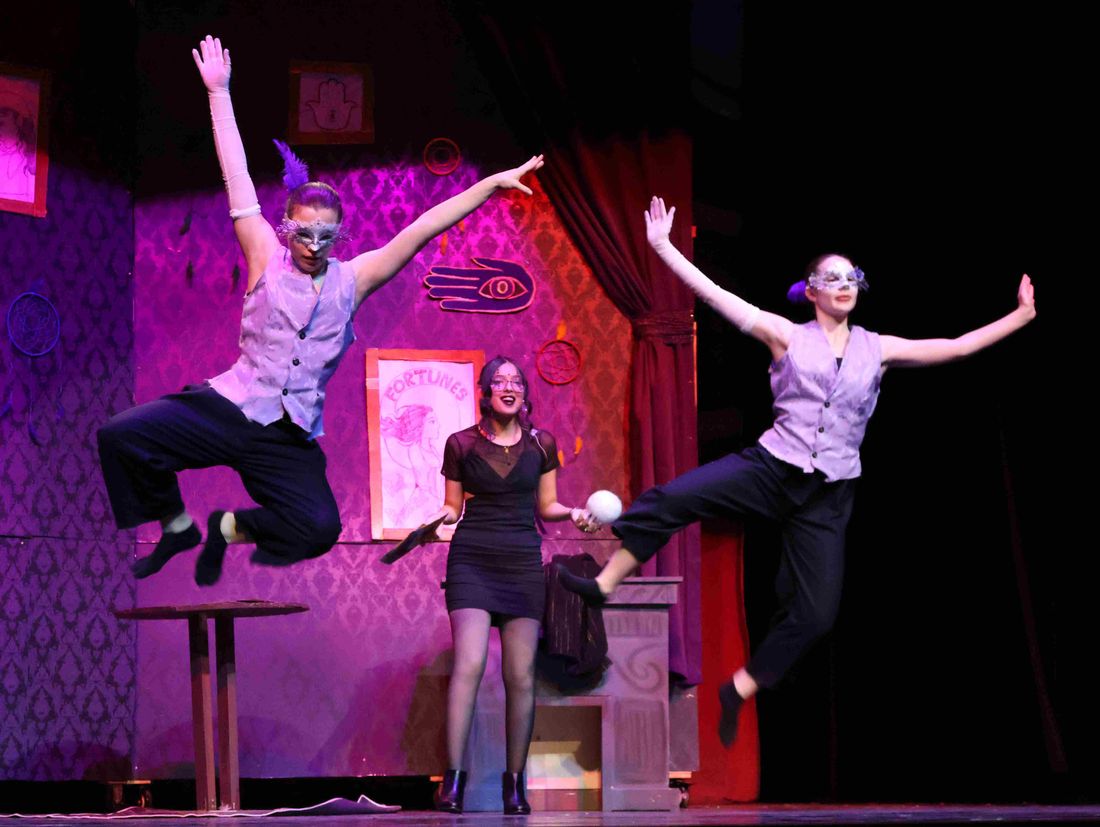
In terms of technical splendor, Junior SING! lacked in comparison to the high-tech production of Senior and SophFrosh SING!. Nevertheless, they utilized the brightly colored extravagance of Mardi Gras to build multiple spectator stands with classic purple, green, and yellow embellishments, as well as a large, vibrant themed backdrop. On the left-hand side of the stage sat a yellow and gold baker’s cart full of sugar-dusted beignets. One set portrayed a sultry jazz club complete with chairs and tables, a small stage, and a thoughtfully-designed poster-wall—it was also in this setting that Junior SING!’s SLATE made a cameo performing “Soda Pop” from KPop Demon Hunters, much to the delight of the audience. At the end of the production, a massive jester float was wheeled in from stage right, serving as the psychic’s attempted getaway vehicle as she fled from the trio—impressive in scale and with a surprisingly amount of mobility, though a bit unsettling up close. The psychic’s lair, though complete with details such as moody purple lighting, purple drapes, and spooky wall decorations, left the stage feeling slightly bare.
Where the sets had their charm, the sound design was a recurring source of frustration and proved to be a consistent issue throughout multiple show nights. Microphone issues plagued key parts of the show—but none more closely than during the heated sing-off between Jillie Bean and Shrank Finatra, one of the production’s most anticipated moments. With Jillie Bean’s mic off, what could have been a showstopping vocal performance landed in near silence. For a competition that leans so heavily on its music, these technical failures undercut scenes the whole production had been building toward. Sound effects, too, were inconsistent, often cuing way too late or feeling low-quality relative to the energy on stage. Junior SING! had the performance talent to back up its ambitions, but fell short when it came to sound issues.
Where Junior SING! struggled narratively, its dance crews occasionally managed to salvage the moment. Latin opened the production with some of the most ambitious choreography of the night, incorporating flips, lifts, spins, and acrobatic tricks that rivaled those of the other grades. Though several dancers visibly slipped or fell during the performance, the group’s confidence and willingness to execute difficult stunts remained impressive. Hip-Hop proved to be another highlight, earning enthusiastic reactions from the audience with clean movements and confident stage presence, despite having an abrupt and disconnected transition into the routine. Meanwhile, Modern, though it consisted of only two dancers, was well integrated into the show’s plot, as the dancers played the psychic’s minions who capture the main trio. Although there were some moments where they were slightly out of sync, the pair still executed the choreography effectively and with clear purpose.
Flow’s performance, considered extended compared to the other grades, was impressive in its creativity, with performers executing tricks that earned the audience’s amazement. However, the routine often felt disconnected, with the crew rarely fully in sync. The Bolly segment, while serving as a major visual moment near the end of the show, fell short of expectations and was noticeably underwhelming. Although the group had some strong moments, the choreography lacked cohesion, and timing inconsistencies disrupted the flow of the routine. Despite representing the colors of Mardi Gras, Bolly’s costumes were relatively plain compared to the vibrant and glamorous outfits seen in Senior SING!, missing the sparkle that usually defines Bolly.
Junior Band stood out throughout the entire performance, keeping the energy high with well-timed transitions. Their transitions between songs felt effortless, helping the performances move smoothly from one segment to the next. Even during moments when the dancers weren’t perfectly in sync, the band’s energy kept the audience engaged.
As the curtains closed to a rendition of “Dancing Queen” and Mr. Baker ripped off his coat to reveal a six-pack of beignet abs, the audience cheered for another exciting SING! performance. Although the ‘27 juniors came in last this year—and the two years prior—they still put on a great show. Let’s hope that next year the Class of ‘27 will have what it takes to break their losing streak and come out victorious as seniors.